Notícias
COP31
Brazil presents actions at COP31 to achieve zero deforestation by 2030
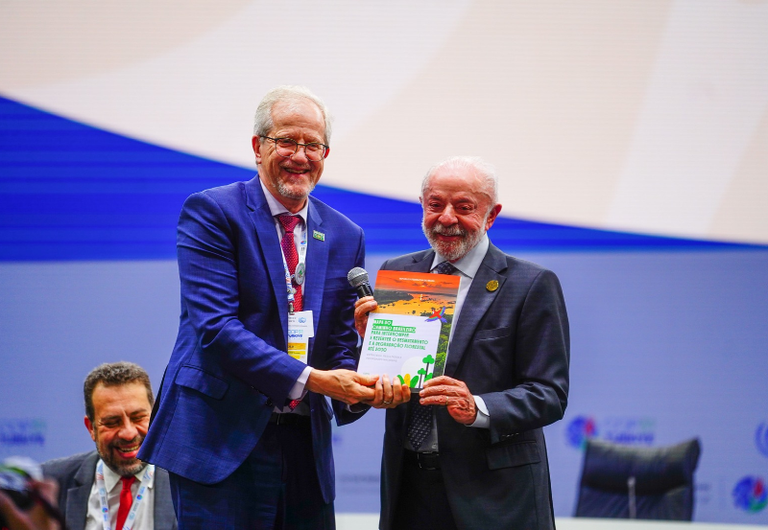
Capobianco hands over Brazil’s Roadmap to Achieve Zero Deforestation by 2030 during meeting with civil society - Foto: Fernando DonascI/MMA
The Ministry of the Environment and Climate Change (MMA) presented the main actions adopted by Brazil to achieve its goal of zero deforestation by 2030 on Thursday (November 12), during the Brazil Pavilion’s program at the 31st United Nations Framework Convention on Climate Change (COP31 UNFCCC), in Antalya, Türkiye. The event marked the international launch of Brazil’s Roadmap to Halt and Reverse Deforestation and Forest Degradation by 2030, following record reductions in deforestation in the Amazon and Cerrado.
The official document was handed over by Minister João Paulo Capobianco to President Luiz Inácio Lula da Silva during a meeting with civil society at COP31, also on Thursday.
The presentation at the Brazil Pavilion brought together the Minister of the Environment and Climate Change, João Paulo Capobianco; the President of the Brazilian Institute of Environment and Renewable Natural Resources (Ibama), Jair Schmitt; the MMA’s Extraordinary Secretary for Deforestation Control and Territorial Environmental Planning, André Lima; and Federal Deputy Marina Silva.
During the discussion, data from the Amazon Deforestation Monitoring Project (PRODES/INPE), covering all Brazilian biomes, were presented.
The latest survey, released in 2026, showed record-low deforestation levels in both biomes analyzed. In the Amazon, the deforested area decreased from 5,796 km² in 2025 to 3,335 km² in 2026, representing a reduction of approximately 42.5%. In the Cerrado, the rate fell from 7,235.27 km² to 5,516.69 km² over the same period, a decrease of 23.8%.
Overall, deforestation declined by 71% in the Amazon and 48% in the Cerrado between 2022 and 2026. Between 2022 and 2025, deforestation also decreased by 63% in the Pantanal, 61% in the Atlantic Forest, 59.6% in the Pampa and 12.9% in the Caatinga.
Based on these figures, the presentation outlined the trajectory of native vegetation loss reduction in the two biomes, demonstrating the country's efforts to meet its commitment to eliminate deforestation by the end of this decade.
Enforcement
Ibama's work has been essential to reducing deforestation, with significant results from enforcement actions carried out between 2023 and 2026. In the Amazon, the agency issued 16,508 violation notices, imposed BRL 9.6 billion in fines, ordered 12,449 embargoes and seized assets valued at BRL 1.85 billion. During this period, 33,142 enforcement actions were carried out and 200 public civil lawsuits were filed.
In the Cerrado, enforcement actions resulted in 3,092 violation notices related to flora, BRL 1.18 billion in fines, 1,935 embargoes and 1,749 seizures. The report also records 9,684 enforcement actions and 80 public civil lawsuits.
Among the strategies presented was the use of remote monitoring tools to identify and combat illegal deforestation. This approach allows enforcement efforts to be directed toward priority areas and strengthens the public authorities’ response capacity. In the 23 priority municipalities with the highest incidence of illegal deforestation, remote embargoes were imposed on 3,824 deforestation polygons, covering a total area of 57,800 hectares.
The presentation also highlighted specific operations to combat environmental crimes. Operation Controle Remoto (Remote Control) monitors illegally deforested areas and imposes embargoes on them. Operations Oito Segundos (Eight Seconds) and Espantalho (Scarecrow), in turn, carry out inspections of embargoed areas, including the seizure of cattle, machinery and agricultural products. Other initiatives include oversight of slaughterhouses, sawmills, financial activities linked to environmental crimes and illegal logging.
In the area of Indigenous territory protection, Operation Xapiri led to the removal of illegal occupants from eight Indigenous Lands and contributed to a 30% reduction in illegal mining. Operation Apoena, in turn, focuses on enforcement actions related to wildfires, with 7,500 rural properties notified.
Brazilian Roadmap
Presented internationally for the first time during a COP31 panel, the Roadmap brings together four main areas of action: forest conservation and sustainable use; forest restoration; the continuation of efforts to combat illegal deforestation and wildfires; and the reduction of legal native vegetation clearing, supported by economic instruments.
Based on the Climate Plan, Brazil’s main instrument for implementing its Nationally Determined Contribution (NDC), the document also brings together actions under the Plans of Action for the Prevention and Control of Deforestation (PPCDs) across all biomes, the National Plan for Native Vegetation Recovery (Planaveg) and the ABC+ Plan.
Brazil’s Roadmap sets out the country's strategic priorities through 2030, bringing together public policies, established instruments and results achieved over decades of efforts to protect native vegetation. It thereby reaffirms Brazil’s commitment to the climate agenda, international cooperation and the mobilization of climate finance.
Approved by the Interministerial Committee on Climate Change (CIM) on November 6, 2026, Brazil’s Roadmap guides the country's next steps to halt and reverse deforestation and forest degradation by 2030.
The Brazilian Roadmap to Halt and Reverse Deforestation and Forest Degradation by 2030 is available here.
Special Advisory Office for Social Communication – MMA
imprensa@mma.gov.br
+55 (61) 2028-1227 / 1051
Access the MMA Flickr page.