Thermo-Hydraulics Laboratory
Main studies developed
Determination of correlations for heat transfer coefficients in single-phase and two-phase regimes, in flow channels with circular, annular and rod bundle geometries with the dimensions of the nuclear fuel elements.
Determination of correlations for pressure drop coefficients in single-phase and two-phase regimes, in flow channels with circular and rod bundle geometries with the dimensions of the nuclear fuel elements. In these cases, correlations were also raised for coefficients in localized contractions and expansions such as the spacer grids and lower nozzles of the nuclear fuel elements (ANGRA 1).
Determination of correlations for critical heat flux in flow channels with circular, annular and rod bundle geometries.
Studies of the behavior of the wetting front on highly heated surfaces
Determination of correlation for limiting the countercurrent flow of liquid/gas through perforated plates and inclined and horizontal pipes joined by a bend.
Calibration of pressure measuring instruments for other institutions and public and private companies.
Qualification of components and painting schemes to be used in the containment of nuclear power plants (ANGRA 2).
Numerical simulation of thermofluiddynamic phenomena in geometries and conditions of nuclear installations with CFD-type programs.
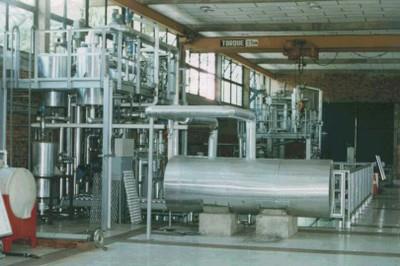
Facilities for Thermo-Hydraulic Experiments
DTLES - LOCA Testing Device - Separate Effects: device designed to simulate the phases: end of depressurization; refilling; and re-flooding during a loss of coolant accident (LOCA) in a PWR reactor. The conditions of this accident are established in a test section consisting of a bundle of rods that represent, on a scale, a nuclear fuel element. (Working pressure < 23 bar).
ITET – Thermal Stratification Testing Facility: facility to simulate the thermal stratification that occurs in horizontal pipes during operational transients of nuclear reactors. By measuring the thermal stresses to which they are subjected, the structural integrity and service life of these pipes can be assessed. (Working pressure < 23 bar).
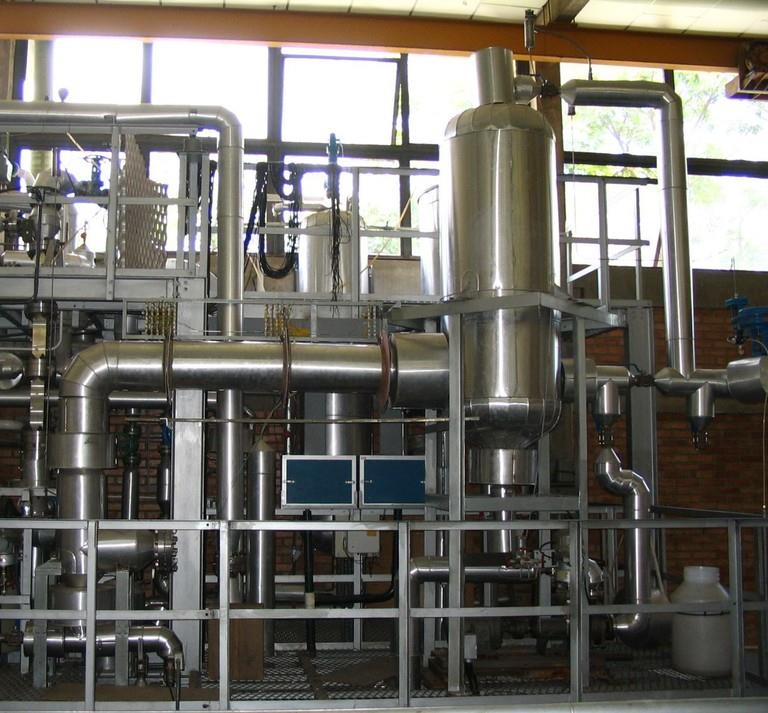
ITR - Rewetting Test Facility: facility to simulate the core re-flooding phase during a loss-of-coolant accident. Enables studies of the evolution of the rewetting front in tubular and annular test sections.
ITCA - Accident Test Facility: facility to simulate the environmental conditions of a large-scale loss-of-coolant accident in the containment of a PWR nuclear reactor. This device is used to qualify the components and paint schemes of the containment. (Working pressure < 6 bar).
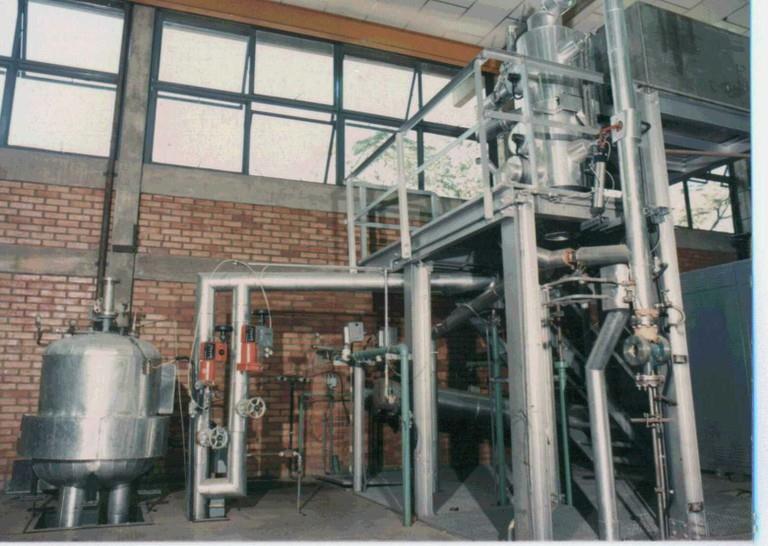
CT1 – Thermal-hydraulic circuit no. 1: closed hydraulic circuit with heat generation and extraction, using pressurized water at 15 bar as the fluid. In this circuit, exploratory experiments can be performed to determine thermal-hydraulic parameters such as: heat transfer and pressure drop coefficients, critical heat fluxes, in single and two-phase regimes, in tubular, annular and beam-shaped geometries.
CAA - Water/Air Circuit: device for studying and visualizing single-phase and two-phase flows. In this circuit, the flow configuration is established with water and/or air, at atmospheric pressure, in horizontal and/or vertical sections.
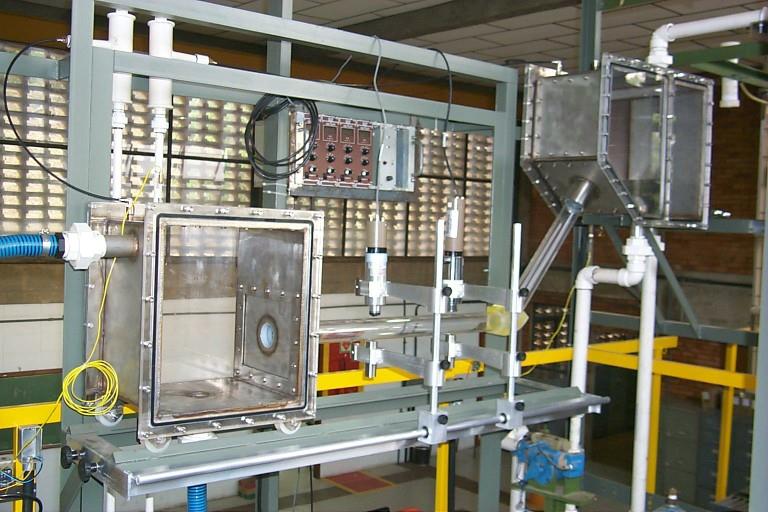
Auxiliary Systems
- Boiler: Production rate: 1000 kg/h; Max. working pressure: 30 bar
- Water deionization system: Production rate: 150 l/h; Conductivity: < 5 mΩ.cm
- Power supply system: Maximum rectified power: 1130 kW (113 V and 10000 A), ripple of 4.2 %
- Data acquisition systems: Computers; A/D conversion and conditioning boards
- Calibration infrastructure: Pressure: 1 to 700 bar; Temperature: 50 oC to 650 oC
- Mechanical and electronic workshops
Team
- André Augusto Campagnole dos Santos
- Antônio Carlos Lopes da Costa
- Antônio Romualdo Cordeiro
- Claudio Cunha Lopes
- Dielson Alves Bispo
- Edson Ribeiro
- Élcio Tadeu Palmieri
- Eduardo Tadeu Stehling Saraiva
- Hugo Cesar Rezende
- José Afonso Barros Filho
- Luiz Leite da Silva
- Marcos Antônio Cândido
- Vitor Vasconcelos Araújo Silva