Weather Station
Objective
Implement a meteorological measurement program suitable for obtaining and applying reliable information for the acceptable assessment of radiological and environmental consequences in operational situations and accident conditions at CDTN facilities and for planning and applying protective measures for CDTN workers, the general public and the environment in emergency situations.
Scope
Determination of atmospheric parameters and carrying out studies on atmospheric dispersion and air quality.
Services
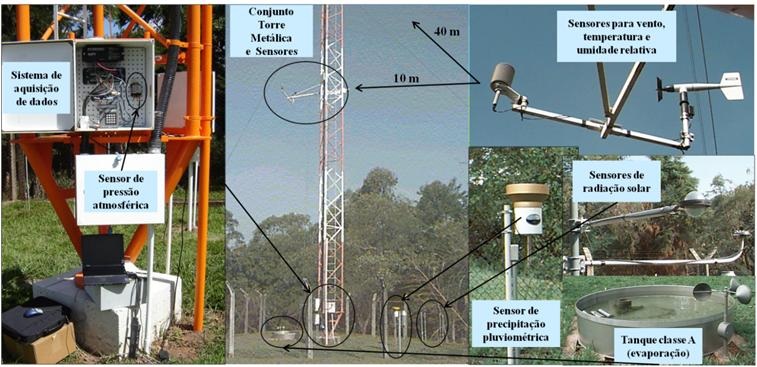
Acquisition and provision of meteorological information [The monitored parameters are: (1) at the 1.5-meter level - solar radiation (net and global), precipitation, evaporation and atmospheric pressure; (2) at the 10-meter level - temperature, humidity, wind speed and direction; and (3) at the 40-meter level - temperature, wind speed and direction.
Carrying out studies on the atmospheric dispersion of pollutants.
The information generated at the CDTN Station is stored in digital format after processing and made available to the public. The main uses verified during the period of operation were in the areas of: environment (air quality studies; studies of atmospheric dispersion of pollutants); architecture (studies of project adequacy aiming at environmental comfort and energy savings); biology (study of the influence of climate on the behavior of animal and plant species); medicine (study of the influence of climate on health); geology (hydrogeological studies); engineering (adaptation of urban projects according to extreme events); physical education (studies of the influence of climate on the execution of physical exercises).
Meteorological Measurement Program
The CDTN meteorological measurement program that controls the monitoring of the automatic sensors installed at the Station was designed with the main objective of creating a database that enables studies of atmospheric dispersion of pollutants to be carried out.
This program instructs the microprocessor to investigate all sensors at 5-second intervals.
Every 15 minutes of data collection, the program performs the following operations:
- Calculates and stores the average air temperature (10 and 40 meters), the average relative humidity, the average atmospheric pressure, the average wind speed and direction (10 and 40 meters);
- Calculates and stores the standard deviation of the horizontal wind direction (10 and 40 meters);
- Calculates and stores the totals of rainfall, net solar radiation and global solar radiation.
In addition to these results, the maximum and minimum values of temperature (10 and 40 meters), relative humidity, atmospheric pressure and wind speed (10 and 40 meters) are calculated and stored at the end of each hour.
At the end of the day, at midnight, the internal temperature of the datalogger and the condition of the system battery are investigated.
These values are stored for later verification.
Since 2008, the Station has had a real-time monitoring system that allows the information monitored to be viewed from the researcher's office. However, due to the need for routine visual inspection of the sensors, a technician visits the Station daily.
In order to certify the measurements taken, a process to update the sensors' operating and calibration routines was initiated in 2010. Currently, the data is investigated weekly from the office (real time) and downloaded to the computer where it is stored in text format. At the end of the month, this data is transferred to an electronic spreadsheet where it is processed.
This processing aims to format the data so that it is compatible with the atmospheric dispersion programs used in the CDTN. Storage in spreadsheets also facilitates the provision of information requested by other researchers.
All results presented in this work were prepared using electronic spreadsheet processing.