Notícias
Inclusive Governance and Diversity – The LA-BORA! gov Case
Inclusive Governance and Diversity – The LA-BORA! gov Case
We realized that we needed to increase the diversity of our team, our audience, and the topics we addressed in the laboratory. To achieve this, the team organized itself and created an internal project to test practices and disseminate knowledge on diversity and inclusive governance.
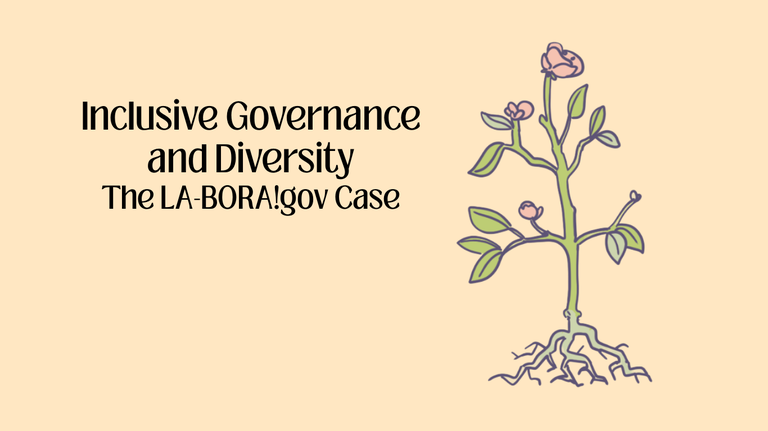
This page features an illustration of a rosebush with visible roots, symbolizing that inclusive growth depends on strong and intentional foundations.
I – How LA-BORA! gov Cultivated Diversity Internally and Built Inclusive Governance
An illustration presents the stages of plant growth, from soil being watered to seeds sprouting and the plant growing. Each stage represents a key action, described below.
Internal Agreements (illustration of soil being watered)
We brought the team together, talked openly, and decided we needed to take action. We prepared the ground through several team meetings focused on discussing the importance of diversity and how we could genuinely become more inclusive in the laboratory.
A psychologically safe environment is essential so everyone can share doubts, perspectives, and suggestions. Establishing agreements increases commitment and collaboration within the team.
Data (illustration of a seed in the soil)
We included diversity criteria in our forms. Data are like seeds, representing the essence of growth, development, and innovation. When properly processed and analyzed, they can blossom into valuable insights and transformative innovation.
To better understand our users, we made significant changes to our forms:
- We invited Free-LAs! to collaborate on this task, ensuring a participatory process with diverse perspectives;
- We included the following items: sex, gender identity, race/color/ethnicity, disability status, age, and city/state of residence;
- We added the question: “How can we better support and welcome you?”;
- We updated our Free-LAs database with the new criteria;
- We began using these criteria to select Free-LAs, new team members, and civil servants interested in our services.
We now keep data readily available, prepared to be processed and analyzed whenever necessary.
Research and Exchanges (illustration of a seed sprouting with roots)
We engaged in dialogue, exchanged experiences with experts, and conducted research. We spoke with partner organizations within the public sector, sharing our project and our understanding of inclusive management.
Ongoing exchanges keep us attentive to inclusive practices happening elsewhere. In addition, we conducted internal studies and commissioned research to gather evidence-based data on inclusive management.
Inclusive Culture (illustration of a young plant with roots and stem)
We invested in building an inclusive culture within the team. Several internal actions were essential to putting into practice what we advocate externally:
- We held check-ins and thematic meetings to mobilize discussion and address questions;
- We created a Learning Community to periodically gather materials and foster debates;
- We conducted two workshops on visual accessibility, both facilitated with the participation of Free-LAs with visual disabilities;
- We continue daily learning on diversity, recognizing that it is an ongoing process.
OKRs (illustration of a fully grown plant with roots, stem, and leaves)
We made diversity a strategic priority. Using the agile planning methodology OKR (Objectives and Key Results), we established ambitious yet achievable goals to increase diversity at LA-BORA! gov.
We work in four-month cycles with biweekly or monthly monitoring of deliverables. So far, we have achieved 100% of our objectives.
II – Disseminating Knowledge: Cultivation Tips for More Inclusive Work Environments
An illustration shows a rosebush with flowers, branches, and roots. Around it, green dots represent pollen, each containing a practical suggestion for cultivating inclusive environments:
Practical Recommendations
- Data: Collect data, understand your organization, and make diversity indicators transparent whenever possible.
- Listening: Practice deep listening. Pay attention to what team members express about prejudice and discrimination.
- Selection: Promote recruitment and promotion processes that include diversity criteria or reserved positions.
- Psychological Safety: Build psychologically safe environments where people can be themselves and share perspectives, concerns, and suggestions intentionally and inclusively.
- Attitude: Strengthen inclusive behaviors in teams and leadership, including commitment to equality, equity, autonomy, and the courage to confront prejudice.
- Accessibility: Use accessibility features to ensure materials and interactions are accessible to people with physical, hearing, visual, and/or intellectual disabilities.
- Language: Adapt language practices. Learn and remove ableist, racist, sexist, and ageist terms. Use plain language and adopt accessibility as a guiding principle in all actions.