Notícias
INNOVATION WEEK 2025 - Environmental Racism
How does environmental racism affect the daily lives of Black public servants, and how can it impact their engagement with their teams?
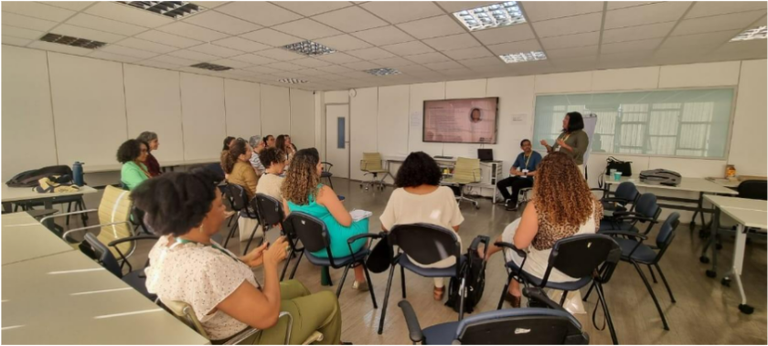
Reflecting on this question, the Innovative Management Laboratory (LA-BORA!gov) of the Ministry of Management and Innovation in Public Services (MGI) organized the workshop “Environmental Racism and Innovation in Public Service: Case Studies.”
The session took place on October 2, 2025, during Innovation Week 2025 at the National School of Public Administration (Enap) in Brasília.
During the workshop, participants were invited to share their understanding of environmental racism. This was followed by a brief presentation on the concept, its historical and geographical variables, and its connection to public servants’ work experiences. Each participant reflected on the environmental challenges and privileges they face based on where they live.
The session concluded with an exercise to map instances of environmental racism and potential interventions to mitigate them. Participants were challenged to propose solutions on three levels:
- What I can do.
- What management can do.
- What the organization can do.
Territorial Equity
The discussion on environmental racism highlighted that those living in territories neglected by public authorities often face the worst conditions in transportation, housing, quality of life, safety, and infrastructure — a reality that also affects public servants.
The workshop, facilitated by LA-BORA!gov staff Marcelo Ivo and Rosinadja Morato, encouraged participants to reflect on the daily experiences of public servants structurally affected by environmental racism, often without even realizing it.
According to Sara Portilho, advisor at the People Management Office of the Federal Council of Psychology and a participant in the workshop:
“Today, together, we thought about strategies and solutions to bring more equality and structural balance to everyone.”
She added:
“It was a privilege to learn alongside professionals who work for a more humanized public service.”