Ir para o Conteúdo 1 Ir para a Página Inicial 2 Ir para o menu de Navegação 3 Ir para a Busca 4 Ir para o Mapa do site 5
Abrir menu principal de navegação
Polícia Federal
Termos mais buscados
  • imposto de renda
  • inss
  • assinatura
  • cnh social
  • enem
Termos mais buscados
  • imposto de renda
  • inss
  • assinatura
  • Assuntos
    • Notícias
      • 2025
    • Academia Nacional de Polícia
      • Institucional
      • Educação cidadã
      • Escola Superior de Polícia
      • ANP Editora
      • Comissão Própria de Avaliação
      • Licitações
      • Museu Criminal da Polícia Federal
      • Biblioteca da ANP
    • Acordos de Cooperação
    • Adoção Internacional
    • Aeroportos
    • Antecedentes Criminais
    • Armas
    • Combate a Crimes Cibernéticos
    • Glossário de Direitos Humanos
      • Direitos da infância e adolescência
      • Expressões racistas
      • Expressões capacitistas
      • Gênero e sexualidade
      • Processos migratórios
      • População em situação de rua
      • Relações étnico-sociais-religiosas
      • Expressões policiais
      • Outros tipos de violência
    • GRU
    • Guardiões da Infância
    • Leilão
    • Licitações e Contratos
    • Migração
      • Dúvidas Frequentes (FAQ)
      • Notificações
    • Passaporte
    • PF Saúde
      • Perguntas Frequentes
    • Produtos Químicos
    • Segurança Privada
    • Segurança Portuária
      • Modelos de Documentos
    • Sigilo Bancário
    • Fundos
    • Validador de Documentos de Inquérito Policial
  • Carta de Serviços
  • Acesso à Informação
    • Institucional
      • Livro PF80
    • Ações e Programas
      • Obras e Projetos
    • Participação Social
    • Auditorias
    • Convênios e Transferências
      • Acordo de Cooperação Técnica - ACT
    • Receitas e Despesas
      • Notas Fiscais Eletrônicas
    • Licitações e Contratos
    • Servidores
      • Servidores Ativos
      • Servidores Aposentados e Pensionistas
      • PF por Elas
      • Rosa dos Ventos
      • PF por Todos
      • Estágio
      • Concursos
      • PF Saude
      • Saúde Mental
    • Informações Classificadas
    • Serviço de Informação ao Cidadão - SIC
      • Relatório Anual da Autoridade de Monitoramento
    • Perguntas Frequentes
    • Dados Abertos
      • Relatório de execução do PDA/PF 2021-2023
      • ePol - Guia de Leitura do painel de business intelligence 'Casos Eleitorais em andamento'
      • ePol - Estatísticas de Polícia Judiciária - Guia de Leitura do painel de business intelligence 'Casos Eleitorais em andamento'
    • Sanções Administrativas
      • 2024
      • 2023
      • Sanções Disciplinares
    • Agenda de Autoridades
    • Carta de Serviços
    • Transparência e Prestação de Contas
      • Credenciamentos - PF Saúde
    • Estatísticas
      • Diretoria de Combate a Crimes Cibernéticos - DCIBER
      • Diretoria da Amazônia e Meio Ambiente - DAMAZ
    • Tratamento de Dados Pessoais
    • Sistema Eletrônico de Informações (SEI)
    • Corregedoria
  • Composição
    • Quem é quem
    • Galeria de ex-Diretores Gerais
  • Canais de Atendimento
    • Assessoria de Imprensa
    • Comunicação de Crimes
    • Ouvidoria
      • Relatórios do Conselho de Usuários
    • Unidades
  • GOV.BR
    • Serviços
      • Buscar serviços por
        • Categorias
        • Órgãos
        • Estados
      • Serviços por público alvo
        • Cidadãos
        • Empresas
        • Órgãos e Entidades Públicas
        • Demais segmentos (ONGs, organizações sociais, etc)
        • Servidor Público
    • Temas em Destaque
      • Orçamento Nacional
      • Redes de Atendimento do Governo Federal
      • Proteção de Dados Pessoais
      • Serviços para Imigrantes
      • Política e Orçamento Educacionais
      • Educação Profissional e Tecnológica
      • Educação Profissional para Jovens e Adultos
      • Trabalho e Emprego
      • Serviços para Pessoas com Deficiência
      • Combate à Discriminação Racial
      • Política de Proteção Social
      • Política para Mulheres
      • Saúde Reprodutiva da Mulher
      • Cuidados na Primeira Infância
      • Habitação Popular
      • Controle de Poluição e Resíduos Sólidos
    • Notícias
      • Serviços para o cidadão
      • Saúde
      • Agricultura e Pecuária
      • Cidadania e Assistência Social
      • Ciência e Tecnologia
      • Comunicação
      • Cultura e Esporte
      • Economia e Gestão Pública
      • Educação e Pesquisa
      • Energia
      • Forças Armadas e Defesa Civil
      • Infraestrutura
      • Justiça e Segurança
      • Meio Ambiente
      • Trabalho e Previdência
      • Turismo
    • Galeria de Aplicativos
    • Acompanhe o Planalto
    • Navegação
      • Acessibilidade
      • Mapa do Site
      • Termo de Uso e Aviso de Privacidade
    • Consultar minhas solicitações
    • Órgãos do Governo
    • Por dentro do Gov.br
      • Dúvidas Frequentes em relação ao Portal gov.br
      • Dúvidas Frequentes da conta gov.br
      • Ajuda para Navegar o Portal
      • Conheça os elementos do Portal
      • Política de e-participação
      • Termos de Uso
      • Governo Digital
      • Guia de Edição de Serviços do Portal Gov.br
    • Canais do Executivo Federal
    • Dados do Governo Federal
      • Dados Abertos
      • Painel Estatístico de Pessoal
      • Painel de Compras do Governo Federal
      • Acesso à Informação
    • Empresas e Negócios
Links Úteis
  • Galeria de Aplicativos
  • Participe
  • Galeria de Aplicativos
  • Participe
Redes sociais
  • Twitter
  • Instagram
  • YouTube
Você está aqui: Página Inicial Assuntos Migração Migrant in Brazil Frequently asked questions
Info

Frequently asked questions

Compartilhe por Facebook Compartilhe por Twitter Compartilhe por LinkedIn Compartilhe por WhatsApp link para Copiar para área de transferência
Publicado em 29/10/2024 18h25 Atualizado em 08/11/2024 18h38

Do not change the contents of this box. To edit without losing formatting, go to the source code by clicking on the HTML button above.

Peso
(tamanho da fonte, de 1 a 5)

termo-de-pesquisa
(deve ser igual aos marcadores)

Rótulo
como vai aparecer na nuvem de palavras

1 autorizacao residence
2 crnm CRNM
4 naturalizacao Naturalisation
5 perda  Loss of residence
2 servicos services
3 traducao translation
2 agendamento Scheduling
Marcadores
(cada marcador deve ser termo único sem espaços, sem cedilhas ou acentos, separados por espaço)
Pergunta Resposta

Scheduling

How do I schedule my service appointment?

Scheduling must be done through the Federal Police website.

Important: The service will be carried out only at the Federal Police unit in the city where you live, except in specific cases provided for in article 67 of Decree No. 9,199/2017.

To schedule your service, fill out the request form on the website. After filling it out, you can schedule, reschedule, consult or cancel the service at any time by accessing the following link: https://servicos.dpf.gov.br/agenda-web/acessar.

If you do not find an available date for your service, contact the Federal Police unit responsible for your city to confirm the best procedure to follow in your case.

You can find the email of the Federal Police unit in your city in the list below. Send a message to the unit corresponding to your region.

  •  Email List  

Services Attendance Scheduling

How do I know the address and contact of the Federal Police in my state?

The Federal Police publishes the address and contacts of each service unit on its official website. For more information, click here.

The services are carried out by appointment, which can be done through the system or by e-mail, at the unit where the immigrant resides. Remember to follow the guidelines and restrictions specific to your location.

If you have an emergency situation in the immigration area, you can send an email to the unit in your region. Check the email list of each PF unit. Look in the table for the city where you live and send your message to the responsible unit.

Services How to request the Migration Registration Certificate?

A migrant can obtain the Migration Registration Certificate directly from a Federal Police unit, as long as they are registered and have the National Migration Registration Card (CRNM).

To request the certificate, follow these steps:

  1. Visit the Federal Police unit in your state.
  2. Present:
    - The National Migration Registration Card (CRNM) or the registration protocol and
    - An identification document.

This service is free of charge.

You can find here the emails of each Federal Police unit. Search for your city and send a message to the unit responsible for your region.

Services What services are available for Migratory Regularization?
  • Obtain Residence Permit - To apply, renew or transform residence permit and obtain the National Migration Registration Card - CRNM;
  • Register as a Foreigner in Brazil - To register and obtain the National Migration Registration Card (CRNM), in the following situations:
  • Registration of immigrant holder of temporary visa;
  • Approved residence permit (published in the Official Gazette of the Union - DOU); and
  • Refugees, Stateless Persons or Asylum Seekers recognized by the competent bodies;
  • Obtain a residence permit for work - For immigrants who want to work in Brazil or for companies that want to hire immigrant labor and invest. (This service is performed by another agency, but includes a stage in the Federal Police).
  • Replace National Migration Registration Card (CRNM) - To correct or change information or renew the CRNM.
  • Request a 2nd copy of the National Migration Registration Card (CRNM) - To obtain an identical copy of your previous CRNM, keeping the same name and expiration date.
  • Extend Stay in Brazil - To extend the stay of a foreigner with a visit visa (tourist).
  • Register as a border alien - For foreigners who reside in cities near the border and wish to facilitate their movement for civilian activities.;
  • Refuge - To request or renew the refugee protocol. (This service is provided by another agency, but includes a stage in the Federal Police).
  • Naturalization - To become a Brazilian citizen. (This service is performed by another agency, but includes a stage in the Federal Police).
  • Request change of address - To request a change of address linked to the National Migration Registry (RNM).
  • Check process/request progress - To track the status of your process or request.
  • Verify authenticity of protocol and certificate - To check the authenticity of documents related to the National Migration Registry (RNM).
Services I have an expired old model license, how do I regularize (Re-registration)?

The Federal Police carried out the first re-registration in 1987 and the second in 1996.

Immigrants who did not participate in these re-registrations are not registered in the Federal Police database, as they were previously registered by the DOPS.

If you have an old Federal Police card (Model 19 or Passbook), it is important to request a replacement, as it may have expired, especially if it is classified as PERMANENT.

To request the replacement of your card by Extemporaneous Re-registration, click on the link.

Authorization

What services are available for Residence Permit or Registration of immigrants in Brazil?

How to Apply for a Residence Permit in Brazil

To apply, renew or change your residence permit and obtain the National Migration Registration Card (CRNM), you can fall into the following situations:

  1. Residence Agreements

    • Mercosur: For citizens of Argentina, Bolivia, Chile, Colombia, Ecuador, Paraguay, Peru and Uruguay.
    • Brazil-Argentina Agreement: For Brazilians and Argentines with permanent residence and free movement.
    • Brazil-Uruguay Agreement: For Brazilians and Uruguayans seeking free movement between the two countries.
    • Study Permit: For foreigners who come to Brazil to study.
    • Family Reunion: For those who wish to bring or stay with family members in Brazil.
    • Health Treatment: For those who need medical treatment in Brazil.
    • Humanitarian Reception: For Haitians or stateless persons in emergency situations, or refugees from Cuba, the Dominican Republic and Senegal.
    • Immigrants on Provisional Release or Serving Sentence: For immigrants in this situation in Brazil.
    • Victims of Human Trafficking or Slave Labor: For people who have been victims of these crimes.
    • Refugees or Stateless Persons: For those who have been recognized as refugees or stateless persons in Brazil.
    • Former Brazilian Nationals: For those who have lost their Brazilian nationality and cannot or do not want to regain it.
  2. Alien Registration in Brazil

    • For those who have received a temporary visa or residence permit and need to register and obtain the CRNM.
  3. Residence Permit for Work

    • For those who want to work in Brazil or for companies that want to hire immigrants.
  4. Renew or Fix CRNM

    • To correct data or renew your National Migration Registration Card (CRNM).
  5. Request the 2nd copy of the CRNM

    • To obtain a new CRNM in case of loss or damage to the original.
  6. Extend your stay in Brazil

    • To extend the term of your visit visa (as a tourist).
  7. Register as a Border Alien

    • For those who live in a border area and need to facilitate movement between Brazil and other countries.
  8. Change Address or Consult the Process

    • To update your address or check how your request is progressing.
  9. Verify the Authenticity of Protocol or Certificate

    • To ensure that your protocol or certificate is valid.
Authorization What is the National Migration Registry (RNM)?

The National Migration Registry (RNM) is a unique number assigned to each immigrant, which is generated from their personal information and fingerprints. This registration is mandatory for all immigrants who have a temporary visa or residence permit in Brazil.

Before, this registry was called RNE (National Registry of Foreigners).

Authorization Where can I pay the fees?

The Union Collection Guide (GRU) must be generated on the Federal Police website (click here), following the guidelines in the service/checklist. Once issued, the GRU can be paid at any bank, lottery houses, post offices or bank correspondents, according to the criteria established by these institutions.

Authorization I am not in a financial position to pay the fee(s) or fine(s). What can I do?

According to article 312 of Decree No. 9,199, of 2017 and Ordinance No. 218, of 2018, if you do not have the financial conditions to pay the fee or fine, you can declare your situation of economic hyposufficiency. This declaration can be made by you or your legal representative, and will be reviewed by the appropriate authority.

(To access the declaration model, click here).

If the declaration is false, the applicant will be subject to the payment of fees or fines and administrative, civil and criminal sanctions.

Authorization

Apostille

Translation

Is it necessary to legalize and officially translate foreign documents?

In general, yes, documents issued abroad need to be legalized and translated according to the established rules.

Legalization

For public documents issued in another country to be valid in Brazil, they must go through a process called legalization. This process generally includes two steps:

  1. Legalization: Done by the Ministry of Foreign Affairs of the country where the document was issued.
  2. Consularization: Done at the Consular Office of the country where the document will be used.

Apostille

The apostille is a faster form of legalization, which eliminates the steps of legalization and consularization. With the Hague Apostille Convention, which came into force in Brazil in 2016, documents from countries that are part of the Convention (more than 110 countries) can be accepted in all these countries with a single apostille process.

The full Convention is called the "Convention on the Elimination of the Requirement of Legalization of Foreign Public Documents" and is also known as the Hague Apostille Convention.

For more information, click here.

Translation

In Brazil, foreign documents, even apostilles, need to be translated by a sworn translator to be valid. This translation can only be done in Brazil and is regulated by article 192 of the Code of Civil Procedure and article 27 of Law No. 14,195, of August 26, 2021.

Exceptions

In some cases, migratory regularization can be done with different rules, depending on specific agreements. These agreements exempt the requirement for legalization or translation of documents. It is not possible to combine standards!

Exceptions include:

  1. Decree No. 6,975, of 2009 - Agreement on Residence for nationals of Mercosur, Bolivia and Chile.

    • Legalization: Done by the consular agent.
    • Article 4, item 2: For the purpose of legalizing the documents, when the application is processed at the consulate, it will be sufficient to notify them of their authenticity, according to the procedures established in the country from which the document originates. When the request is processed by the immigration services, such documents must only be certified by the consular agent of the petitioner's country of origin, accredited in the country of reception, without other care.
  2. Decree No. 5,852 of 2006 - Agreement on Exemption from Translation of Administrative Documents for Immigration Purposes between the States Parties of Mercosur, Bolivia and Chile.

    • Translation Waiver.
    • Article 1: This Agreement shall apply to documents submitted for the purposes of immigration procedures related to visa applications, renewal of the period of stay and granting of permanence.
  3. Accession of the Republic of Peru to the Agreement on Exemption from Translation of Administrative Documents for Immigration Purposes between the MERCOSUR States Parties, the Republic of Bolivia and the Republic of Chile: The Republic of Peru has acceded to the Agreement on Exemption from Translation of Administrative Documents for Immigration Purposes, which was already valid among the MERCOSUR States Parties, the Republic of Bolivia and the Republic of Chile. This Agreement was signed on December 15, 2000, in the city of Florianópolis, Brazil.

  4. Decree No. 5,851, of 2006 - Agreement on Exemption from Translation of Administrative Documents between the States Parties of Mercosur.

    • Translation Waiver.
    • Article 1: Applies to documents for immigration procedures.
  5. Decree No. 9,089, of 2017 - Brazil/Uruguay Agreement on Permanent Residence.

    • Legalization and Translation Waiver.
    • Article 5, item 1: The legalization and translation of documents for the purposes of the Agreement is waived.
  6. Decree No. 6,736, of 2009 - Brazil/Argentina Agreement for the Granting of Permanence to Holders of Temporary Visas.

    • Translation Waiver.
    • Article 7: Documents presented for immigration procedures are exempt from translation, except if there are doubts as to the content of the document.
  7. Interministerial Ordinance MJSP/MRE No. 19, of March 23, 2021 - Granting of residence permits to immigrants from bordering countries (when the residence agreement is not in force).

    • Legalization and Translation Waiver for birth and marriage certificates.
    • Article 3, paragraph 2: Certificates may be accepted without legalization or apostille, with a declaration of authenticity of the immigrant.
  8. MJSP/MRE Interministerial Ordinance No. 27, of December 30, 2021 - Humanitarian reception of Haitians and stateless persons affected by an environmental disaster.

    • Legalization and Translation Waiver for birth and marriage certificates.
    • Article 6, paragraph 2: Certificates may be accepted with the applicant's declaration of authenticity.
  9.  MJSP/MRE Interministerial Ordinance No. 28, of March 03, 2022 - Humanitarian reception for Ukrainians and stateless persons affected by armed conflict.

    • Legalization and Translation Waiver for birth and marriage certificates.
    • Article 6, paragraph 2: Certificates may be accepted with the applicant's declaration of authenticity.

Authorization

Common-law marriage

How to prove the stable union relationship between the applicant and the Brazilian or immigrant beneficiary of a residence permit?

Common-law marriage can be proven in different ways, depending on the situation:

  1. Key documents:

    • Certificate of stable union issued by a competent authority in the country of origin; or
    • Proof of stable union issued by a competent court in Brazil or an authority abroad.
  2. If it is not possible to present the above documents, the stable union can be proven with:

    • Certificate or similar document issued by a national civil registry authority or equivalent abroad; and
    • Declaration, under the penalties of the law, of two people who confirm the stable union (click here); and at least one of the following documents:
      • Proof of tax dependence issued by the Federal Revenue Service or corresponding agency;
      • Religious marriage certificate;
      • Testamentary dispositions that prove the bond;
      • Life insurance policy in which one of the partners is the settlor and the other is the beneficiary;
      • Deed of purchase and sale or property lease agreement, with both names;
      • Joint bank account;
      • Birth certificate of the couple's child (if foreigner);
      • Another document that proves the stable union.

Authorization

Border

I would like to register as a border resident. What should I do? To register as a border resident, it is necessary to meet specific conditions defined by regulations or treaties between countries. For more information, click here.
Authorization I am an immigrant and I am in Brazil on a visit visa. I want to obtain the residence permit. What should I do?

To obtain a residence permit in Brazil, the general rule is that the foreigner obtains a consular visa from the Brazilian Diplomatic Representation in the country where he resides. (For more information, click here).

Another option is to request the transformation of the visit visa into a residence permit, provided that the visitor meets the requirements established in Decree 9.199, of 2018.

For more details, visit the Migration page on the Federal Police website, where you will find information about the services of:

  • Obtain Residence Permit
  • Register as a Foreigner in Brazil
  • Obtain a Residence Permit to work or invest in Brazil.
Authorization I am a foreigner and would like to live in the country, being able to work, study and start a family. What should I do?

To live in Brazil, with the possibility of working, studying and starting a family, the foreigner must obtain a residence permit. The most common way is to obtain a consular visa from the Brazilian Diplomatic Representation in the country where you reside. (For more information, click here).

It is also possible to turn the visa you already have into a residence permit, as long as it meets the legal requirements.

For more details, visit the Migration page on the Federal Police website, where you will find information about the services of:

  • Obtain Residence Permit
  • Register as a Foreigner in Brazil
  • Obtain a Residence Permit to work or invest in Brazil.

Authorization

loss

I spent more than 2 years outside Brazil. Have I lost my residence permit?

If the immigrant stays more than two years outside Brazil, he may lose his residence permit for not having presented a justification for his absence.

Upon returning to Brazil, the immigrant will have the opportunity to justify the reason for the absence and the impossibility of returning within two years. At the time of entry into the country, the immigrant will be notified by immigration control to go to the Federal Police unit closest to his residence, where he can present the justification and regularize his migratory situation.

The immigrant can present his defense through his own means or through a constituted lawyer, and has the right to use all available legal resources, such as translator or interpreter, if necessary.

If the justification is not accepted, a procedure for the loss of the residence permit will be initiated, according to article 135, item III, of Decree No. 9,199, of 2017, guaranteeing the right to a full defense and adversarial proceedings.

Authorization

Address

I am an immigrant registered with the Federal Police and I changed my address. What should I do?

To change your address in the National Migration Registry, whether it is residential, commercial, educational institution or abroad, you must:

  1. Fill out the electronic form available on the Federal Police website;
  2. Attach proof of address, such as utility bills, that contain the full address (including zip code).

The request will be processed completely online, that is, it is not necessary to appear in person at the service unit.

This service is free of charge.

You can track the status of your request and check if the request has been granted by accessing the process progress section.

Authorization What is the deadline for applying for registration and issuance of the National Migration Registration Card (CRNM) after the residence permit is granted? How to do it?

After the residence permit is granted, the immigrant has a period of 30 days to apply for registration and the issuance of the National Migration Registration Card (CRNM). This period begins to count from the date of publication of the approval.

If registration is not requested within this period, the sanction provided for in article 307, item IV, of Decree 9,199, of 2017 will be applied.

For more information, access the Register as a Foreigner in Brazil service.

Authorization How do I have to prove my income or livelihoods? And how can I prove lawful livelihoods for my family?

To prove that you have the means of subsistence and financial conditions to support yourself and your family in Brazil, the following documents are accepted (without prejudice to others that may be equally valid):

  1. Employment contract in force or CTPS with annotation of the current relationship;
  2. Service Provision Agreement;
  3. Printed salary statement;
  4. Proof of receipt of retirement;
  5. Articles of association of a company or simple company in operation, where the immigrant is a partner or individual responsible;
  6. Active registration in Professional Council in Brazil;
  7. Professional registration card or equivalent;
  8. Proof of registration as an individual microentrepreneur (MEI);
  9. Statement proving income perception;
  10. Annual adjustment statement for income tax purposes;
  11. Registration as self-employed in the registers of the competent bodies;
  12. Proof of financial investments or possession of assets or rights sufficient for the maintenance of oneself and the family;
  13. Declaration of economic dependence, with proof of subsistence of the responsible person, for legal dependents;
  14. Declaration, under the penalties of the law, that you have lawful and sufficient means of living for your subsistence and that of your family in Brazil. ( (click here to access the model).

Economic Dependents

The following are considered economic dependents:

  1. Descendants under 18 years of age, or of any age, if unable to provide for themselves;
  2. Ascendants, if unable to provide for themselves;
  3. Siblings under 18 years of age or of any age, if unable to provide for themselves;
  4. Spouse or common-law partner;
  5. Stepchild or minor under guardianship, if they are under 18 years old;
  6. Persons under guardianship.

Dependents who are proven to be students will be considered as such until the calendar year in which they turn 24 years old.

Attention!

  • Submission of just one of these documents does not automatically guarantee its acceptance as proof of income or means of subsistence. The responsible authority may require additional documents and/or take steps to verify and confirm the data provided.
  • The immigration authority may, at its discretion, request further information or documents to prove your situation.
Authorization What is Prior Residence Permit?

The Prior Residence Permit is a step in the immigration process to Brazil, which applies to some types of temporary visas and other specific visa categories. According to article 12 of Law No. 13,445, of 2017, and regulated by article 5 of Decree No. 9,199, of 2017, authorization is necessary for the applicant to obtain the appropriate visa to enter or remain in the country.

Main points about the Prior Residence Permit:

  1. Visas that require a Prior Residence Permit:

    • The Prior Residence Permit process is required to obtain some types of temporary visa. For other types of visas (such as diplomatic, official or courtesy), registration is done directly at the Ministry of Foreign Affairs (MRE), but does not require a Prior Residence Permit.
  2. Registration in Brazil:

    • For temporary visa holders, registration is done with the Federal Police.
    • For holders of diplomatic, official or courtesy visas, registration is carried out at the MRE (Ministry of Foreign Affairs).
    • Holders of visit visas, on the other hand, do not need to register with the Federal Police or the MRE.
  3. Application Procedure:

    • The application for a Prior Residence Permit is made through the MIGRANTEWEB system, which digitizes the application process for the procedures before the General Coordination of Labor Immigration (CGIL).
    • If the request is approved, the CGIL sends the digital communication to the MRE, which passes the decision on to the consular posts and publishes the authorization in the Official Gazette of the Union. This publication serves to publicize the decision, but does not replace the official registration with the Federal Police.
  4. After the approval of the Prior Residence Permit:

    • Once the consular post receives the authorization, the visa is granted to the immigrant.
    • With the visa in hand, the immigrant can enter Brazil and, upon arrival, must proceed with the registration with the Federal Police to complete the migratory regularization process.

In summary, the Prior Residence Permit is a preliminary step for granting the visa, which allows the immigrant to enter the country and subsequently register with the Federal Police.

Authorization What is "calling" and "calling" for the purposes of residence permit by family reunion?

Calling and calling are terms used to designate the parties involved in the family reunion process for the purposes of a residence permit in Brazil.

  • CALLANTE: It is the Brazilian or immigrant already a beneficiary of a residence permit in Brazil with whom the applicant wishes to carry out the family reunion. That is, the caller is the one who is already regularized in the country and is responsible for summoning the family member to the meeting.

  • CALLING: It is the current applicant for the residence permit, who wishes to meet with the Brazilian or the immigrant already a beneficiary of a residence permit. The call is the one who seeks to meet with the caller and request authorization to live in Brazil.

Who can be CALLED to family home evening?

According to article 6 of Interministerial Ordinance No. 12, of June 14, 2018, the following persons may be considered called, and thus apply for a residence permit by family reunion:

  1. Spouse or partner: No discrimination, according to the terms of the Brazilian legal system.

  2. Child of a Brazilian or an immigrant beneficiary of a residence permit.

  3. Stepchild of a Brazilian or immigrant beneficiary of a residence permit:

    • Under 18 years of age;
    • Up to 24 years of age, if proven to be a student;
    • Of any age, if economic dependence on the caller is proven.
  4. Father or mother who has a Brazilian child.

  5. Father or mother who has an immigrant child who is a beneficiary of a residence permit.

  6. Ascendant up to the second degree of Brazilian or immigrant beneficiary of a residence permit (example: grandparents).

  7. Descendant up to the second degree of a Brazilian or immigrant beneficiary of a residence permit (example: grandchildren).

  8. Brother of a Brazilian or immigrant beneficiary of a residence permit:

    • Under 18 years of age;
    • Up to 24 years of age, if proven to be a student;
    • Of any age, if economic dependence on the caller is proven.
  9. Person who has a Brazilian under his or her guardianship, curatorship or custody.

Summary:

Family reunion allows family members of Brazilians or immigrants with residence permits to live together in Brazil. The caller is the family member who is already legally in Brazil and requests the meeting, while the caller is the one who seeks a residence permit to reunite with the family member in Brazil, based on family relationships recognized by Brazilian law.

Authorization How to request a refund of the fee paid?

To request the refund of a fee or fine paid, the applicant must access the service Request refund of fees or fines on the Federal Police website.

It is necessary to follow the guidelines available in the service, which include filling out a form and sending the documents required to prove the undue payment. The process can be done online, without the need for face-to-face attendance.

If the request is granted, the refund will be processed according to the rules of the Federal Police.

protocol

Does the protocol I received in the request for the issuance of the National Migration Registration Card guarantee my rights?

Yes, according to article 63, paragraph 1 of Decree 9,199, of 2017, the application protocol for the National Migration Registration Card (CRNM) guarantees the immigrant the same rights provided for in Law No. 13,445, of 2017, for a period of up to 180 days, and may be extended by the Federal Police, at no cost to the applicant.

During this period, the immigrant, with the protocol, will be able to exercise the following rights, among others guaranteed by the Migration Law:

  • Civil, social, cultural and economic rights and freedoms;
  • Freedom of movement within the national territory;
  • Family reunion, allowing the spouse, partner, children, and other dependent family members to come;
  • Access to public health, social assistance and social security services, without discrimination by nationality or migratory status;
  • The right to public education, with the guarantee of equal access, without discrimination;
  • Access to justice and free comprehensive legal assistance for immigrants who prove insufficient resources;
  • Right to work with the guarantee of compliance with labor obligations without discrimination;
  • Right to open a bank account, among other essential rights.

In addition, the protocol also guarantees the immigrant, while waiting for the issuance of the CRNM, the possibility of exercising other rights such as transportation and access to essential services, as if they were already regularized in Brazil.

Therefore, the application protocol for the issuance of the National Migration Registration Card ensures you several rights provided for by Brazilian law while waiting for the completion of your migratory process.

protocol

How do I verify the authenticity of a protocol or certificate?

You can verify the authenticity of a protocol or certificate related to the National Migration Registry (RNM) in a simple and secure way. To do this, follow the guidelines below:

  1. Access the Verification System:

    • The process of verifying authenticity is done through online consultation. On the Federal Police website, there is a specific tool for this purpose, where you can enter the protocol or certificate number.
  2. Required Information:

    • It will be necessary to provide specific data, such as the protocol number or registration number (in the case of certificates), so that the query is carried out correctly.
  3. Digital Verification:

    • The verification is done in real time in the Federal Police system, allowing you to confirm that the document is valid and corresponds to the registration made in the official system.
  4. Identification Documents:

    • If there is any doubt about the authenticity or any data that needs to be confirmed, the consultation can be complemented with the presentation of other personal documents or the use of official means of communication.

To access the official verification page and make the query, click here.

crnm

What is the difference between MRI and CRNM?

RNM (National Migration Registry) is a unique, alphanumeric number assigned to each immigrant in Brazil. This number is generated from the immigrant's personal information and their fingerprints. It serves to identify the immigrant in the Brazilian immigration system.

CRNM (National Migration Registration Card) is the physical identification document of the immigrant in Brazil. It contains the RNM number and is valid throughout the national territory, functioning as the official identity of the registered immigrant.

In the past, the RNM was known as RNE (National Registry of Foreigners) and the CRNM as CIE (Foreigner Identity Card)

crnm

How to obtain the National Migration Registration Card (CRNM)?

To obtain the National Migration Registration Card (CRNM), you must access the following services on the Federal Police website:

  1. Obtain Residence Permit
    Apply, renew, or transform your residence permit and obtain the CRNM.

  2. Register as a Foreigner in Brazil
    To register a temporary visa or a deferred residence permit. This service also applies to refugees, stateless persons and asylum seekers recognized by the competent body.

  3. Obtain a residence permit to work or invest in Brazil
    If you intend to work in Brazil or make investments, this service allows you to obtain a residence permit and the CRNM.

  4. Replace National Migration Registration Card (CRNM)
    If you need to correct or change registration data, or even renew the CRNM.

  5. Request a 2nd copy of the CRNM
    If you have lost or had your CRNM damaged, you can request a 2nd copy, which will be identical to the previous one, with the same name and expiration date.

  6. Registering as a border foreigner
    If you habitually reside in a border municipality and want to facilitate your movement to carry out civil acts, you can register to make it easier to move between countries.

These services are all available online. Visit the Federal Police website for more details and guidance on how to proceed.

crnm

How to check the validity of a National Migration Registration Card (CRNM)?

To check the validity of a National Migration Registration Card (CRNM) or a Provisional National Migration Registration Document (DPRNM), simply consult the QR-Code that is located on the back of the document. By scanning the QR-Code with a compatible cell phone or device, you will have access to confirmation of the authenticity and validity of your migratory record.

This procedure is a quick and secure way to verify information related to your migratory status in Brazil.

crnm How do I know if the National Migration Registration Card (CRNM) is available for pickup at the service unit?

To find out if the National Migration Registration Card (CRNM) is ready to be withdrawn, you can check the status of your process on the internet. Click here to consult. The system will inform you if your document is already available for pickup at the service unit.

If you have any questions, we suggest that you contact the service unit where you entered the process, since they are the ones who control this delivery.

crnm What should I do to renew my National Migration Registration Card (CRNM)?

If you want to renew your National Migration Registration Card (CRNM), follow the steps below:

  1. If your CRNM term is about to expire, you can request renewal up to 90 days before the expiration date.

  2. If you have a permanent residence permit (residence without a defined term), access the service to replacethe CRNM;

  3. If you need to renew your residence permit or transform your temporary residence into a permanent one, access the service to Obtain Residence Permit or Obtain Residence Permit to work or invest in Barsil;

  4. If you have already had your new residence permit approved, access the service to Register as a Foreigner in Brazil.

These procedures can be done online, on the Federal Police website.

crnm What to do in case of loss, theft or robbery of my National Migration Registration Card (CRNM)?

If you have lost, had your National Migration Registration Card (CRNM) stolen or stolen, you can request a duplicate.

To do this, simply access the Request 2nd copy of CRNM service on the Federal Police website. There, you will find all the information on how to apply for the new license.

crnm My National Migration Registration Card (CRNM) is expired. Do I need to pay a fine to renew it?

If your National Migration Registration Card was issued due to a permanent residence permit (with an indefinite term), there is no provision for a fine for renewal.

However, if your CRNM was issued due to a temporary residence permit, there is the possibility of a fine.

According to article 307, item II, of Decree 9.199, of 2017, if you stay in Brazil after the expiration of your migratory document, the fine will be applied for each day of delay. In addition, if you do not regularize your situation within the established period, you may be deported.

Therefore, it is important to regularize your situation before you go over the deadline to avoid sanctions.

crnm Can I renew my National Migration Registration Card (CRNM) outside Brazil?

The renewal of your National Migration Registration Card (CRNM) needs to be done in person, at the Federal Police unit in Brazil, before the expiration of the document.

Therefore, if you are outside the country, you will need to return to Brazil to renew your CRNM.

crnm Can I get a duplicate of a deceased immigrant ancestor's ID?

The Federal Police does not issue a duplicate of the identity document for deceased immigrants. However, descendants of the immigrant can apply for a National Migration Registration Certificate.

If the immigrant was registered in the SINCRE (Foreigners Control System), the Federal Police can provide the certificate confirming the immigrant's registration.

Important:

  • Re-registration of immigrants: The Federal Police carried out two important re-registrations: in 1987 and 1996. Immigrants who did not participate in these re-registrations are not in the current database of the Federal Police.

  • Unregistered immigrants: Those who have not registered with the Federal Police or do not have old documents (such as Model 19 or Identity Booklet) should look for the documents at the National Archives, as the old documents were sent there.

How to obtain the documents:

  1. Immigrant Memorial website: www.memorialdoimigrante.sp.gov.br
  2. National Archives: www.arquivonacional.gov.br

If the ancestor was registered with the Federal Police and you have the old document, contact the Federal Police unit in your state. You can consult the email list of the PF units here.

Other sources:

If the immigrant has not been registered with the Federal Police, it is still possible to locate historical records in other sources, such as passenger lists, emigration permits, passport records, among others. Some non-governmental institutions organize and make this information available online.

crnm Can I withdraw the CRNM by proxy?

Yes, it is possible to withdraw the National Migration Registration Card (CRNM) through a power of attorney. To do so, the authorized person (the proxy) must be properly identified and present a specific power of attorney, with a signature recognized for authenticity, which grants clear powers to withdraw the CRNM on behalf of the immigrant.

Alternatives:

  1. Signature at the time of service: The immigrant can sign the power of attorney directly at the service unit, without needing a notarized signature.

  2. Immigrant identification document: The attorney can also bring an original identification document with the immigrant's signature, for verification, and then pick up the CRNM.

That is, the power of attorney can be made in different ways, but it must contain the necessary powers for the withdrawal of the CRNM on behalf of the immigrant

dprnm How to obtain the Provisional National Migration Registration Document (DPRNM)?

To obtain the Provisional National Migration Registration Document (DPRNM), access the specific service available on the Federal Police website. There, you will find all the information and guidance you need for the application.

dprnm How to check the validity of a Provisional National Migration Registration Document (DPRNM)?

To check the validity of the Provisional National Migration Registration Document (DPRNM), simply consult the QR-CODE that is located on the back of the document. By scanning the code, you will be able to access the updated information about the validity of your DPRNM.

controle_migratorio How to get a visa to travel to Brazil?

To obtain a visa to travel to Brazil, access the "Get a visa to travel to Brazil" service on the Federal Police website or at the Brazilian diplomatic representation in your country. There, you will find all the necessary information about the types of visas and the application procedure.

controle_migratorio What is the validity period of the visa to enter Brazil?

The validity period of the visa is the period in which it can be used to enter Brazil. This period is indicated on the visa itself and begins to be counted from the date of issue. After the end of this period, the visa can no longer be used to enter the country.

The validity periods for different types of visas are:

  • Visit visa: Generally, it is valid for 1 (one) year and allows multiple entries while it is valid. In cases of reciprocity, the visa may be valid for up to 10 (ten) years.

  • Temporary visa: It can be granted for a period of up to 1 (one) year and also allows multiple entries while it is valid.

Please note: The validity period of the visa is not the same as the residence permit period. The residence permit will be defined by the Federal Police at the time of registration, according to the legal conditions for each type of visa.

controle_migratorio What are the rules for children and teenagers traveling abroad?

The Federal Police is not responsible for regulating or standardizing international travel by minors. This responsibility lies with the National Council of Justice (CNJ).

To find out the rules and legal requirements about children and adolescents traveling abroad, you or your legal representative should consult the National Council of Justice (CNJ) portal. There, you'll find all the information you need, including:

  1. CNJ Booklet: A summary of the main information on the subject.
  2. Parental authorization: When formal authorization from one or both parents is required.
  3. Authorization requirements: How the authorization issued by those responsible must be made.
  4. Judicial authorization: In some cases, judicial authorization is required for international travel.
  5. Electronic authorization: There is the possibility of producing the electronic travel authorization for minors.
  6. Certificate of residence abroad: For minors residing abroad, this certificate may waive the parents' travel authorization. The certificate must be issued by the Brazilian consular office and is valid for up to two years. If the certificate is not presented at the time of travel, formal authorization from the parents will be required.

CNJ Useful Links:

  • General portal on minors traveling abroad: CNJ - Viagem ao Exterior

  • CNJ Booklet: International Travel for Minors Booklet

  • Electronic Travel Authorization and Certificate of Residence Abroad: Additional information on the CNJ website

These links can be changed or updated by the CNJ, so in case of difficulties, it is recommended to look directly on the official CNJ portal.

controle_migratorio Payment of fine through international banking transaction (SWIFT)

English

This guide aims to guide the procedures for the execution of the Foreign Payment Order (OPE) in favor of the Federal Police, in situations where there is a penalty (fine) applied to foreigners, as a way to offer an alternative to the payment of the GRU in addition to the existing modalities (bank clearing in a financial entity in Brazil, PIX, national credit card or payment in cash at the cashier).

It is not yet possible to pay the GRU by international credit card, as payment service providers accredited in pagTesouro (a federal government payment platform maintained by the National Treasury) do not include this possibility.

The bank account belonging to the foreigner abroad must be previously enabled to make international transfers in the widely used SWIFT standard. Once the account is enabled, the foreigner fined when leaving the national territory can be instructed to carry out the procedure at migration control or on return to the country of origin. Due to the need for subsequent proof of payment with Banco do Brasil, this script does not apply to the entry of foreigners into Brazil.

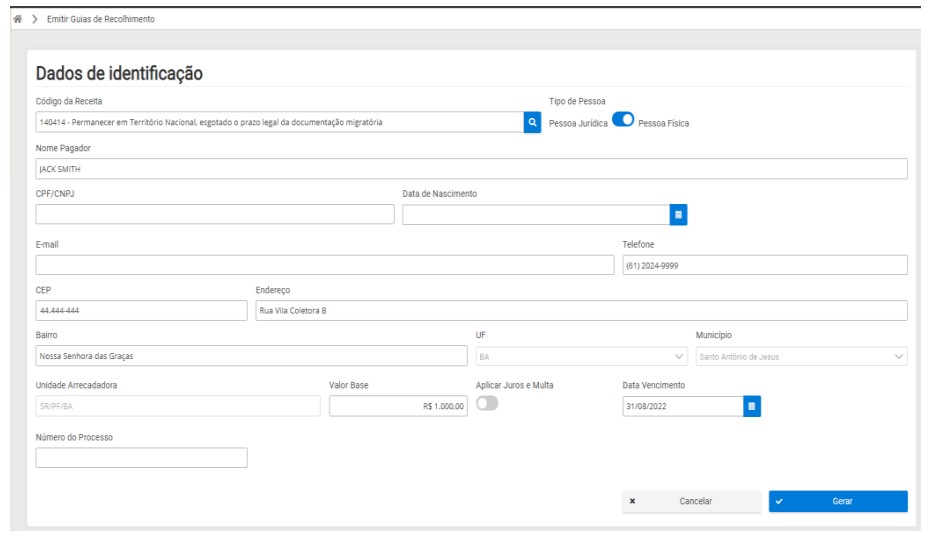
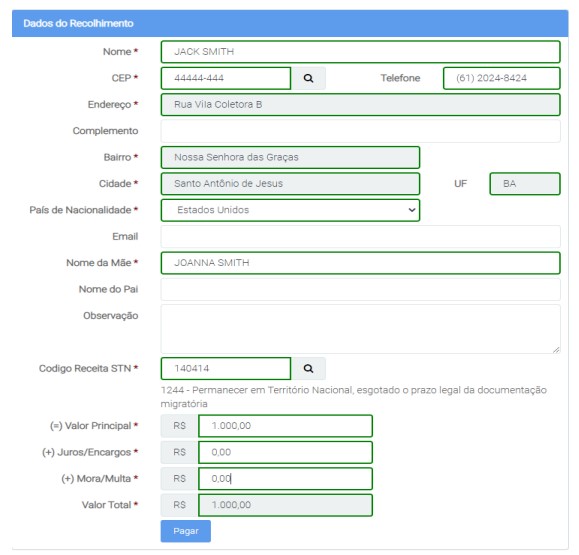
  1. Fill out the GRU through SIAR2 (systems catalog) or through the form on the PF portal. The zip code field is mandatory, the one for the airport or immigration post can be used:


    Screen 01 – Issuance of GRU by SIAR2 (systems catalog)


    Screen 02 – Issuance of GRU by the form on the PF portal

  2. The following bank details regarding SWIFT must be informed:

    SWIFT code: BRASBRRJCTA
    IBAN : BR3500000000016070003331415C1
    Agency 1607-1, account 333.141-5 – BANCO DO BRASIL
     
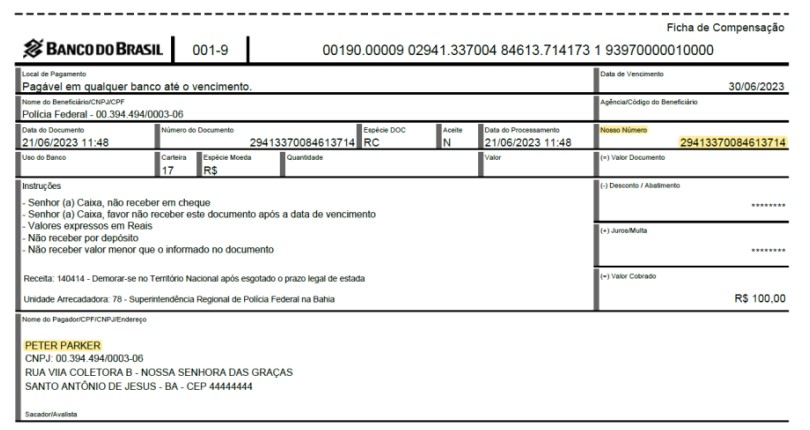
  3. If the "Description", "Note" or equivalent field is available in the transfer data, ask the payer to enter Our GRU Number (numerical sequence starting with 2941....) and his name (whole or part), so that the OPE can be linked with the GRU.


    Screen 03 – Location of Our Number in GRU

  4. After the transfer, instruct the payer to keep the statement, receipt or "print" of the operation, as it will still be necessary to verify that the OPE was correctly received at Banco do Brasil, a process that takes 1 or 2 business days depending on the time of the transfer and the international bank used. Thus, explain to the payer that the operation is subject to confirmation by the PF.

  5. The payer must be instructed to send the proof of the international transfer and the GRU object of payment to the receitas@pf.gov.br email for verification by CGOF/DLOG/PF. Include additional payer identification data, if any.

  6. Once the OPE is available for settlement in Banco do Brasil's system, CGOF/DLOG/PF will request the procedure through credit via GRU, to be collected by Banco do Brasil, whose confirmation will be given on the following business day. That is, the payment will be made through another GRU different from the original one issued abroad.

  7. After confirmation of payment by Banco do Brasil, CGOF/DLOG/PF will mark the payment of the original GRU issued to foreigners in SIAR2 and will notify the collection unit issuing the guide, at which time any restrictions may be removed in the migration control systems.

  8. In the case of payment in cash, it is important to take into account that Resolution No. 4,648-BACEN limits the payment to the amount of R$ 9,999.99. Above this amount, it is necessary to "break" the amount by more than one GRU, as bank clearing will not be possible. For example, if the total amount to be applied is R$ 12,000.00, it is necessary to generate two GRUs: one of R$ 9,999.99 and another of R$ 2,000.01.
Naturalization Services What is Naturalization? Naturalization is the process by which a person voluntarily acquires the nationality of a country other than the one where he or she was born, and becomes a citizen of that new country.
Naturalization Services What are the modalities of Naturalization?

According to Brazilian legislation, there are five types of naturalization:

  1. Ordinary Naturalization
    For the immigrant who:

    • He has civil capacity according to Brazilian law.
    • Resides in Brazil for at least 4 years (indefinite term).
    • Has the ability to communicate in Portuguese.
    • He has no criminal conviction or has already been rehabilitated according to the law.
  2. Extraordinary Naturalization
    For the immigrant who:

    • Resides in Brazil for at least 15 years (indefinite term).
    • He has no criminal conviction or has already been rehabilitated according to the law.
  3. Provisional Naturalization
    For immigrant children or adolescents who:

    • They established residence in Brazil before the age of 10 and indefinitely.
  4. Conversion of Provisional Naturalization to Definitive
    For the immigrant who has obtained provisional naturalization and applies for conversion to definitive within 2 years of reaching the age of majority.

  5. Special Naturalization
    For those who:

    • Is married or has lived in a stable union with a member of the Brazilian Foreign Service for more than 5 years, or with someone at the service of the Brazilian State abroad.
    • It is or has been employed in a diplomatic mission or in a consular office in Brazil for more than 10 consecutive years.

These are the types of naturalization provided for in Brazilian legislation, each with specific requirements for obtaining Brazilian nationality.

Naturalization Services How can I become a naturalized citizen in Brazil and what documents are required? To find out the requirements and guidelines on the naturalization process in Brazil, you can access the Federal Police website through the link: Naturalization. There, you will find detailed information about the types of naturalization, the documents required, and the procedure for applying
Naturalization Services How to track the progress of my naturalization process?

Naturalization processes are analyzed on a first-come, first-served basis. However, naturalization requests from people aged 60 or over or who have a serious illness have priority in the process. If you fall into one of these situations, it is necessary to inform the Federal Police and send the corresponding proof. You can do this in two ways:

  1. By Electronic Protocol: Access the SEI system to send the information. Here is the manual for accessing the SEI.

  2. By mail: Send a letter to the address below, informing your situation and attaching the necessary proofs:

    Ministry of Justice – Department of Migration
    Esplanade of the Ministries, Block T, annex II, room 301
    Brasília - DF, CEP: 70.064-900

This will help speed up the progress of your naturalization process.

Naturalization Services How to present complementary documents in the naturalization process?

After submitting your naturalization process, it is not possible to add supplementary documents directly. If it is necessary to present more documents, we recommend that you contact the unit where the process is in progress:

  • If the process is in the Federal Police: Request information directly from the responsible agency, in the unit where the process was filed.
  • If the process is in the Nationality and Naturalization Division: Send an email to naturalizarse@mj.gov.br requesting the return of the process to attach the missing documents.

This is the best way to ensure that all the necessary documents are presented correctly.

Naturalization Services What to do if the Naturalize system has an error?

If you find any errors on the Naturalize platform or have difficulties using the system, send an email to naturalizarse@mj.gov.br. In the email, describe the error that occurred and mandatorily send screenshots (screenshots) so that the problem can be corrected as soon as possible. This will help the team resolve the situation efficiently.

Naturalization Services I still have questions about the naturalization process, what should I do?

If you have questions about the progress of your naturalization process, follow these guidelines:

  1. Follow the progress of the process: Access the Ministry of Justice website here and enter the protocol number to follow your naturalization process.

  2. Contact the Federal Police: If you do not find the information you need on the website, contact the Federal Police unit where you filed the case directly. The PF is responsible for receiving and forwarding the process to the Ministry of Justice, and they will be able to provide detailed information on the progress and deadlines.

  3. Contact with the Ministry of Justice: If necessary, you can also consult the Ministry of Justice directly. More information can be found on the Ministry of Justice website.

  4. Find the unit responsible for your region: To find out which Federal Police unit is responsible for your district, see the link with the addresses and contacts of the PF units here.

This is the most effective way to get detailed and accurate information about your naturalization process

Naturalization Services How to contact me to find out about the Naturalization process?

You can contact the Department of Migration of the Ministry of Justice to obtain information about your naturalization process through the following channels:

  1. By email:

    • naturalizarse@mj.gov.br
    • dinat@mj.gov.br
  2. By phone:

    • (061) 2025-3375
    • (061) 2025-3455
    • (061) 2025-9889
    • (061) 2025-9557
    • (061) 2025-9429
    • (061) 2025-9374
  3. Via WhatsApp:

    • (061) 2025-9766
    • (061) 2025-3375
    • (061) 2025-9429
    • (061) 2025-3425

These channels are for answering questions and obtaining information about the progress of your naturalization process.

Refugio How to apply for asylum?

To request asylum, access the Federal Police service channels and follow the procedures indicated.

Statelessness What is statelessness?

Statelessness is the condition of a person who is not considered a national by any country.

Statelessness I don't have nationality, what should I do?

If you are not recognized as a national of any country (according to the 1954 Convention on the Status of Stateless Persons) and reside in Brazil, in addition to having no criminal record in the countries where you have lived in the last five years, you can apply for recognition of statelessness.

For more information on how to proceed, click here.

work What are the labor rights of migrants?

Migrants have the right to fair working conditions and protection from discrimination in the workplace.

work Where can I find information about work and employment for foreigners in Brazil?

The Ministry of Labor and Social Security, through the Undersecretariat of Labor Inspection (SIT), in collaboration with the International Labor Organization (ILO), the International Organization for Migration (IOM) and the UN Refugee Agency (UNHCR), created a website with important information for migrants and refugees about rights and measures adopted in labor and employment relations in Brazil.

For more details, visit the website here.

Services Channels Scheduling

What are the Federal Police's service channels?

The channels include face-to-face services, e-mail and telephone. See the Federal Police website for more details.

Services Channels Scheduling I still have questions, where can I get in touch?

For more information about your case, contact the Federal Police unit in the region where you live.

Click on your state and look for the email of the Immigration Police Station at the following link: Superintendencies and Police Stations.

Services Channels Scheduling

I need other service channels, where can I find it?

You can access the Federal Police service channels through the following link: Federal Police Service Channels.

Não altere o conteúdo abaixo desta linha.

Compartilhe por Facebook Compartilhe por Twitter Compartilhe por LinkedIn Compartilhe por WhatsApp link para Copiar para área de transferência
  • Assuntos
    • Notícias
      • 2025
    • Academia Nacional de Polícia
      • Institucional
      • Educação cidadã
      • Escola Superior de Polícia
      • ANP Editora
      • Comissão Própria de Avaliação
      • Licitações
      • Museu Criminal da Polícia Federal
      • Biblioteca da ANP
    • Acordos de Cooperação
    • Adoção Internacional
    • Aeroportos
    • Antecedentes Criminais
    • Armas
    • Combate a Crimes Cibernéticos
    • Glossário de Direitos Humanos
      • Direitos da infância e adolescência
      • Expressões racistas
      • Expressões capacitistas
      • Gênero e sexualidade
      • Processos migratórios
      • População em situação de rua
      • Relações étnico-sociais-religiosas
      • Expressões policiais
      • Outros tipos de violência
    • GRU
    • Guardiões da Infância
    • Leilão
    • Licitações e Contratos
    • Migração
      • Dúvidas Frequentes (FAQ)
      • Notificações
    • Passaporte
    • PF Saúde
      • Perguntas Frequentes
    • Produtos Químicos
    • Segurança Privada
    • Segurança Portuária
      • Modelos de Documentos
    • Sigilo Bancário
    • Fundos
    • Validador de Documentos de Inquérito Policial
  • Carta de Serviços
  • Acesso à Informação
    • Institucional
      • Livro PF80
    • Ações e Programas
      • Obras e Projetos
    • Participação Social
    • Auditorias
    • Convênios e Transferências
      • Acordo de Cooperação Técnica - ACT
    • Receitas e Despesas
      • Notas Fiscais Eletrônicas
    • Licitações e Contratos
    • Servidores
      • Servidores Ativos
      • Servidores Aposentados e Pensionistas
      • PF por Elas
      • Rosa dos Ventos
      • PF por Todos
      • Estágio
      • Concursos
      • PF Saude
      • Saúde Mental
    • Informações Classificadas
    • Serviço de Informação ao Cidadão - SIC
      • Relatório Anual da Autoridade de Monitoramento
    • Perguntas Frequentes
    • Dados Abertos
      • Relatório de execução do PDA/PF 2021-2023
      • ePol - Guia de Leitura do painel de business intelligence 'Casos Eleitorais em andamento'
      • ePol - Estatísticas de Polícia Judiciária - Guia de Leitura do painel de business intelligence 'Casos Eleitorais em andamento'
    • Sanções Administrativas
      • 2024
      • 2023
      • Sanções Disciplinares
    • Agenda de Autoridades
    • Carta de Serviços
    • Transparência e Prestação de Contas
      • Credenciamentos - PF Saúde
    • Estatísticas
      • Diretoria de Combate a Crimes Cibernéticos - DCIBER
      • Diretoria da Amazônia e Meio Ambiente - DAMAZ
    • Tratamento de Dados Pessoais
    • Sistema Eletrônico de Informações (SEI)
    • Corregedoria
  • Composição
    • Quem é quem
    • Galeria de ex-Diretores Gerais
  • Canais de Atendimento
    • Assessoria de Imprensa
    • Comunicação de Crimes
    • Ouvidoria
      • Relatórios do Conselho de Usuários
    • Unidades
Redefinir Cookies
Redes sociais
  • Twitter
  • Instagram
  • YouTube
Acesso àInformação
Todo o conteúdo deste site está publicado sob a licença Creative Commons Atribuição-SemDerivações 3.0 Não Adaptada.
Voltar ao topo da página
Fale Agora Refazer a busca