Notícias
Palestra no ON fala sobre como as observações do JWST estão mudando o nosso conhecimento do sistema solar exterior
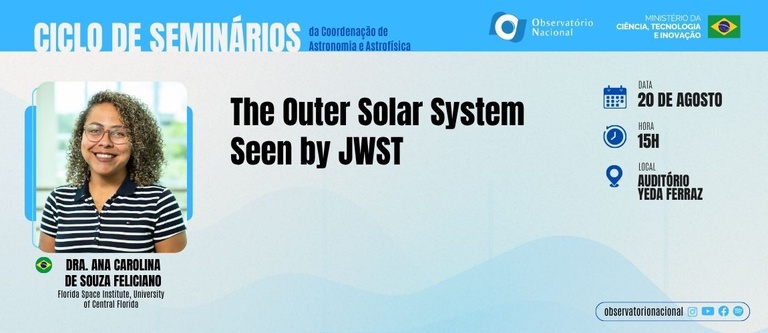
A Coordenação de Astronomia e Astrofísica (COAST) do Observatório Nacional (ON/MCTI) terá na próxima quinta-feira, 20 de agosto, mais uma palestra do ciclo 2026 dos seus seminários semanais.
A palestra será ministrada pela Dra. Ana Carolina de Souza Feliciano, do Florida Space Institute, da University of Central Florida. O seminário terá como tema “The Outer Solar System Seen by JWST” e será realizado presencialmente no Auditório Yeda Ferraz, no ON, às 15h. O coffee break será às 14h30.
Palestrante: Dr. Ana Carolina de Souza Feliciano (Florida Space Institute, University of Central Florida)
Data e hora: 20 de agosto de 2026, às 15h (coffee break às 14h30)
Local: Auditório Yeda Ferraz
Título: The Outer Solar System Seen by JWST
Resumo: Trans-Neptunian objects (TNOs) are icy remnants of the protoplanetary disk from which our solar system formed, orbiting the Sun in the distant region beyond Neptune. Since they preserve material largely unaltered since the early solar system, they are key tracers of its primordial composition and dynamical history, offering a window into the origin and evolution of the outer solar system. Before the James Webb Space Telescope (JWST), TNOs could be roughly grouped by surface composition. The largest objects showed clear signatures of water and methane ice. Some small and medium-sized TNOs showed weaker or more ambiguous indications of water ice alongside red or featureless spectral slopes, with minor contributions from nitrogen-bearing species or methanol ice. Most smaller TNOs exhibited featureless spectra spanning a diverse range of visible colors, suggestive of surfaces composed of complex organic compounds mixed with amorphous silicates. With four years of science operations, JWST is substantially revising this picture. Several General Observer and Guaranteed Time Observation programs have targeted small, mid-sized, and large TNOs, many of which were previously inaccessible to ground-based spectroscopy. In this presentation, we review the discoveries emerging from these observation programs and discuss how they are reshaping our understanding of the trans-Neptunian region and the primordial state of the Solar System.
Bio: Dr. Ana Carolina de Souza Feliciano is a Research Assistant Professor at the Florida Space Institute, University of Central Florida. Her research draws on ground- and space-based facilities, including the James Webb Space Telescope and, more recently, the Hubble Space Telescope, to study the surface composition and rotational properties of trans-Neptunian objects, trans-Neptunian binaries, and Jupiter and Neptune Trojan asteroids. She earned her Ph.D. in Astronomy from Brazil's National Observatory in 2020, and in 2023 the International Astronomical Union named the minor planet (30575) AnaCarolina in her honor. She was recognized with UCF's Early Career Space Achievement Faculty Award during Space Week 2025 and received a 2026 Reach for the Stars Award as an early-career researcher, the university's second-highest honor. Her portfolio includes more than 25 research articles (four in Nature Astronomy) and three book chapters.
AVISO
Notícia veiculada durante o período do defeso eleitoral e de acordo com as regras do mesmo, conforme Resolução nº 23.760 (02/03/2026) e as condutas vedadas.