Notícias
Palestra no ON fala sobre a aplicação de Large Language Models em astronomia
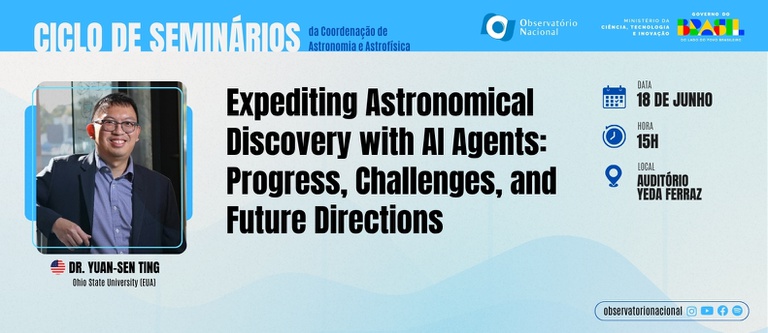
A Coordenação de Astronomia e Astrofísica (COAST) do Observatório Nacional (ON/MCTI) realizará em 18 de junho, quinta-feira, mais uma palestra do ciclo 2026 dos seus seminários semanais.
A palestra será ministrada pelo Dr. Yuan-Sen Ting, da Ohio State University (EUA). O seminário terá como tema “Expediting Astronomical Discovery with AI Agents: Progress, Challenges, and Future Directions” e será realizado presencialmente no Auditório Yeda Ferraz, no ON, às 15h. O coffee break será às 14h30.
Data: 18/06/2026 às 15h.
Local: Auditório Yeda Ferraz, no Observatório Nacional.
Palestrante: Dr. Yuan-Sen Ting, da Ohio State University (EUA).
Título: Expediting Astronomical Discovery with AI Agents: Progress, Challenges, and Future Directions.
Resumo: The expansive, interdisciplinary nature of astronomy, combined with its open-access culture, makes it an ideal testing ground for exploring how Large Language Models (LLMs) can accelerate scientific discovery. Recent developments in LLM reasoning capabilities have shown substantial progress — our work demonstrates that AI agents can now achieve gold medal performance on International Olympiad on Astronomy and Astrophysics (IOAA) problems, indicating their growing analytical abilities. In this talk, I will present our recent advances in applying LLMs as agents to real-world astronomical challenges. We demonstrate how LLM agents can conduct end-to-end research tasks in galaxy spectral fitting — encompassing data analysis, strategy refinement, and knowledge accumulation — approaching capabilities similar to human intuition and domain knowledge, and extending to spectroscopic measurements that once took months of expert effort and to sifting hundreds of millions of light curves for rare systems. However, limitations remain. The Moravec paradox manifests clearly in astronomy: tasks requiring abstract reasoning may be easier for AI than seemingly simple perceptual tasks, and current models still struggle with chart reading, multi-modal data interpretation, and other fundamental astronomical workflows. To make large-scale applications viable, we developed lightweight, open-source specialized models (AstroSage) that match frontier models on astronomy Q&A at a fraction of the cost, evaluated against carefully curated astronomical benchmarks. Looking ahead, the path forward involves not just better models but a comprehensive ecosystem — rigorous benchmarks, literature-scale retrieval, and agent-ready tools. I will close by reflecting on what this transformation means for scientific understanding itself, and why understanding the universe remains a distinctly human project, even with non-human collaborators.