Notícias
Palestra no ON aborda métricas de tensão generalizadas para múltiplos conjuntos de dados cosmológicos
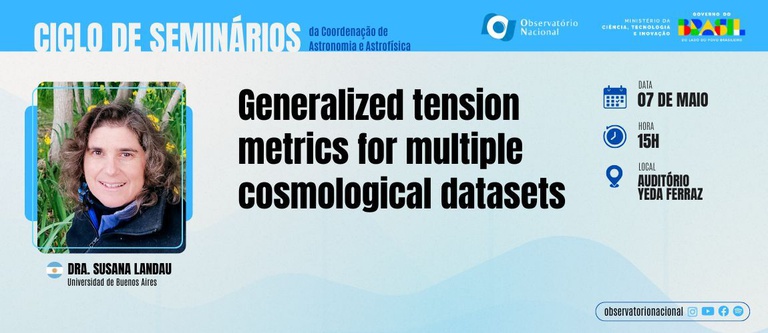
A Coordenação de Astronomia e Astrofísica (COAST) do Observatório Nacional (ON/MCTI) terá na próxima quinta-feira, 7 de maio, mais uma palestra do ciclo 2026 dos seus seminários semanais.
A palestra será ministrada pela Dra. Susana Landau, da Universidad de Buenos Aires. O seminário terá como tema “Generalized tension metrics for multiple cosmological datasets” e será realizado presencialmente no Auditório Yeda Ferraz, no ON, às 15h. O coffee break será às 14h30.
Palestrante: Dra. Susana Landau, da Universidad de Buenos Aires.
Título: Generalized tension metrics for multiple cosmological datasets.
Data e hora: 7 de maio de 2026, às 15h.
Local: Auditório Yeda Ferraz.
Resumo: Over the past two decades, cosmological observations have achieved unprecedented precision and volume. Although the LambdaCDM model successfully describes most observational datasets, persistent discrepancies remain, being the most significant one the Hubble tension: measurements of the present-day Hubble parameter derived from CMB observations within the LambdaCDM framework are incompatible with late-time determinations from Type Ia supernovae and Cepheids. Despite considerable effort, the source of this tension remains unresolved, highlighting the need for rigorous statistical tools to compare parameter estimates across independent datasets. In this talk, I will describe a novel estimator to quantify statistical tensions among multiple cosmological datasets simultaneously. This estimator generalizes the Difference-in-Means statistic, QDM, to the multi-dataset regime. Our framework enables the detection of dominant tension directions in the shared parameter space. It further provides a geometric interpretation of the tension for the two- and three-dataset cases in two dimensions. According to this approach, the previously reported increase in tension between DESI and Planck from 1.9 sigma (DR1) to 2.3 sigma (DR2) is reinterpreted as a more modest shift from 1.18 sigmaeff (DR1) to 1.45 sigmaeff (DR2).