Notícias
Palestra no Observatório Nacional fala sobre a formação da Via Láctea
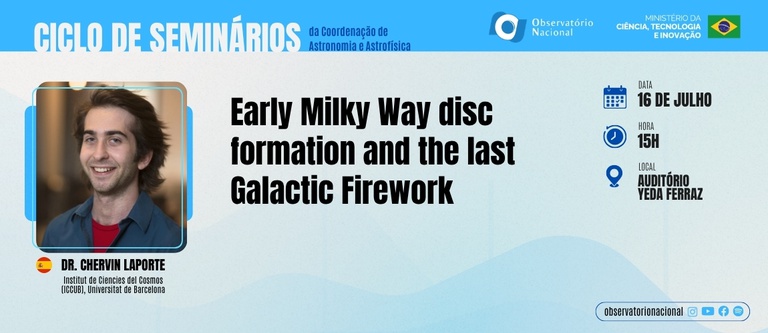
A Coordenação de Astronomia e Astrofísica (COAST) do Observatório Nacional (ON/MCTI) terá na próxima quinta-feira, 16 de julho, mais uma palestra do ciclo 2026 dos seus seminários semanais.
A palestra será ministrada pelo Dr. Chervin Laporte, do Institut de Ciències del Cosmos (ICCUB), da Universitat de Barcelona. O seminário terá como tema “Early Milky Way disc formation and the last Galactic Firework” e será realizado presencialmente no Auditório Yeda Ferraz, no ON, às 15h. O coffee break será às 14h30.
Palestrante: Dr. Chervin Laporte, do Institut de Ciències del Cosmos (ICCUB), Universitat de Barcelona.
Data e hora: 16 de julho de 2026, às 15h.
Local: Auditório Yeda Ferraz.
Título: Early Milky Way disc formation and the last Galactic Firework.
Resumo: In this talk, I will present a novel method to empirically infer the timing of the last significant merger in the Milky Way using field stars and draw a timeline for the formation of the disc based on kinematics, chemistry and ages of field stars and globular clusters (GCs). After successfully testing it against cosmological simulations of galaxy formation, I will apply this method to the Milky Way subgiant stars with spectro-photometric ages, finding that the last significant merger (which is identified as the Gaia-Sausage-Enceladus - GSE) occured 11 Gyrs ago. I will show that this coincides with a group of coeval in-situ GCs in the central disc and bulge region of the Galaxy, indicating a merger-induced starburst which occured at a lookback time of τ = 11.2 ± 0.1 Gyr. Interestingly, the most metal-rich GSE GCs were also born around that same time τ = 10.9 ± 0.1 Gyr and likely formed during the interaction prior to disruption of the GSE. I will show that omegaCen's most metal-rich stellar populations share similar ages and metallicity to the GSE's, but more importantly, that its entire age-metallicity relation follows that of the GSE GCs, signaling that omegaCen is the remnant core of the GSE. Although omegaCen's retrograde orbit is usually taken as evidence against such an association, I will argue that its present-day location in phase-space can also be understood through the action of bar driven resonances without the need of invoking another putative retrograde merger. Finally, I will demonstrate that the mean metallicity at which point MW stellar orbits transition from halo-like to disc-like shows an upward inflexion point [Fe/H] ∼ -1.33, which sets an upper-limit for when the disc was forming. Using proto-MW GCs that formed before the last significant merger with disc-like orbits places this epoch of early-disc formation at z ≳ 4.
AVISO
Notícia veiculada durante o período do defeso eleitoral e de acordo com as regras do mesmo, conforme Resolução nº 23.760 (02/03/2026) e as condutas vedadas.