Notícias
Palestra no Observatório Nacional explora os colisores de partículas cósmicos e o estudo da matéria escura
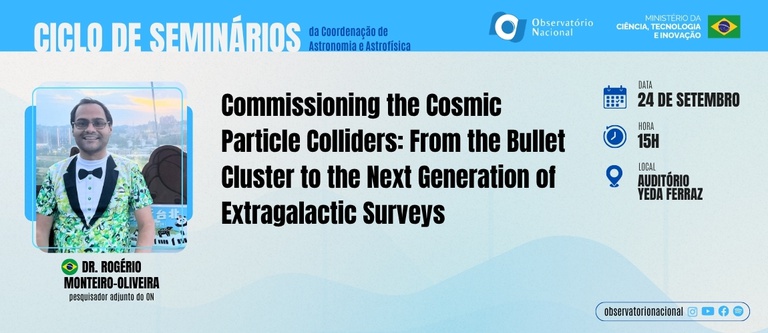
A Coordenação de Astronomia e Astrofísica (COAST) do Observatório Nacional (ON/MCTI) terá na próxima quinta-feira, 24 de setembro de 2026, mais uma palestra do ciclo 2026 dos seus seminários semanais.
A palestra será ministrada pelo Dr. Rogério Monteiro-Oliveira, pesquisador adjunto do ON. O seminário terá como tema “Commissioning the Cosmic Particle Colliders: From the Bullet Cluster to the Next Generation of Extragalactic Surveys” e será realizado presencialmente no Auditório Yeda Ferraz, no ON, às 15h. O coffee break será às 14h30.
Palestrante: Dr. Rogério Monteiro-Oliveira, pesquisador adjunto do ON.
Data e hora: 24 de setembro de 2026, às 15h (coffee break às 14h30).
Local: Auditório Yeda Ferraz, no ON.
Título: Commissioning the Cosmic Particle Colliders: From the Bullet Cluster to the Next Generation of Extragalactic Surveys.
Resumo: Billions of dollars are invested in particle colliders such as the LHC (and for good reason!). But when it comes to dark matter, these large experiments run into a simple problem: on Earth, dark matter is far too rare to be caught in the act. Nature, however, has built its own colliders, much larger, much more violent, and on a cosmic scale: merging galaxy clusters. When two clusters collide, the result is a genuine particle physics experiment on megaparsec scales. Since roughly 80% of the mass of these systems is dark matter, each collision becomes a unique laboratory, not only for probing the nature of dark matter, but also for understanding the behavior of the hot gas and the galaxies under extreme conditions. Nature, however, does not make things easy: unlike a laboratory experiment, we do not choose the initial conditions of the collision, nor do we control when it occurs. Reconstructing what actually happened (the geometry of the encounter, the merger stage, the velocities involved) requires genuine cosmic detective work, combining data across multiple wavelengths with computational simulations. Far from trivial, this reconstruction remains one of the central challenges of the field. In this seminar, I will tell that story: from the iconic discovery of the Bullet Cluster, the first "smoking gun" to visually separate dark matter from baryonic matter, to the present, where a new generation of multiwavelength surveys (eROSITA, LSST, Roman) promises to turn these rare cosmic events into a robust statistical sample, paving the way for increasingly precise tests of the nature of dark matter and the evolution of baryonic matter on large scales.
Bio: Dr. Rogério Monteiro-Oliveira is currently an Associate Researcher at the National Observatory (ON/MCTI). He holds a Ph.D. in Extragalactic Astrophysics from IAG/USP, with postdoctoral research at USP and Academia Sinica (ASIAA, Taiwan), alongside prior faculty experience at UFRGS, IAG/USP, and UESC. His research investigates the formation and evolution of large-scale structures in the Universe (galaxies, clusters, and superclusters). He is currently a member of the LSST, PFS, and J-PAS collaborations. For more details, visit monteiro-oliveira.com.
AVISO
Notícia veiculada durante o período do defeso eleitoral e de acordo com as regras do mesmo, conforme Resolução nº 23.760 (02/03/2026) e as condutas vedadas.