Notícias
Palestra no Observatório Nacional aborda uso de redes neurais na inferência de parâmetros em núcleos ativos de galáxias
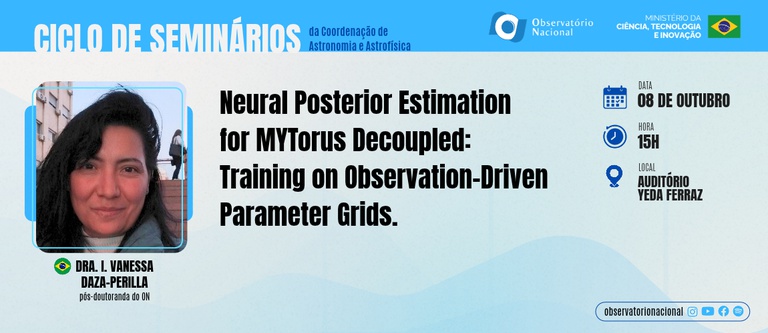
A Coordenação de Astronomia e Astrofísica (COAST) do Observatório Nacional (ON/MCTI) terá na próxima quinta-feira, 8 de outubro de 2026, mais uma palestra do ciclo 2026 dos seus seminários semanais.
A palestra será ministrada pela Dra. I. Vanessa Daza-Perilla, pós-doutoranda do Observatório Nacional (ON/MCTI). O seminário terá como tema “Neural Posterior Estimation for MYTorus Decoupled: Training on Observation-Driven Parameter Grids” e será realizado presencialmente no Auditório Yeda Ferraz, no ON, às 15h. O coffee break será às 14h30.
Palestrante: Dra. I. Vanessa Daza-Perilla (ON).
Data e hora: 8 de outubro de 2026, às 15h (Coffee break às 14h30).
Local: Auditório Yeda Ferraz, no ON.
Título: Neural Posterior Estimation for MYTorus Decoupled: Training on Observation-Driven Parameter Grids.
Resumo: This talk introduces the development of an automated inference tool tailored to extract key physical parameters from obscured AGN X-ray spectra by means of more complex physical models than ever before with machine learning. For our pilot work, we use the decoupled MYTorus model in a toroidal or clumpy geometry, with separate direct and scattered ("reflected") continua, as well as Fe K fluorescence. Such a complex model poses a significant computational challenge for traditional inference techniques. To address this, we construct a physically informed, observation-driven training grid, based on the parameter space spanned by nearby AGN observed with NuSTAR. We use this grid to train a Neural Posterior Estimation (NPE) model within the framework of simulation-based inference (SBI). The parameters inferred are the photon index (Γ), the global and line-of-sight equivalent hydrogen column densities (N_Hs and N_Hz), and the reflection scaling factor (A_S), each with associated uncertainties. This approach demonstrates a path to likelihood-free posterior estimation using neural networks, providing a scalable alternative to traditional methods for parameter inference in complex astrophysical models.
Bio: I am a postdoctoral researcher at the Observatório Nacional in Rio de Janeiro, supported by a FAPERJ Pós-Doutorado Nota 10 fellowship. My research focuses on applying machine learning and statistical inference techniques to astronomical data analysis, with particular interest in photometric redshift estimation and large astronomical surveys such as J-PAS. I earned a PhD in Astronomy and have previous research experience in Argentina and as a Faculty Research Assistant at NASA. I have also been involved in mentoring and supervising students in Argentina.
AVISO
Notícia veiculada durante o período do defeso eleitoral e de acordo com as regras do mesmo, conforme Resolução nº 23.760 (02/03/2026) e as condutas vedadas.