To enable English subtitles, click the gear icon (Settings)
Sustainable Forest Management
This piece was developed to COP30 by the Brazilian Forest Service. The timber comes from Jacundá National Forest (Rondônia, Brazil), in the Amazon biome, acting under forest concession activities, using low-impact management techniques for logging.
Forests play a crucial role in carbon capture and stock reducing greenhouse gas emissions, contributing to climate change mitigation. It also helps regulate hydrological cycles, maintaining water quality and availability, which is fundamental for the population, biodiversity, and economic development.
Forest management conserves biodiversity and ecosystems, ensuring that natural resources are used responsibly and efficiently. Well-managed forests can provide continuous income using timber and non-timber forest products without compromising the health of the ecosystem. It promotes a balance between economic development, social inclusion, and environmental protection, aligning with the Sustainable Development Goals (SDGs).
In this sense, conserving Brazilian public forests, promoting sustainable production, stimulating regional economic development, and improving the quality of life of people living around these areas are the main objectives of the forest concession policy. Under this policy, the State may grant legal entities, including companies, cooperatives, and local community associations, permission to carry out low-impact sustainable forest management, extract timber and non-timber forest products, and offer tourism services in federal public forests.
The concessionary companies are selected through public bidding and earn the right to manage the area. The concessionaires periodically transfer finacial resources defined in the contract to local and federal governments aiming the implementation of sustainability policies. The execution of the contracts is rigorously monitored by the Brazilian Forest Service through forest monitoring instruments. The Forest Concession policy allows federal, state, and municipal governments to effectively manage public assets and restrict illegal activities such as land grabbing, illegal mining, deforestation, and forest fires.
Forest Monitoring and Timber Tracking
The Brazilian Forest Service has developed a traceability system that relies on a Chain of Custody System (SCC). This system allows the entire path from growth to production to be tracked.
The Chain of Custody System records the location of all trees in the forest. When trees are harvested inside the limits of a Forest Concession area, the forest concessionaire is required to report all production in the system. Each transport of wood from the forest to the industry is also recorded in the system, which generates a QR code for each document. Upon arrival at the concessionaire's sawmill, the logs are converted into sawn timber, forming bundles or bales. Each bundle of sawn timber also receives a QR code generated by the SCC. Thus, by consulting the generated codes, the system automatically retrieves which trees originated the consulted wood and generates a map with the geographic coordinates of these trees.
This, therefore, provides traceability of timber from forest concessions from the moment the products are removed from the forest to the sawmill. The tool also allows access to production reports from concessions in national forests.
The Forest Products Laboratory
The pieces were manufactured by the carpentry sector of the Forest Products Laboratory of the Brazilian Forest Service. The laboratory researches wood technology and other forest products, generating knowledge to foster the development of sustainable forestry activities. Its technical and scientific work supports public policies, forest management practices, and the strengthening of forest-based production chains, promoting economic alternatives, especially in territories of local communities, settlements, and extractive communities, and expanding access for local producers to differentiated and more demanding markets.
Used species

CUMARU-FERRO – Dipteryx odorata
Uses: exterior and interior constructions, flooring, sliced veneers, framing, turnery, tool handles, furniture, decks and others.

ROXINHO – Peltogyne lecointei
Uses: fine cabinet work, railroad crossties, civil and naval constructions, sculptures, flooring, turnery and others.

TAMARINDO – Martiodendron elatum
Uses: housing construction (beems, battens, laths, doors and windows threshold, ceiling, flooring, decks), furniture and others.

IPÊ – Handroanthus incanus
Uses: bridges, railroad crossties, doors, windows, flooring, decks, furniture, turnery, musical instruments, tool handles and others.
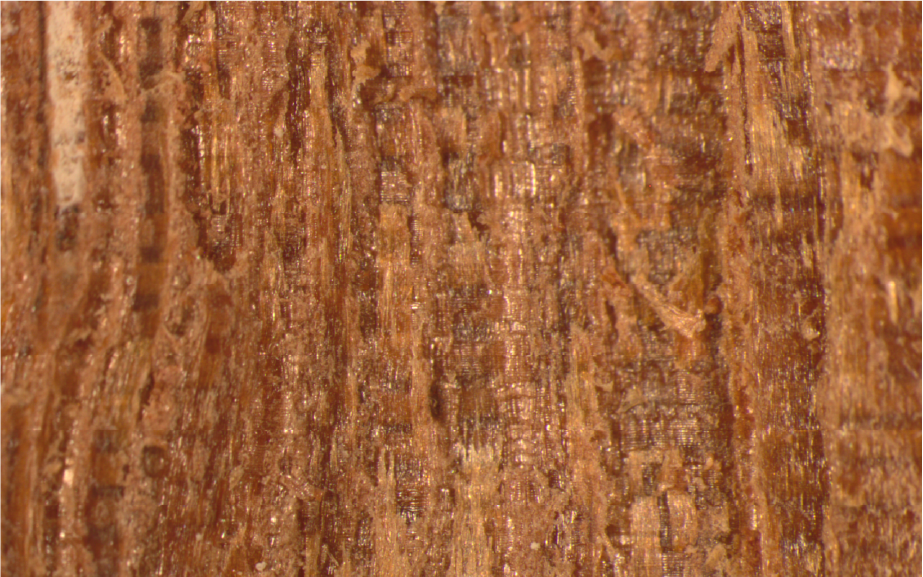
CUMARU-ROSA – Dipteryx magnifica
Uses: exterior and interior constructions, flooring, sliced veneers, framing, turnery, tool handles, furniture, decks and others.

GUARIÚBA – Clarisia racemosa