Boletim Webnuclear - Noviembre 2025

Año 20 - Nº 232 - noviembre 2025



Sitios


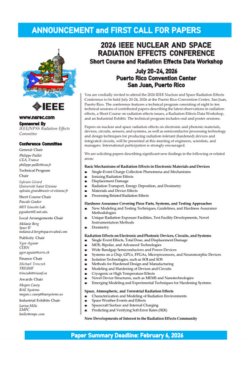
Congresos
Revistas
Publicaciones
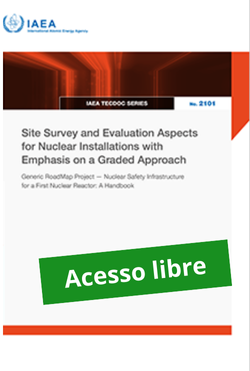
Site Survey and Evaluation Aspects for Nuclear Installations with Emphasis on a Graded Approach
IAEA-TECDOC-2101 ¦ English ¦ ISBN 978-92-0-119025-3 ¦ 114 pages ¦ Date published: 2025
This TECDOC provides guidance for Member States planning to expand their nuclear power programmes through the deployment of advanced nuclear power plants (NPPs). It also provides key information for newcomer countries embarking on their first NPP projects, including those adopting advanced NPP technology. It outlines practical steps for site selection and characterization and considers the application of a graded approach for advanced NPPs. The publication outlines key activities at each stage of the site survey and evaluation process, with a focus on optimizing data collection. It offers a tailored approach to site characterization based on the radiological hazard categories of these installations, reflecting the advanced safety features and robust designs. It also introduces a methodology for radiological hazard categorization based on consequence analysis, followed by practical guidance for grading site investigations, particularly seismic and geotechnical hazards, which are resource intensive.
Application of Non-destructive Testing and In-service Inspection to Research Reactors
IAEA- TECDOC-1263 (Rev. 1) ¦ English ¦ 84 pages ¦ Date published: 2025
This publication is a revision of IAEA TECDOC No. 1263 and offers practical guidance for establishing, implementing and improving in-service inspection programmes based on non-destructive testing methods for research reactors. The publication addresses all aspects of programme development and execution, including its review and continuous improvement. It adopts a methodological approach and incorporates practical examples from operating research reactors to support programme implementation. This guidance is intended for research reactor operating organizations, designers, and support organizations.
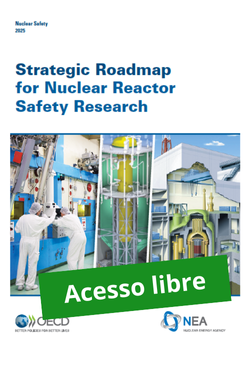
Strategic Roadmap for Nuclear Reactor Safety Research
Nuclear Energy Agency/OECD ¦ NEA No. 7738 ¦ English ¦ 68 pages ¦ Date published: 2025
Projections indicate that nuclear capacity will expand substantially in the coming years, as many countries pursue programmes to increase supply and broaden applications of nuclear energy. Ensuring the safe, efficient and resilient operation of existing plants – while enabling the timely deployment of innovative designs such as small modular reactors (SMRs) – is therefore an urgent priority. This publication presents a strategic roadmap for international nuclear reactor safety research, designed to help governments, regulators, industry and research organisations address emerging safety challenges. It highlights the growing gap between research needs and available facilities following the closure of key experimental infrastructures, and calls for stronger international co-operation to sustain expertise and accelerate progress. The roadmap identifies urgent priorities across fuels and claddings, advanced materials, thermal-hydraulics, severe accidents, long-term operation and disruptive technologies such as advanced manufacturing and artificial intelligence. It offers actionable recommendations for co-ordinated research, funding and stakeholder engagement to ensure nuclear safety keeps pace with innovation. By aligning safety research with global deployment goals, this roadmap aims to support a safe, flexible and sustainable nuclear energy future.
Best Practices in the Disinfection of Cultural Heritage Artefacts and Archives Using Ionizing Radiation
STI/PUB/2115 ¦ English ¦ ISBN 978-92-0-113925-2 ¦ 316 pages ¦ Date published: 2025
Cultural heritage artifacts hold immense historical and societal value, as they reflect the origins, identity and essence of multiple generations. However, the organic materials in these artifacts are prone to biodegradation, accelerated by factors like climate change. To address this issue, the IAEA has supported extensive research into radiation technology as a viable means of safeguarding and conserving cultural heritage. This publication serves as a manual for cultural heritage protection, bridging the gap between radiation science and heritage conservation and explaining how radiation treatments offer swift, effective disinfection that surpass conventional methods. From climate change challenges to interdisciplinary collaboration, this publication empowers professionals to preserve our rich cultural legacy. It will be especially useful for radiation technologists who interact directly with various stakeholders, including cultural heritage professionals, conservators and individuals responsible for collections. In addition, it will be of interest to providers of irradiation services and to beginners who are encountering radiation technology application in the field of cultural heritage protection and conservation for the first time.
Legal Frameworks for Long-Term Operation of Nuclear Power Reactors: Second Edition
Nuclear Energy Agency/OCDE ¦ NEA No. 7736 ¦ English ¦ 208 pages ¦ Date Published: 2025
With more than two-thirds of the world’s operating nuclear reactors over 30 years of age, countries around the world are assessing whether to allow reactor operation to continue past the 50-60-year mark and potentially up to 80 years. Ensuring a proper legal framework for the long-term operation (LTO) of nuclear power reactors is a key component of such considerations. In the five years since the publication of the 2019 Legal Frameworks for Long-Term Operation of Nuclear Power Reactors (2019 LTO Report), numerous reactors have reached or exceeded the terms of their original operating licences and countries have further developed and adapted their LTO laws, regulations and policies. The aim of this second edition is to provide up-to-date information regarding the various LTO laws, regulations and policies of each reporting country, highlighting some of the commonalities that emerge and the possible reasons for some of the variations. The second edition also increases the number of country reports, from 25 to 29, compared with the 2019 LTO Report.
Guidance on Cost Estimate of Available NORM Waste Disposal Options
IAEA-TECDOC-2103 ¦ English ¦ ISBN 978-92-0-120625-1 ¦ 90 pages ¦ Date published: 2025
With a focus on facilities designed to handle small and medium volumes of NORM waste, this TECDOC provides guidance on cost estimation for its disposal. It establishes a clear definition of NORM waste, explores the typical sources of small to medium quantities and outlines the range of disposal options according to the associated waste hazards. The report introduces a lifecycle-based cost estimation model, which serves as a foundational framework for developing cost estimates. It also identifies key components and variables within disposal plans that may influence cost variability. In addition, this publication presents high-level insights into various cost-estimation methodologies. Rather than offering a catalogue of specific costs, this TECDOC aims to equip Member States with a structured approach for collecting and applying their own cost data in the planning and development of NORM waste disposal facilities, acknowledging that cost elements are highly context-dependent and may vary across Member States.
Nuclear Innovation and Newly Emerging Disruptive Technologies: Recent Initiatives by Industry, Research Laboratories and Governments
Nuclear Energy Agency/OECD ¦ NEA/WKP(2025 ¦ English ¦ 203 pages ¦ Date published: 2025
From its inception as a scientific discovery to its evolution into a key component of global energy infrastructure, nuclear energy has benefited from breakthroughs in physics, engineering and materials science. The sector now faces critical challenges that demand technological advancements and shifts in strategic thinking. Embracing next-generation reactor designs, leveraging digital technologies and fostering a culture of creativity and collaboration can unlock new applications for nuclear-generated industrial heat for, inter alia, energy-intensive industries, hydrogen production, petrochemical operations and district heating. This compilation of articles focused on nuclear innovation and newly emerging technologies gathers insights and perspectives from government, industry and research organisation stakeholders. It presents a snapshot of initiatives for disruptive innovation in nuclear energy technologies across the industrial economy.
Roadmaps to New Nuclear 2025: Report for Ministers and CEOs
Nuclear Energy Agency/OECD ¦ English ¦ 88 pages ¦ Date published: 2025
This Roadmaps to New Nuclear: Report for Ministers and CEOs focuses on efforts to chart a collaborative path toward delivering new nuclear energy construction at the scale and pace required to meet growing global demand. Following on the work accomplished by delegates, including ministers and CEOs at previous Roadmaps to New Nuclear conferences, this brief provides a summary overview of identified strategic priorities and the actions taken since by the NEA. It sets the scene for discussions among this year’s delegates to advance international collaboration, foster strategic partnerships, share best practices and learn from each other’s experiences. The brief provides current data with insights from economic analyses and recommendations to inform policy and investment decisions. It sets out initiatives to enable the use of nuclear energy to deliver on climate and economic priorities more effectively during the ongoing energy transition.
Structural Behaviour of Fuel Assemblies in Light Water Reactors WN Dez/25
IAEA-TECDOC-2106 ¦ English ¦ ISBN 978-92-0-123025-6 ¦ 110 pages ¦ Date published: 2025
Fuel assemblies (FAs) in light water reactors (LWRs) are engineered for high robustness and reliability, delivering strong performance under normal and demanding operating conditions, such as power uprates, high burnups, extended cycle lengths of up to 24 months, and challenging water chemistry environments. Since the mid-2000s, and especially following the Fukushima accident, significant advancements have been made in FA design, safety analysis, and testing methodologies to better understand structural behaviour and demonstrate mechanical integrity in water-cooled reactors. This publication covers design considerations, safety and design analysis, operational and handling experience, and the in-reactor structural behaviour of LWR fuel assemblies.
Defining Generic Test Conditions for Dual Purpose Casks (2016–2019)
IAEA-TECDOC-2102 ¦ English ¦ ISBN 978-92-0-119225-7 ¦ 50 pages ¦ Date published: 2025
This comprehensive TECDOC on the International Project on Development of an Approach for Defining Generic Test Conditions for Dual Purpose Casks (GeTeC) addresses the growing need for efficient and safe spent fuel storage solutions. As reactor pool capacities reach their limits, the innovative Dual Purpose Cask (DPC) concept offers a flexible and economically efficient option for managing spent fuel. DPCs are designed to meet stringent national and international safety standards, ensuring safe storage and transport without the need for additional equipment. The IAEA's GeTeC working group has developed an integrated safety case methodology for DPCs, providing Member States with a robust framework to establish their national requirements. This publication outlines generic test conditions for DPCs, reflecting the latest industry standards and best practices.