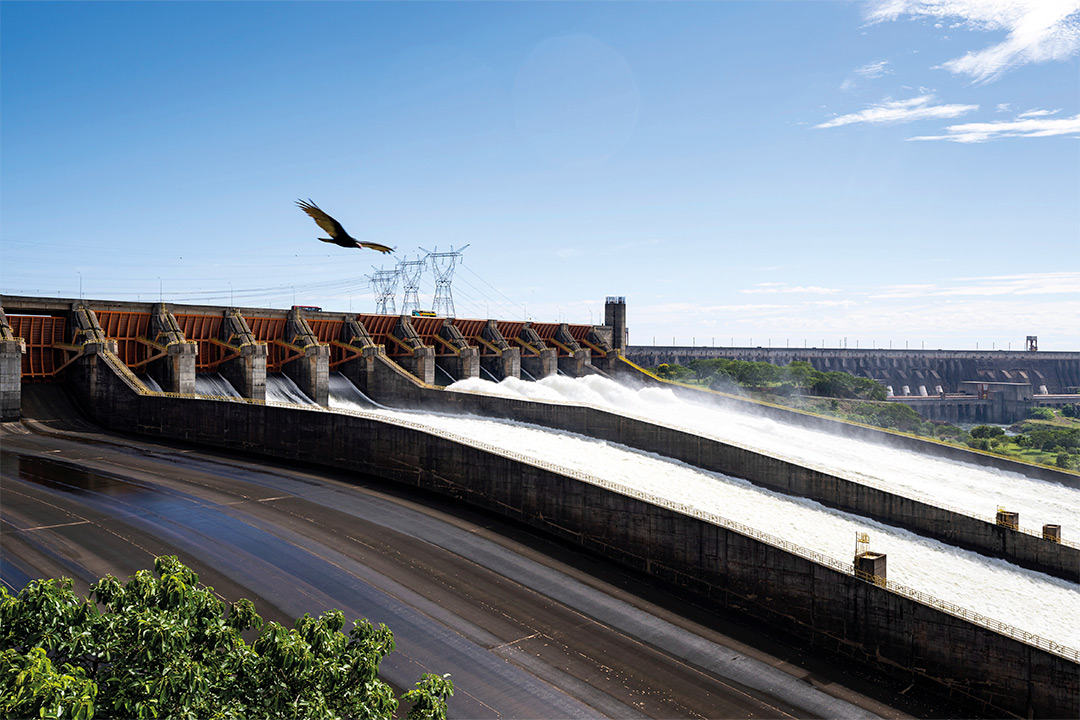
Revitalization of the Itaipu energy transmission system
A stage of the project to revitalize the energy transmission system of the Itaipu hydroelectric plant, aimed at modernizing and upgrading the technology in use, was completed on 12/13/2024 with the participation of the Ministry of Mines and Energy (MME). The Ministry played a key role in monitoring and coordination, ensuring that progress adhered to the established technical and financial parameters.
Essential to Brazil’s energy security, the Furnas High-Voltage Direct Current (HVDC) System, which transmits part of the energy generated by Itaipu to Brazil, is undergoing renovation. Built in the 1980s, the system now faces risks of collapse and requires revitalization, as it has already exceeded its useful life. It is being transformed into a modern and resilient transmission infrastructure.
The project connects Foz do Iguaçu (Paraná) to Ibiúna (São Paulo), reinforcing the reliability of electricity supply for millions of Brazilians. This modernization will ensure energy security for the population while contributing to lower tariffs, reducing costs for consumers.
An addendum to the original agreement was signed in May 2024 between the MME and Itaipu Binacional to guarantee that the work is carried out without impacting electricity bills, underscoring efficient management and commitment to society.
With investments of approximately R$ 1.9 billion, the project ensures greater flexibility for Itaipu, optimizing production while strengthening Brazil’s power system. This will provide high-quality, reliable electricity transmission services while avoiding tariff increases.
The MME played a decisive role in securing contributions and coordinating actions among the different entities involved, ensuring compliance with the timeline. The amendment also reduced costs for Brazilians and decreased Itaipu’s non-operating expenses, redirecting resources to the electricity sector itself.
Beyond structural revitalization, the initiative incorporates cutting-edge technologies, such as real-time monitoring systems, which significantly reduce the risk of transmission failures. This technological progress strengthens Brazil’s ability to ensure a stable and efficient energy supply, even in periods of high demand or adverse weather conditions.
The revitalization is scheduled for completion in 2026, followed by assisted operation from 2027 to 2029. It also includes modernizing equipment at the converter station in Foz do Iguaçu, which transforms alternating current from Itaipu at 50 Hertz (Hz) into 60 Hz at the Ibiúna station.
The completion of this stage in December 2024 is part of MME’s broader effort to modernize and reinforce Brazil’s energy infrastructure. The full upgrade of all converters is strategic to prevent supply interruptions and ensure that the increasing demands of both the population and industry are met, consolidating Brazil’s role as a benchmark in innovation and energy security.
Itaipu’s non-operating expenses are being redirected to the electricity sector itself, preventing additional costs for consumers.
The Itaipu transmission system will also sustain ongoing energy integration among Mercosur countries, further advancing South America’s economic development.
With half a century of experience, Itaipu Binacional continues to demonstrate the possibility of harmonizing economic growth with environmental conservation. As a generator of clean and renewable energy, it remains a global symbol of energy integration.
THE HVDC SYSTEM
According to information from Itaipu Binacional, the HVDC system is approximately 800 km long and connects the substations of Foz do Iguaçu (Paraná) and Ibiúna (São Paulo). It transmits the energy produced by Itaipu at 50 Hz (the frequency used in Paraguay) that is not consumed by the neighboring country, a partner in the venture. In Ibiúna, the energy is converted into 60 Hz alternating current, the Brazilian standard.
The system transmits part of the energy produced by the Itaipu hydroelectric plant, supplying Brazil’s main consumer centers, such as Rio de Janeiro and São Paulo. The Ibiúna substation is located less than 100 km from the center of São Paulo’s capital.
This renovation is the first since the system began operating in 1984, alongside the start of power generation at the plant. It represents a crucial investment for the electrical system, as this type of equipment requires constant and specialized attention.
NUMBERS
800 km - Total length of the HVDC system connecting Foz do Iguaçu and Ibiúna substations.
R$ 1.9 billion - Planned investment value
DATES
05/16/2024 – Signing of the addendum for the revitalization of the Furnas High-Voltage Direct Current system.
Published: November 12, 2025
Photo credits: Rafa Kondlatsch (Itaipu Binacional) e Getty Images