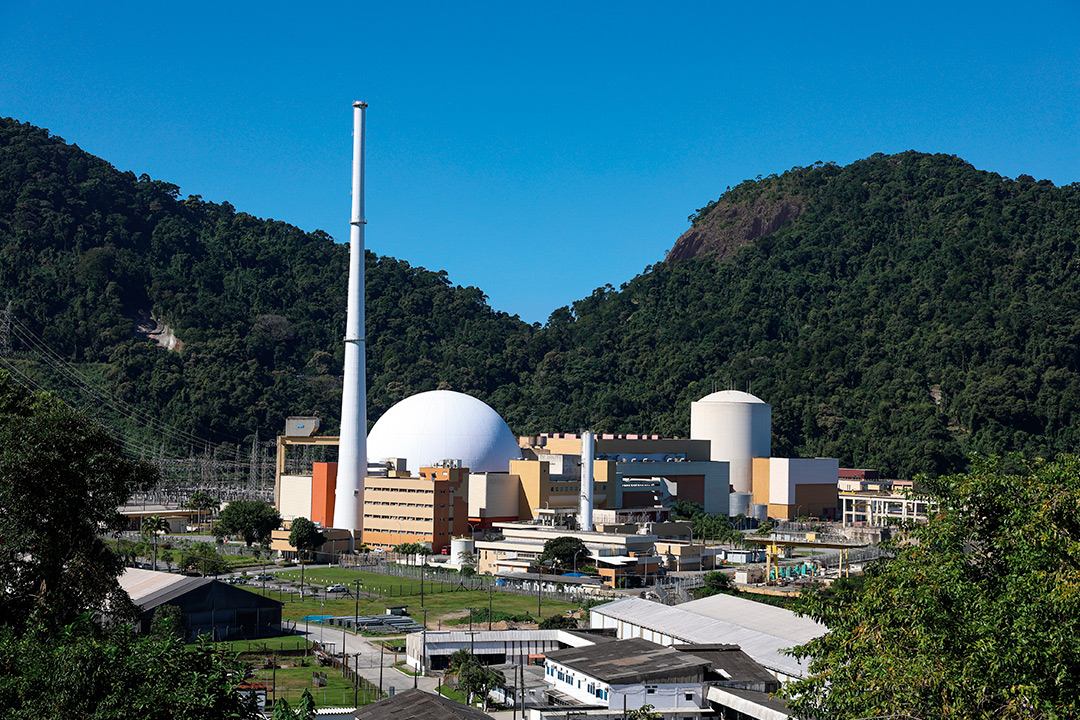
Nuclear energy
In 2023 and 2024, Brazil began to recognize nuclear energy as an important component of its energy transition strategy. It is a clean source of electricity generation, as it does not produce greenhouse gases.
The Ministry of Mines and Energy (MME) is conducting studies and actions to resume investments in the sector. One of the objectives is to strengthen Brazil’s nuclear energy chain, advancing the development of a policy that covers the entire cycle from uranium mining to electricity generation, while also considering the future application of small nuclear reactors. Brazil has the potential to become the third largest holder of uranium reserves in the world.
In addition to contributing to global decarbonization, expanding nuclear energy supply is strategic to meet the growing and accelerating energy demand associated with technological advances in Artificial Intelligence and data centers. Companies such as Microsoft, Google, Amazon, Oracle, and Nvidia are beginning to explore nuclear energy as a way to ensure clean, steady, and reliable power for their operations.
Brazil currently ranks eighth in the world in uranium reserves. With new technologies and comprehensive mapping of its territory, the expectation is to rise in this ranking. The potential of the reserves is considered comparable in importance to Petrobras or a new oil discovery in the pre-salt layer.
Exploration remains limited. The only mine in operation is in Caetité, Bahia. A project is under development for the Itataia deposit in Santa Quitéria, Ceará, in conjunction with phosphate fertilizer production, which will contribute to food production and strengthen food security for Brazilians. In addition, there are smaller deposits in Gandarela (Minas Gerais), Rio Cristalino (Pará), and Figueira (Paraná).
Uranium is classified as a strategic resource, and its production is a federal monopoly. Recent legislative changes have facilitated greater private sector participation.
Brazil is among the few countries in the world with the expertise and technology for all stages of the nuclear fuel cycle, from mining to manufacturing inputs for nuclear power plants. Prospecting for nuclear minerals advanced mainly during the 1970s and 1980s, but only a fraction of the national territory has been systematically explored. It is believed that the country may hold one of the largest uranium resources globally, as less than one-third of its territory has been surveyed.
The current overview of uranium resources is as follows:
Measured and indicated resources – 209,700 tU
Inferred resources – 172,600 tU
Potential resources – 300,000 tU
Speculative resources – 500,000 tU.
The MME seeks to integrate nuclear energy as a vital part of the national energy matrix. The Brazilian Nuclear Program is viewed as a strategic opportunity to enhance energy security and promote economic development, enabling job creation, foreign exchange generation, and technological innovation.
Regarding the Angra 1 plant, the MME authorized its operation for an additional 20 years, as announced on 11/21/2024, in compliance with a resolution by the National Nuclear Energy Commission (CNEN). Extending Angra 1’s useful life will require investments of R$ 3.2 billion over four years, which is more cost-effective than building a new plant.
As for Angra 3, negotiations are underway to resume construction, originally started in the 1980s but later suspended.
PROMISING INTERNATIONAL MARKET
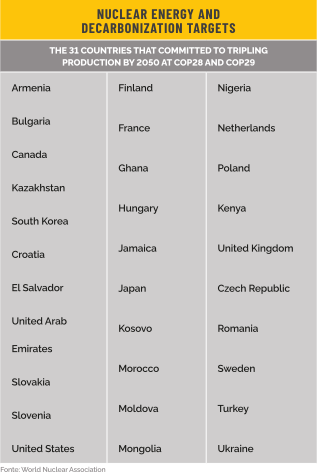
At COP28 (Dubai, 2023) and COP29 (Baku, 2024), 31 countries committed to tripling nuclear energy production by 2050 to meet decarbonization targets.
This global commitment opens significant opportunities for Brazil, one of the few nations with expertise across the entire nuclear fuel chain and substantial uranium reserves. Currently, more than 450 nuclear power plants are in operation worldwide, with an additional 60 under construction.
After enrichment, uranium becomes the main fuel used in these plants. Brazil could position itself as an exporter of nuclear fuel—a strategic, high-value-added product that could make a meaningful contribution to its trade balance.
The Federal Government promotes diversification of the national energy matrix. By expanding nuclear energy, Brazil strengthens its energy security, reduces costs for the population, attracts investments, generates jobs, and advances sustainable development.
The MME has initiated discussions with other countries and companies in the nuclear sector to establish partnerships, leverage international expertise, and attract investment in studies of Brazil’s mineral potential. Currently, only 26% of Brazil’s subsoil has been explored. The expectation is to finalize a cooperation agreement by the end of 2025.
Brazil is a member of the International Atomic Energy Agency (IAEA) and has long maintained training and cooperation initiatives under its framework.
SMALL MODULAR REACTORS (SMR)
The MME, with support from EPE, has identified promising prospects for the application of Small Modular Reactors (SMRs), with a capacity of 10 to 300 MW.
Among the advantages of using SMRs are:
Modularization reduces costs, facilitating investment attraction
Smaller size shortens construction timelines.
Can serve remote and isolated systems, such as in the Amazon.
Enable electricity-intensive industries to reduce transmission investments and overall costs.
Brazil already masters key stages of the production cycle, with robust industrial and regulatory capacity.
Compact size allows for factory mass production, with subsequent transport to the installation site, in compliance with licensing requirements.
Modularity offers greater operational flexibility compared to conventional nuclear plants.
NUMBERS
Brazil ranks 8th globally in uranium reserves
URANIUM PRODUCTION IN BRAZIL:
Caetité (Bahia) – 101,000 tons (estimated), with annual production capacity of 400–800 tons
Santa Quitéria (Ceará) – 142,500 tons (estimated), with annual production capacity of 2,300 tons
Angra Nuclear Power Plants (Total capacity: ~2 GW)
Angra 1 – 640 MW (in operation since 1985)
Angra 2 – 1,350 MW (in operation since 2001)
Angra 3 – Awaiting resumption of construction – 1,405 MW
DATES
- 11/21/2024 – MME announces authorization for Angra 1 to operate for 20 more years.
Published: November 12, 2025
Photo credit: Tomaz Silva (Agência Brasil)