Welcome to Museu do Forte
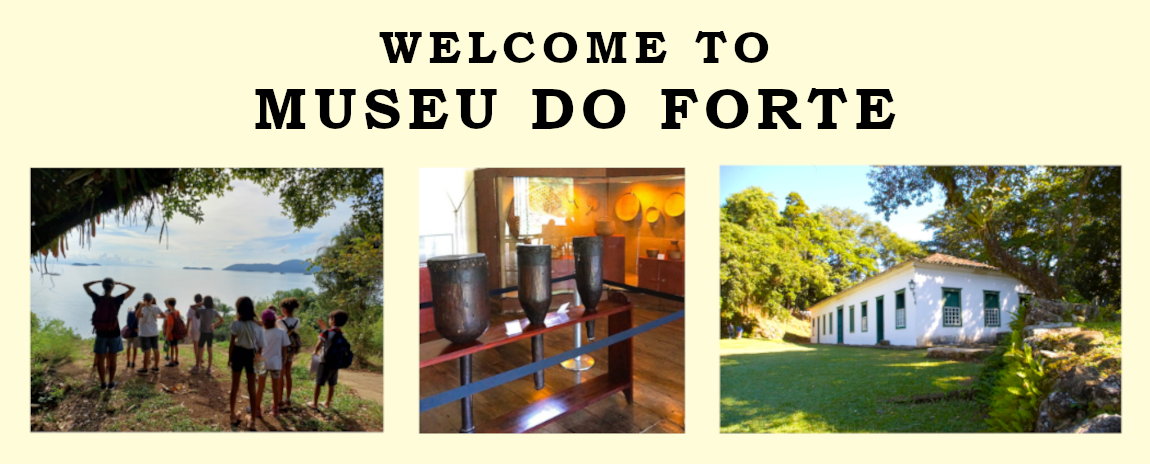
- Welcome to Museu do Forte!
We are a public museum oficially entitled Museu Forte Defensor Perpétuo, dedicated to the historical, cultural, and environmental heritage of the city of Paraty, managed by the Brazilian Institute of Museums (Ibram), an autonomous agency linked to the Ministry of Culture/Federal Government.
The access path is 450 meters long — a 7 to 12 minutes walk, moderately inclined.
Admission is free!
Opening Hours
Wednsdays to Fridays: 10am - 5pm
Saturdays, Sundays and Holidays: 10am - 2pm
Mondays and Tuesdays: closed for maintenance
The outdoor area is open everyday from 7am to 7pm.
Contact us: equipe.forte@museus.gov.br
Learn more about the museum and its History:
History of the Fort
The Forte Defensor Perpétuo Museum occupies one of the most important places of memory in Paraty. Its elevation by the sea holds the secrets of our first inhabitants in the sambaqui of the beach (circa 2.000 years b.p.) and of the first colonial occupations in the region in the 17th Century. After its brief period of military use, the site served various functions over the years: as an infirmary and quarantine facility during the smallpox epidemic of the early 20th century, as housing for large displaced families, as a temporary jail, and as a filming location following the city's discovery by Cinema Novo filmmakers in the 1960s.
There are still doubts about when the military building was edified. Founding dates like 1703 or 1793 are common in local literature, but they lack firm evidence. More accurate studies argue that Forte Defensor Perpétuo was only built in 1822, designed to head the defensive complex of Paraty over at least six other strategic positions. The designation paid homage to D. Pedro I, awarded the title of Defensor Perpétuo of Brazil. Despite the official name, the construction is not technically a fort, but a battery – a cannon position openat its collar.
The establishment of Forte Defensor Perpétuo in 1822 is historically related to the reinforcement of Brazilian defenses, in a scenario of political tensions that culminated with the emancipation of Brazil from Portugal in September 7th 1822. After the Declaration of Independence, the threat of a counter offensive by ships and troops still loyal to the Portuguese crown caused the new independent Empire to project a massive defensive increment all along the Brazilian shore.
The fort continued to be garrisoned due to the Cisplatine War against Províncias Unidas do Rio da Prata (currently Argentina) which lasted from 1825 to 1828. Although the next years saw the position lacking ammunition and personell, occasional episodes had the government sending troops and weapons – as occurred in the case of the diplomatic crisis with England in 1850 and in World War II.
In 1856, the fort was disarmed by the Empire and transferred to the Provincial Government of Rio de Janeiro. According to recent visitors, it was garrisoned with soldiers during World War II for a few months.
In 1957, Forte Defensor Perpétuo was declared part of historical heritage by Iphan (National Arts and History Heritage Institute) and now works as a museum under the administration of Ibram (Brazilian Institute of Museums).
Projects and Activities
Through its technical and educational team, the museum carries out a set of activities that compasses research and museum education projects and events such as temporary exhibitions, workshops and publications.
Partnerships with local public schools allow for scheduled visits by groups of students and also continuing education projects.
The exhibition Uma Breve História De Paraty weaves textual and iconographic narrative of the history of Paraty, developed by our technical department, based on documentary, archaeological and bibiographic sources. The narrative was adapted into a bilingual booklet, that you can access freely in PDF here.
As part of the museum’s collection in the Central Hall, a new set of the exhibition O Modo De Fazer, which shows records of artisanal manufacturing processes in Paraty in the 1980s, is on view.
The museum also hosts art and culture events and workshops from the traditional communities of Paraty, and carries our research projects in oral history, in the digitization of documentary, photographic and audiovisual collections and in other diverse fronts.
Collection
The Forte Defensor Perpétuo Museum collection is quite diverse, encompassing pieces related to the fort and its military uses, artifacts from the traditional culture and arts of popular communities and objects related to other historical contexts in Paraty.
The artillery on display in the museum’s exterior is mostly made up of 12-pounder cast iron cannons, forged in Great Britain during the second half of the 18th century. After the Napoleonic Wars (1799- 1815), the cannons were sold to Brazil to compose the artillery of several fortifications in the country. Only one cannon is outside this context, as it was probably made in the 17th century.
The collections Centro de Artes e Tradições Populares and O Modo de Fazer consist of pieces related to the uses, practices and knowledge of the traditional communities of Paraty — fishing, music, basketwork and miniature artifacts, and are part of the museum’s permanent exhibition in the Central Hall.
Part of our collection is available online through the Tainacan Platform.