About Ligem.Redes
General Objectives
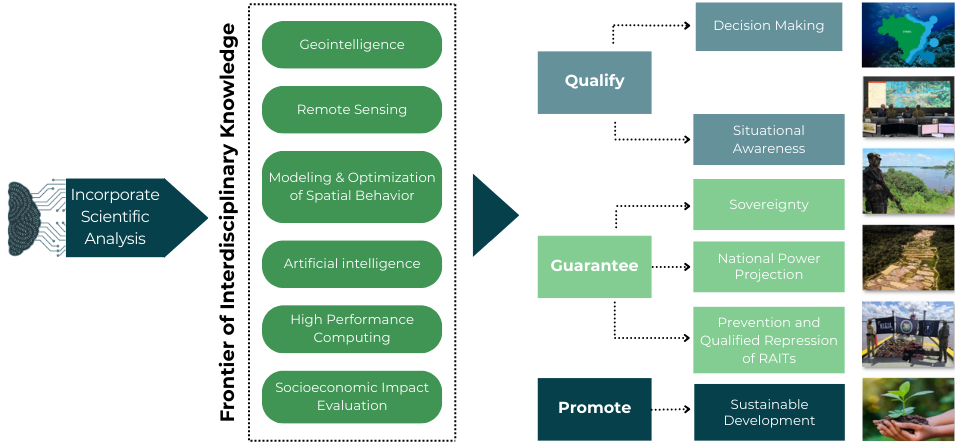
To create, structure, and develop applied research capacity with its own governance and innovative modus operandi, aiming at the qualification and incorporation of scientific analysis to support activities related to the proposal, planning, coordination, and execution of integrated actions to guarantee sovereignty, project national power, prevention, and qualified repression of transnational organized crime networks in the Brazilian Amazon and the Blue Amazon, as well as to assess the impacts of these networks and activities on the sustainable development of both regions.
Specific Objectives
Consolidate and reposition applied research within the Ministry of Defense at the scientific frontier in the areas of security, defense, and development (SDD), GEOINT, behavioral modeling and prediction, complex networks, AI, high-performance computing, socioeconomic impact assessment, econometric and statistical modeling, and forecasting related to transnational drug trafficking and environmental crimes.
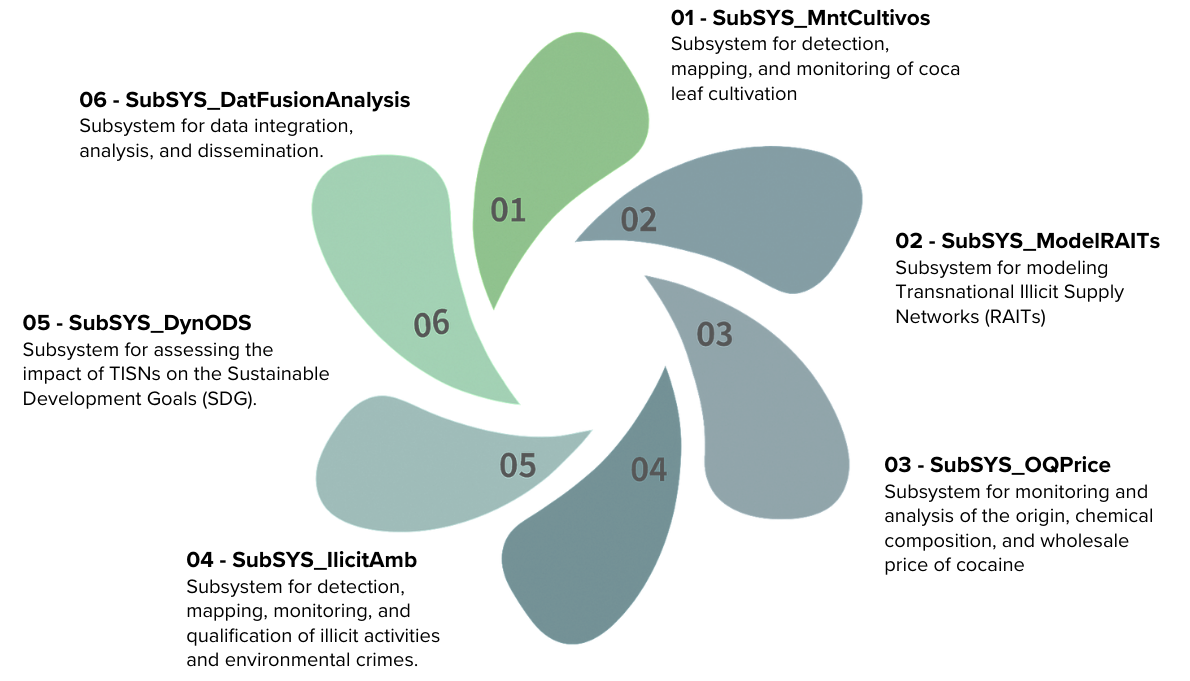
Develop SIDEM³RAIT: Integrated System for Detection, Mapping, Monitoring, Modeling, and Impact Assessment of Transnational Illicit Supply Networks in the Amazon.
LIGEM.Redes Deliverables
The Legal Amazon, the Border Strip, and the “Blue Amazon”
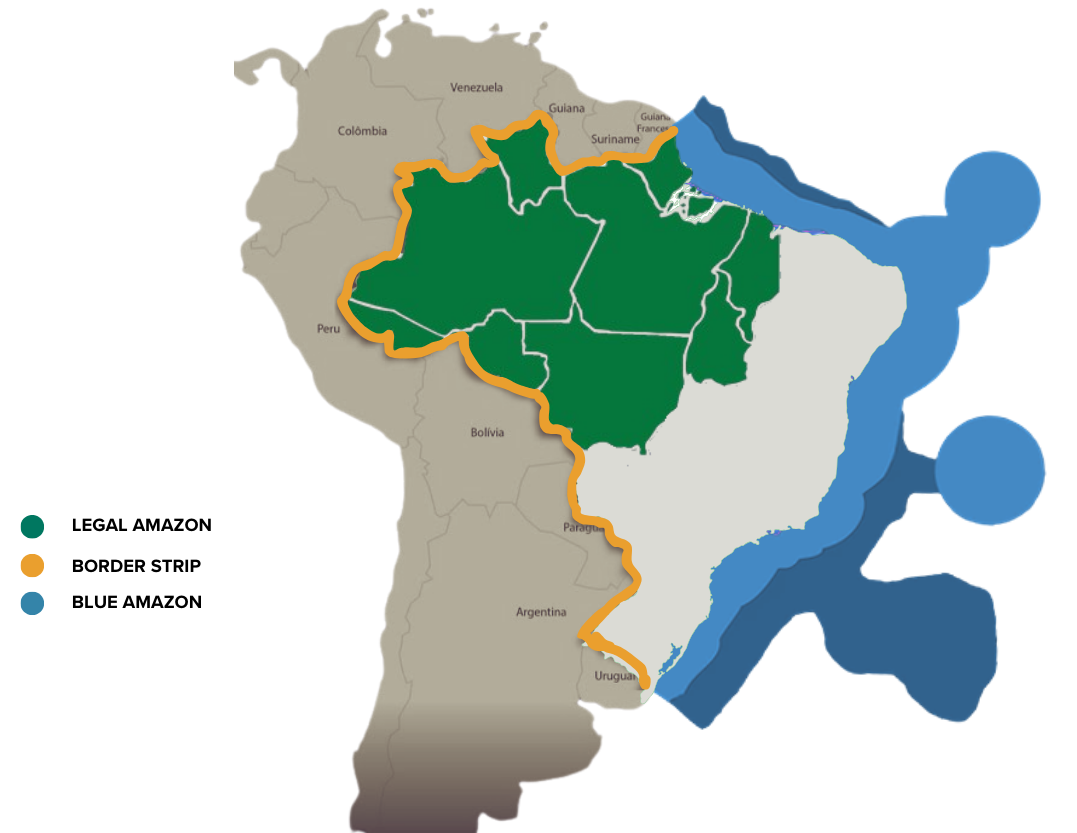
Brazil has an extensive land border of 16,886 km. Its border strip covers 1.4 million km², spread across the southern, central, and northern arcs (see map below). In the northern arc, this border strip connects with the Legal Amazon, which spans 5.2 million km² and is home to 30 million people living amid unparalleled biodiversity and difficult access. The Legal Amazon is a strategic region for Brazil’s sovereignty; however, it presents significant monitoring, surveillance, and protection challenges in the face of the threat posed by Transnational Illicit Supply Networks (RAITs).
These threats have intensified both due to the integration of coastal cities and the Blue Amazon into criminal structures, and due to the significant increase in the sophistication, adaptability, and resilience of these networks. Therefore, it is urgent to equip the Ministry of Defense and various federal and state agencies and institutions with scientific capability, prioritizing behavioral analysis and modeling of RAITs to support solutions and inform assessments related to confronting transnational organized crime and its impacts on sustainable development.
General Concept of LIGEM.Redes
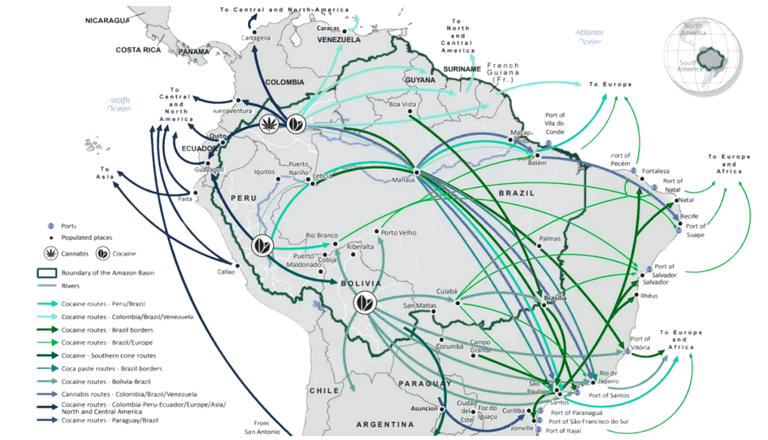
Main Drug Trafficking Routes in Brazil
Recently, there has been a major organizational shift in the modus operandi of these networks, which have begun to operate as sophisticated supply chains capable of adapting and, consequently, demonstrating high resilience to countermeasures (MAGLIOCCA et al., 2021). More specifically, transnational organized crime has become not only a priority public security issue but also a threat to Brazil’s national security—both internal and external (PIMENTEL, 2019).
Domestically, these networks contribute to increased homicide rates, fear, and prison system challenges wherever they operate. Politically, criminal factions (such as PCC and CV) influence electoral processes by attempting to recruit politicians and public servants (FERREIRA, 2019). Externally, the economic and military strength of these factions exposes neighboring countries to risks, and the continued growth of these groups may become a defense concern for Brazil and for the economic expression of its National Power (PIMENTEL, 2019).
Currently, Brazil’s centrality in the transnational drug trafficking landscape is undeniable, as highlighted in official State documents, speeches, and reports issued by government agencies or United Nations bodies (CDE, 2021; UNODC, 2023a).
Why Censipam?
Censipam was selected to host LIGEM.Redes because it:
- Has spent two decades developing scientific knowledge to support the articulation, planning, and coordination of actions in accordance with SIPAM guidelines.
- Utilizes data generated by a unique technological infrastructure composed of integrated subsystems of remote sensing, radars, meteorological stations, and data-collection platforms.
- Provides, through its analysts, qualified monitoring of the Legal Amazon and the Blue Amazon, producing methodologically grounded information in near real time.
- Became a Scientific, Technological, and Innovation Institution (ICT) under Ordinance No. 1,279, dated March 12, 2021.
