Ir para o Conteúdo 1 Ir para a Página Inicial 2 Ir para o menu de Navegação 3 Ir para a Busca 4 Ir para o Mapa do site 5
Abrir menu principal de navegação
Laboratório Nacional de Astrofísica - LNA
Termos mais buscados
  • imposto de renda
  • inss
  • assinatura
  • cnh social
  • enem
Termos mais buscados
  • imposto de renda
  • inss
  • assinatura
  • Acesso à Informação
    • Institucional
      • Laboratório Nacional de Astrofísica
      • Histórico
      • Regimento Interno
      • Estrutura Organizacional
      • Unidades Colegiadas
      • Quem é Quem
      • Termo de Compromisso de Gestão
      • Horário de Atendimento
      • Programa de Gestão e Desempenho
      • Núcleo de Inovação Tecnológica - NIT-LNA
      • Marca LNA
      • Escritório de Negócios
    • Agenda de Autoridades
      • Agenda do Diretor
    • Ações e Programas
      • Plano Diretor
      • Termo de Compromisso de Gestão
      • Programa Institucional de Auxílio à Iniciação Científica de Bolsa do LNA
      • Programa de Pesquisador Voluntário - PPV - do LNA
      • Fundo de Amparo ao Trabalhador - FAT
    • Participação Social
      • LNA Sustentável
    • Auditorias
    • Convênios e Transferências
    • Receitas e Despesas
    • Licitações e Contratos
      • 2020
      • 2021
      • 2022
      • 2023
      • 2024
      • 2025
    • Servidores
      • Termo de responsabilidade
    • Atendimento ao Cidadão
      • Denúncia
      • Solicitação
      • Sugestão
      • Elogio
    • Informações Classificadas
    • Perguntas Frequentes
    • Dados Abertos
    • Carta de Serviços LNA
    • Plano de Desenvolvimento de Pessoas
      • 2024
      • 2023
      • 2022
      • 2021
      • 2020
      • 2019
    • Programa de Gestão e Desempenho
    • Atos Normativos
    • Serviço de Informação ao Cidadão - SIC
    • Consulta Pública Abertura de Dados
    • Acesso ao Fala BR - Ouvidoria e LAI
    • LGPD - Privacidade e Proteção de Dados Pessoais
    • Fundações de Apoio
      • FUPAI
      • FUNDEP
  • Assuntos
    • Notícias
      • visitas-comunicado
      • Concurso público no âmbito do LNA
    • Eventos
      • imagens
      • I Jornada do PCI/LNA
      • Portas Abertas Perguntas Frequentes
      • BAWG 2025
      • SOAR Science 2025
      • South Pol Workshop
    • Oportunidades
      • Concurso Público
      • Bolsas PCI 01-2020
      • Oportunidades
      • Formação de Cadastro de Reserva para bolsas PCI do LNA - Chamada Pública No. 01/2022
      • Formação de Cadastro de Reserva para bolsas PCI do LNA - Chamada Pública No. 01/2023
      • Formação de Cadastro de Reserva para bolsas PCI do LNA - Chamada Pública No. 01/2024
      • bolsas-pci-2023
      • Formação de Cadastro de Reserva para bolsas PCI do LNA - Chamada Pública No. 02/2025
      • Bolsa de Pós-Doutorado da FAPEMIG no Laboratório Nacional de Astrofísica (LNA/MCTI) - Chamada Pública 01/2025
      • Seleção para bolsas de IC do LNA - 2025
      • Edital de abertura do processo de escolha de Diretor do LNA
      • Prorrogação do prazo para encaminhamento da documentação dos(as) interessados(as) à candidatura ao cargo de Diretor(a) do LNA
      • Homologação das inscrições no processo seletivo para o(a) novo(a) Diretor(a) do Laboratório Nacional de Astrofísica
      • Formação de Cadastro de Reserva para bolsas PCI do LNA - Chamada Pública No. 04/2025
      • Formação de Cadastro de Reserva para bolsas PCI do LNA - 2025
    • Tarde e Noite de Portas Abertas
  • Canais de Atendimento
    • Fale Conosco
  • Centrais de Conteúdo
    • Publicações (Biblioteca)
      • Artigos e Publicações
      • Legislação (Leis e decretos)
      • Livros
    • Vídeos
  • percepcao
    • Pesquisa de percepção
  • Composição
    • Diretoria
      • Assessoria
    • Coordenação de Administração - COADM
    • Coordenação de Astrofísica - COAST
    • Coordenação de Engenharia e Desenvolvimento de Projetos - COEDP
    • Coordenação do Observatório do Pico dos Dias - COOPD
      • Serviço de Manutenção e Apoio Operacionais - SEOPE
      • Serviço de Suporte Logístico do OPD - SELOG
  • soar-25b
  • Concurso Público do Laboratório Nacional de Astrofísica
  • GOV.BR
    • Serviços
      • Buscar serviços por
        • Categorias
        • Órgãos
        • Estados
      • Serviços por público alvo
        • Cidadãos
        • Empresas
        • Órgãos e Entidades Públicas
        • Demais segmentos (ONGs, organizações sociais, etc)
        • Servidor Público
    • Temas em Destaque
      • Orçamento Nacional
      • Redes de Atendimento do Governo Federal
      • Proteção de Dados Pessoais
      • Serviços para Imigrantes
      • Política e Orçamento Educacionais
      • Educação Profissional e Tecnológica
      • Educação Profissional para Jovens e Adultos
      • Trabalho e Emprego
      • Serviços para Pessoas com Deficiência
      • Combate à Discriminação Racial
      • Política de Proteção Social
      • Política para Mulheres
      • Saúde Reprodutiva da Mulher
      • Cuidados na Primeira Infância
      • Habitação Popular
      • Controle de Poluição e Resíduos Sólidos
    • Notícias
      • Serviços para o cidadão
      • Saúde
      • Agricultura e Pecuária
      • Cidadania e Assistência Social
      • Ciência e Tecnologia
      • Comunicação
      • Cultura e Esporte
      • Economia e Gestão Pública
      • Educação e Pesquisa
      • Energia
      • Forças Armadas e Defesa Civil
      • Infraestrutura
      • Justiça e Segurança
      • Meio Ambiente
      • Trabalho e Previdência
      • Turismo
    • Galeria de Aplicativos
    • Acompanhe o Planalto
    • Navegação
      • Acessibilidade
      • Mapa do Site
      • Termo de Uso e Aviso de Privacidade
    • Consultar minhas solicitações
    • Órgãos do Governo
    • Por dentro do Gov.br
      • Dúvidas Frequentes em relação ao Portal gov.br
      • Dúvidas Frequentes da conta gov.br
      • Ajuda para Navegar o Portal
      • Conheça os elementos do Portal
      • Política de e-participação
      • Termos de Uso
      • Governo Digital
      • Guia de Edição de Serviços do Portal Gov.br
    • Canais do Executivo Federal
    • Dados do Governo Federal
      • Dados Abertos
      • Painel Estatístico de Pessoal
      • Painel de Compras do Governo Federal
      • Acesso à Informação
    • Empresas e Negócios
Links Úteis
  • Galeria de Aplicativos
  • Participe
  • Galeria de Aplicativos
  • Participe
Redes sociais
  • Facebook
  • YouTube
  • Twitter
  • Instagram
Você está aqui: Página Inicial Assuntos Notícias Discovery of Two Planetary Systems Around Sun-like Stars
Info

Notícias

Laboratório Nacional de Astrofísica, December 15, 2023

Discovery of Two Planetary Systems Around Sun-like Stars

Compartilhe por Facebook Compartilhe por Twitter Compartilhe por LinkedIn Compartilhe por WhatsApp link para Copiar para área de transferência
Publicado em 15/12/2023 07h22 Atualizado em 15/12/2023 14h11

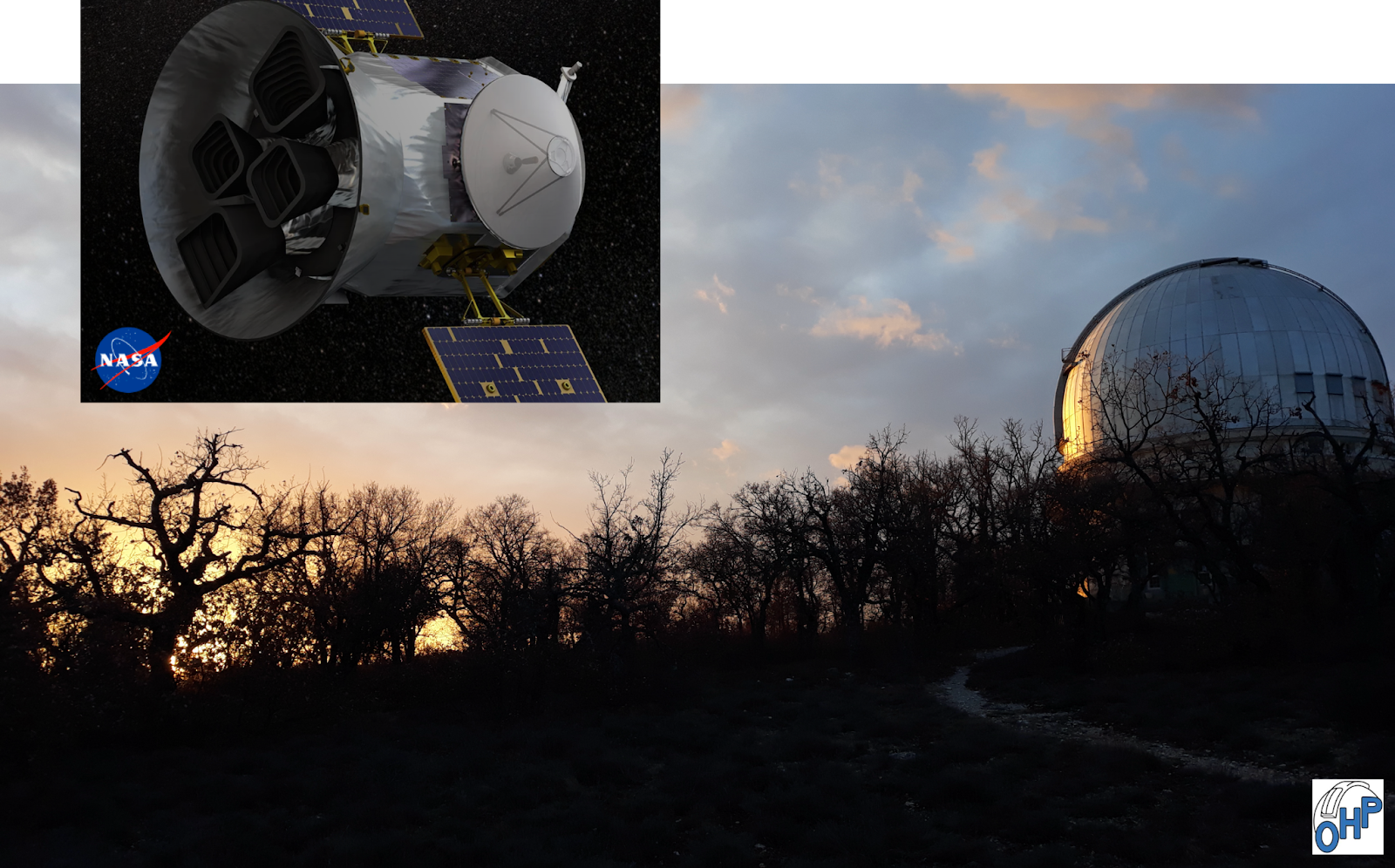
A study published today in the journal Astronomy & Astrophysics reveals the discovery of two new planetary systems orbiting stars similar to our Sun, also known as solar analogs. The study was led by Dr. Eder Martioli, a full researcher at the Laboratório Nacional de Astrofísica (LNA/MCTI) and an associate researcher at the Institut d'astrophysique de Paris (IAP), and by Dr. Guillaume Hébrard, a researcher at the Institut d'astrophysique de Paris (IAP). Observations responsible for detecting these two systems, named TOI-1736 and TOI-2141, were conducted using NASA's TESS space telescope and the SOPHIE spectrograph installed on the 1.93 m telescope at the Observatoire de Haute-Provence (OHP) in southern France, both illustrated in Figure 1. Planetary systems like these not only expand our understanding of the formation and evolution of planets around Sun-like stars but also enable more precise measurements of the physical properties of these planets by leveraging the similarity between the host star and our Sun.
French version


Figure 1: The small panel on the top left shows an illustration of NASA's TESS space telescope, responsible for the first identification of the exoplanets TOI-2141b and TOI-1736b. The background image is a photo of the OHP observatory with the dome of the 1.93 m telescope, where the SOPHIE instrument is installed, responsible for the detection and characterization of the exoplanets TOI-2141b, TOI-1736b, and TOI-1736c. Image credit: Eder Martioli.


Exoplanets

The discovery of the first exoplanet around a sun-like star, 51 Pegasi b, in 1995, made using the same 1.93 m telescope at OHP and resulting in the Nobel Prize in Physics for astronomers Michel Mayor and Didier Queloz, marked the beginning of a revolution in our understanding of planetary systems in the Universe. Today, more than 5,500 exoplanets are known, and this count grows daily. The discovery of these objects offers an opportunity to study the occurrence of planets around stars and the variety of physical characteristics found in different systems. One of the lessons learned since the discovery of the first exoplanet is that the Solar System is not unique and does not encompass all possible types of planets. For instance, the planet 51 Pegasi b is Jupiter-sized but orbits much closer to its star than any other planet in the Solar System, hence termed a 'hot Jupiter.' Other common types of planets in exoplanetary systems include super-Earths and mini-Neptunes, both absent in our Solar System. Another significant discovery is that a variety of stellar types, whether larger or smaller, hotter or cooler, do not prevent the formation of planets. However, the stellar type can influence the frequency of certain planet types. The work by Dr. Eder Martioli's team focused on studying two stars very similar to the Sun, each hosting a mini-Neptune and one of them also hosting a super-Jupiter. Neither type of these planets has a counterpart in the Solar System. This allowed for a deeper understanding of the presence of planets with distinct characteristics and how these bodies evolve in an environment similar to our  Sun.


The planetary system TOI-2141

The first system in this discovery, TOI-2141, consists of a star located 250 light-years away, with a size nearly identical and a slightly more advanced age than our Sun. Its chemical composition also reveals a scarcity of heavier elements compared to the Sun. The quantity of these heavier elements is an important factor in the planetary formation process.

The planet TOI-2141b was detected using the transit method, where the planet passes in front of the star, causing small periodic eclipses enabling its detection by monitoring variations in the star's brightness. This planet has a diameter three times larger than Earth and a mass approximately 24 times that of Earth, classified as a mini-Neptune. It completes an orbit around the star every 18.26 days, maintaining a distance of only 13% of the distance between Earth and the Sun. Due to its proximity to the star, it's estimated the planet has a temperature of about 450 degrees Celsius. Its density suggests the presence of a rocky core and an atmosphere with a large amount of water, albeit solely in gaseous form due to the high temperatures. No other planets have been identified in this system, but the possibility of finding smaller planets cannot be ruled out due to the limitations of observation methods.


The planetary system TOI-1736

The second system of this discovery, TOI-1736, has revealed itself to be somewhat exotic. The main star is located at a distance of 290 light-years and is very similar to the Sun, especially in terms of temperature and age, being only about 15% larger than the Sun and having a slightly higher concentration of heavier chemical elements. In this study, it was discovered that the TOI-1736 system has a companion star, smaller and cooler, thereby characterizing it as a binary star system. Nevertheless, the cooler star is sufficiently distant to avoid interference with the planetary system, which orbits exclusively around the primary sun-like star. At least two planets were detected in this system, as illustrated in Figure 2.
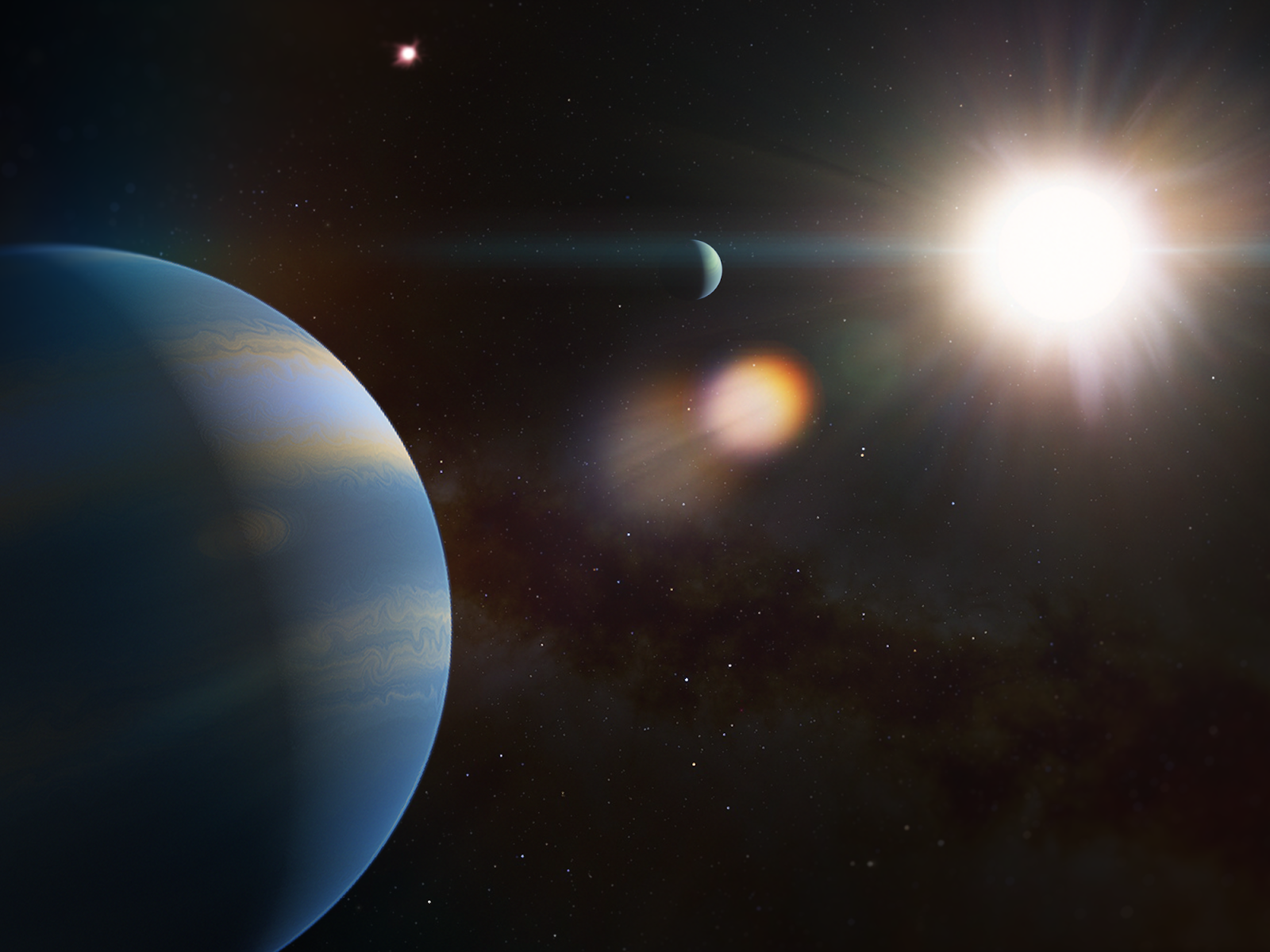
 

Figure 2: Artistic representation of the TOI-1736 planetary system, with out-of-scale depictions of the planets TOI-1736c (on the left) and TOI-1736b (in the center). Image credit: Leandro de Almeida.


The first, TOI-1736b, is also a mini-Neptune, with a diameter 2.5 times larger than Earth and a mass 13 times greater than Earth's. It exhibits transits and orbits at a distance from the star equivalent to only 7% of the distance between Earth and the Sun, completing an orbit every 7.1 days. Due to this proximity, the planet receives significantly more radiation from the star, resulting in an estimated temperature of 800 degrees Celsius.

The second planet, TOI-1736c, does not show transits, and it has a mass 2800 times greater than that of Earth, nearly 9 times larger than Jupiter - the largest planet in the solar system. With this size, TOI-1736c is classified as a super-Jupiter and narrowly missed becoming a star. It completes an orbit every 570 days. Located just 30% farther away than Earth is from the Sun, this planet is situated in the so-called habitable zone of the star TOI-1736. This zone is defined as the region around the star with a suitable temperature to allow for the existence of liquid water on the planet's surface. TOI-1736c is likely a gas giant, similar to Jupiter, so it is not expected to have a solid surface like Earth's. However, if by chance the planet TOI-1736c hosts a moon, such a solid body might have an atmosphere, potentially enabling the presence of liquid water and, perhaps, being an habitable world.

Observations of TOI-1736 revealed indications of a possible third planet orbiting at a greater distance, requiring long-term monitoring for confirmation. Therefore, the team continues to observe TOI-1736 with the SOPHIE spectrograph at the OHP, hoping to soon gather more information about this star, so similar to the Sun but hosting such a diverse planetary system.


Research Group

This research was conducted by an international collaboration led by researchers Dr. Eder Martioli from LNA & IAP and Dr. Guillaume Hébrard from IAP, along with their direct collaborators, Dr. Leandro de Almeida and Dr. Diego Lorenzo de Oliveira, both from LNA, and Dr. Neda Heidari from IAP. The team comprises members from various institutions in France involved in OHP's instrumental projects and in the US linked to the TESS space mission. Additionally, there were contributors who provided supplementary observations from the Gemini, SOAR, LCOGT, FLWO observatories, and Gaia. Further details about this work can be found in the scientific article linked below. Other links and references for all facilities used in this work are available at the end of this article.

The research of Dr. Eder Martioli is supported by the Minas Gerais Research Support Foundation (FAPEMIG) under project number APQ-02493-22 and by the National Council for Scientific and Technological Development (CNPq), research productivity grant number 309829/2022-4.


Contacts:

Eder Martioli
emartioli@lna.br 
Research scientist at Laboratório Nacional de Astrofísica (LNA/MCTI) and associate scientist at Institut d'astrophysique de Paris (IAP).


Guillaume Hébrard
hebrard@iap.fr 
Research scientist at Institut d'astrophysique de Paris (IAP) & Observatoire de Haute-Provence (OHP)


Links: 

Scientific article: https://www.aanda.org/10.1051/0004-6361/202347744

Laboratório Nacional de Astrofísica (LNA): https://www.gov.br/lna/pt-br/ 
Institut d'astrophysique de Paris (IAP): https://www.iap.fr/ 
NASA's Transiting Exoplanet Survey Satellite (TESS): https://science.nasa.gov/mission/tess/ 
Observatoire de Haute-Provence (OHP): https://www.obs-hp.fr/ 
Gemini Observatory : https://www.gemini.edu/
Southern Astrophysical Research (SOAR) Telescope: https://noirlab.edu/public/programs/ctio/soar-telescope/ 
Las Cumbres Observatory Global Telescope (LCOGT):  https://lco.global/ 
Fred Lawrence Whipple Observatory (FLWO): https://www.cfa.harvard.edu/facilities-technology/cfa-facilities/fred-lawrence-whipple-observatory-mt-hopkins-az
ESA's Gaia satellite: https://sci.esa.int/web/gaia 


Ciência e Tecnologia
Tags: NotíciasMinas Gerais
Compartilhe por Facebook Compartilhe por Twitter Compartilhe por LinkedIn Compartilhe por WhatsApp link para Copiar para área de transferência
  • Acesso à Informação
    • Institucional
      • Laboratório Nacional de Astrofísica
      • Histórico
      • Regimento Interno
      • Estrutura Organizacional
      • Unidades Colegiadas
      • Quem é Quem
      • Termo de Compromisso de Gestão
      • Horário de Atendimento
      • Programa de Gestão e Desempenho
      • Núcleo de Inovação Tecnológica - NIT-LNA
      • Marca LNA
      • Escritório de Negócios
    • Agenda de Autoridades
      • Agenda do Diretor
    • Ações e Programas
      • Plano Diretor
      • Termo de Compromisso de Gestão
      • Programa Institucional de Auxílio à Iniciação Científica de Bolsa do LNA
      • Programa de Pesquisador Voluntário - PPV - do LNA
      • Fundo de Amparo ao Trabalhador - FAT
    • Participação Social
      • LNA Sustentável
    • Auditorias
    • Convênios e Transferências
    • Receitas e Despesas
    • Licitações e Contratos
      • 2020
      • 2021
      • 2022
      • 2023
      • 2024
      • 2025
    • Servidores
      • Termo de responsabilidade
    • Atendimento ao Cidadão
      • Denúncia
      • Solicitação
      • Sugestão
      • Elogio
    • Informações Classificadas
    • Perguntas Frequentes
    • Dados Abertos
    • Carta de Serviços LNA
    • Plano de Desenvolvimento de Pessoas
      • 2024
      • 2023
      • 2022
      • 2021
      • 2020
      • 2019
    • Programa de Gestão e Desempenho
    • Atos Normativos
    • Serviço de Informação ao Cidadão - SIC
    • Consulta Pública Abertura de Dados
    • Acesso ao Fala BR - Ouvidoria e LAI
    • LGPD - Privacidade e Proteção de Dados Pessoais
    • Fundações de Apoio
      • FUPAI
      • FUNDEP
  • Assuntos
    • Notícias
      • visitas-comunicado
      • Concurso público no âmbito do LNA
    • Eventos
      • imagens
      • I Jornada do PCI/LNA
      • Portas Abertas Perguntas Frequentes
      • BAWG 2025
      • SOAR Science 2025
      • South Pol Workshop
    • Oportunidades
      • Concurso Público
      • Bolsas PCI 01-2020
      • Oportunidades
      • Formação de Cadastro de Reserva para bolsas PCI do LNA - Chamada Pública No. 01/2022
      • Formação de Cadastro de Reserva para bolsas PCI do LNA - Chamada Pública No. 01/2023
      • Formação de Cadastro de Reserva para bolsas PCI do LNA - Chamada Pública No. 01/2024
      • bolsas-pci-2023
      • Formação de Cadastro de Reserva para bolsas PCI do LNA - Chamada Pública No. 02/2025
      • Bolsa de Pós-Doutorado da FAPEMIG no Laboratório Nacional de Astrofísica (LNA/MCTI) - Chamada Pública 01/2025
      • Seleção para bolsas de IC do LNA - 2025
      • Edital de abertura do processo de escolha de Diretor do LNA
      • Prorrogação do prazo para encaminhamento da documentação dos(as) interessados(as) à candidatura ao cargo de Diretor(a) do LNA
      • Homologação das inscrições no processo seletivo para o(a) novo(a) Diretor(a) do Laboratório Nacional de Astrofísica
      • Formação de Cadastro de Reserva para bolsas PCI do LNA - Chamada Pública No. 04/2025
      • Formação de Cadastro de Reserva para bolsas PCI do LNA - 2025
    • Tarde e Noite de Portas Abertas
  • Canais de Atendimento
    • Fale Conosco
  • Centrais de Conteúdo
    • Publicações (Biblioteca)
      • Artigos e Publicações
      • Legislação (Leis e decretos)
      • Livros
    • Vídeos
  • percepcao
    • Pesquisa de percepção
  • Composição
    • Diretoria
      • Assessoria
    • Coordenação de Administração - COADM
    • Coordenação de Astrofísica - COAST
    • Coordenação de Engenharia e Desenvolvimento de Projetos - COEDP
    • Coordenação do Observatório do Pico dos Dias - COOPD
      • Serviço de Manutenção e Apoio Operacionais - SEOPE
      • Serviço de Suporte Logístico do OPD - SELOG
  • soar-25b
  • Concurso Público do Laboratório Nacional de Astrofísica
Redefinir Cookies
Redes sociais
  • Facebook
  • YouTube
  • Twitter
  • Instagram
Acesso àInformação
Todo o conteúdo deste site está publicado sob a licença Creative Commons Atribuição-SemDerivações 3.0 Não Adaptada.
Voltar ao topo da página
Fale Agora Refazer a busca