Notícias
IAEA workshop in Brazil brings member states together to discuss SMRs
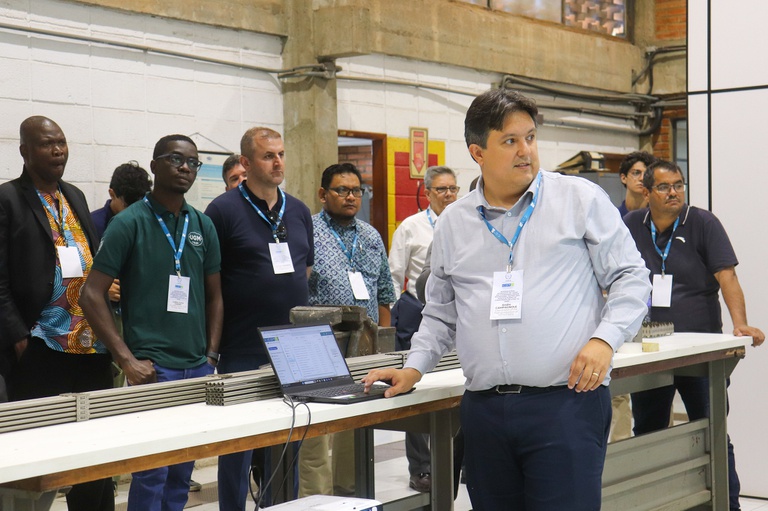
Workshop participants during the technical visit to CDTN (Photo: Alice Queiróz/CDTN)
Belo Horizonte, Brazil – Small Modular Reactors (SMRs) are advanced nuclear reactors designed to generate up to 300 megawatts of electricity, enough to supply a small to medium-sized city. A key feature of these systems is their modular design, which allows for factory fabrication, transportation and on-site installation, significantly reducing construction time and costs.
Growing global interest in SMRs reflects increasing demand for safer, more reliable and sustainable energy systems, particularly in the context of climate change and rising electricity consumption. For the safe deployment and development of SMRs, establishing a broad and sustainable supply chain for components is essential, with a focus on reducing implementation costs and enabling economies of scale.
With this objective, the International Atomic Energy Agency (IAEA) organized the Interregional Workshop on Codes and Standards, Design Engineering, Testing and Manufacturing of Components Related to SMRs, held in Brazil from 11 to 15 May 2026.
The workshop programme was led by IAEA experts Christina Fischer and Benoît Lepouzé, with contributions from experts José Bastos and John Moore. Over the course of the week, participants addressed legal frameworks as well as key topics such as safety, workforce development, supply chains, fuel cycle considerations, radioactive waste management and engineering.
The event brought together around 30 participants from nuclear and energy institutions across 10 countries and was hosted by the Nuclear Technology Development Centre (CDTN). The Centre is a unit of Brazil’s National Nuclear Energy Commission (CNEN), a federal agency under the Ministry of Science, Technology and Innovation.
Brazil was represented by professionals from units of the Brazilian National Nuclear Energy Commission (CNEN), as well as from the Ministry of Mines and Energy and the Ministry of Defence. International participants included representatives from Azerbaijan, Malaysia, Myanmar and Sri Lanka, as well as from Ghana, Niger, Kenya, Tunisia and Zambia.
“We had the privilege of hosting this initiative aimed at supporting countries in adopting SMRs. It was very valuable to exchange such diverse experiences and take part in these discussions. IAEA experts presented ongoing efforts to harmonize processes worldwide, enabling countries to speak the same technical language, which is essential for an industry that relies on economies of scale—meaning multiple reactors being produced and a more robust supply chain,” said Andre Campagnole, a researcher at CDTN and the local host.
Photos from the workshop are available at the following link: https://flic.kr/s/aHBqjCUej4.
Communication Office
Nuclear Technology Development Centre (CDTN/CNEN)
comunicacao@cdtn.br