STELES Science Verification Call 2026V / Chamada de Verificação de Ciência 2026V
STELES Science Verification: Call for Proposals
Deadline for applications: August 12, 2026 at 11:59 PM (BRT) / 10:59 PM (CLT) / 7:59 PM (MST)
The SOAR Telescope Echelle Spectrograph (STELES) team invites the community to submit proposals for the Science Verification (SV) phase of the instrument. This SV campaign represents an opportunity for the astronomical community to conduct scientific observations with STELES before regular operations begin, enabling early scientific exploitation of the instrument while helping to refine its operational procedures, calibration strategies, and data-reduction tools.
STELES is the new high-resolution optical spectrograph installed at the 4.1-m SOAR Telescope. The instrument offers a unique combination of broad simultaneous wavelength coverage, high spectral resolution, and high throughput in the near-ultraviolet, enabling a wide range of astrophysics investigations.
STELES will be offered in shared-risk mode and the primary goals of the SV campaign are:
- To demonstrate the scientific capabilities of STELES;
- To validate observing procedures and operational modes;
- To evaluate and improve the STELES data reduction pipeline;
- To collect feedback from early users on instrument performance, observing procedures, calibration strategies, and data products before regular scientific operations.
Successful teams will be expected to produce science results promptly, on time scales of a few months at most, and to provide feedback on instrument performance, observing procedures, and data products as part of the SV campaign.
Data obtained during the SV campaign will have a 3-month proprietary period following their release to the PIs, after which they will become publicly available.
STELES Capabilities
STELES is a high-resolution, near-ultraviolet/optical spectrograph permanently mounted at the SOAR Telescope. The instrument is a Nasmyth-fed, dual-channel (blue/red), VPH cross-dispersed echelle spectrograph operating in a quasi-Littrow white-pupil configuration.
The spectrograph provides simultaneous wavelength coverage from approximately 3100 to 9600 Angstrom and is optimized for high throughput, particularly at near-ultraviolet wavelengths.
Table 1. Main instrument characteristics
|
Parameter |
Value |
|
Spectrograph type |
Slit-fed white-pupil echelle |
|
Spectral coverage |
3100 - 9600 Angstrom |
|
Echelle grating |
R4, 41.671 lines/mm |
|
Cross-dispersers |
VPH gratings |
|
Slit height |
8.0 arcsec |
|
Available slit widths (*) |
0.6, 0.8, 1.0, 1.2, 1.5, 1.7, 2.0, and 3.0 arcsec |
|
Number of channels |
Two (blue and red) |
|
Detectors |
Two 4k × 2k CCDs |
|
Optical bench |
Bench-mounted, environmentally controlled |
(*) For the SV campaign, only the default 0.8 arcsec slit is available.
Table 2. Main characteristics of each spectral channel
|
Parameter |
Blue Channel |
Red Channel |
|
Spectral orders |
66 |
48 |
|
Average resolving power (**) |
R ~ 50,000 |
R ~ 45,000 |
|
Wavelength range (A) |
3,100 - 5,400 |
5,000 - 9,600 |
|
Gain (e-/ADU) |
2.24 |
2.21 |
|
Read noise (e-) |
5.82 |
6.94 |
|
Dark current (e-/hr/pix) |
3.26 |
5.01 |
|
Saturation limit (ADU) |
65,434 |
65,434 |
|
Full well (e-) |
140,000 |
138,600 |
(**) the reported resolving power corresponds to the 0.8 arcsec slit, which is the only configuration available for the SV campaign.
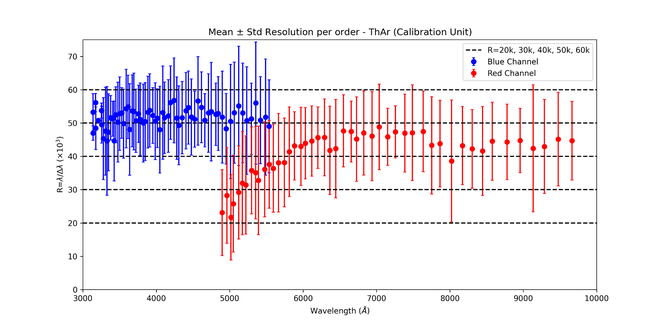
Figure 1. Average resolving power per order as a function of wavelength for the blue and red channels, measured using the 0.8 arcsec slit. Error bars indicate the range of values within each spectral order.
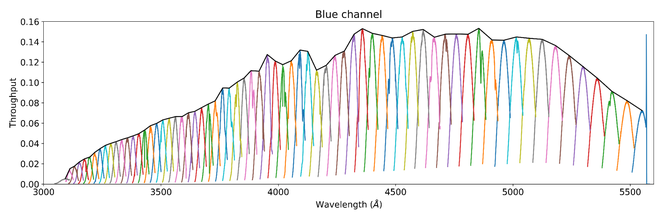
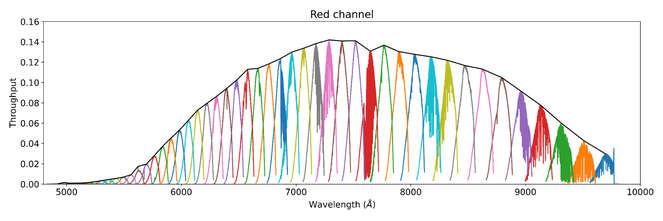
Figure 2. Measured total throughput (atmosphere + telescope + instrument + detector) for the blue (top) and red channels (bottom) based on observations of HR1996 (O9.5V; V=5.18 mag), using the 3.0 arcsec slit, from January 29 2026. Individual spectral orders are shown in different colors, and the black curves trace the peak efficiency across orders.
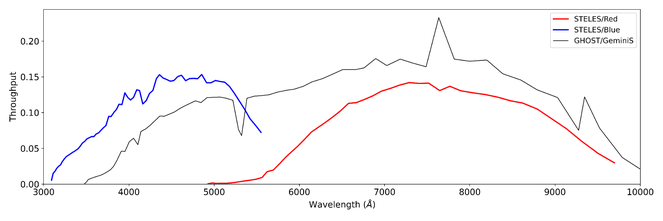
Figure 3. Comparison of peak total throughput (atmosphere + telescope + instrument + detector) between SOAR/STELES (blue and red channels) and Gemini/GHOST as a function of wavelength.
Scientific Scope
The SV campaign is primarily focused on stellar astrophysics and science cases that benefit from the unique capabilities of STELES.
Science cases of particular interest include:
- Near-ultraviolet abundance diagnostics;
- Galactic archaeology and chemical evolution;
- Lithium and beryllium abundance studies;
- Emission-line sources;
- Cataclysmic variables;
- Time-domain spectroscopy;
- Stellar variability and transient phenomena;
- Other science cases that require high-resolution optical spectroscopy with broad wavelength coverage.
The review committee goal will be to select focused scientific programs that showcase the features and capabilities of STELES, and offer results on a short timescale of a few months. Long term and large programs requiring significant observing time and requiring long lead times for publishing will not be considered in this call.
Available Observing Time
A total of 11 nights (approx. 100 hours) are available for the SV campaign:
- 2026 September 8 to 11 (4 nights)
- 2026 October 7 to 10 (4 nights)
- 2026 December 4 to 6 (3 nights)
These runs are scheduled during dark and grey nights.
Observations will be conducted in queue mode and executed by the STELES/SOAR team.
Target Visibility Constraints
-
Targets must be observable from SOAR during at least one of the scheduled SV runs. The available observing windows during the SV campaign are approximately:
|
Observing Run |
Preferred Right Ascension Range |
|
2026 September 8-11 |
15h < RA < 6h, Dec < +30 deg |
|
2026 October 7-10 |
20h < RA < 9h, Dec < +30 deg |
|
2026 December 4-6 |
0h < RA < 12h, Dec < +30 deg |
- Limited visibility: 12h < RA < 15h. Targets within this RA range may be difficult to schedule.
- Targets near the visibility limits of a given SV run may still be considered. However, applicants should be aware that such observations may need to be executed at larger hour angles and airmasses higher than optimal, potentially resulting in lower signal-to-noise ratios (SNR), increased atmospheric effects, or reduced observing efficiency. These factors should be taken into account when preparing exposure time estimates and defining the scientific requirements of the program.
- Applicants are encouraged to select targets that can be observed at airmasses < 1.5 whenever possible, particularly for programs requiring high SNR or observations at near-ultraviolet wavelengths.
- Targets that are only accessible at higher airmasses may still be proposed, provided that the scientific justification and exposure time estimates appropriately account for the expected atmospheric effects and reduced throughput.
- STELES currently operates without an image derotator. As a consequence, the orientation of the slit changes with time during an observation and observations at a specific (e.g., parallactic) angle are not possible. Science programs should be designed for single-object spectroscopy, and observations requiring fixed slit position angles, spatially resolved spectroscopy of extended targets, or simultaneous observations of multiple targets within the slit are not supported during the SV campaign.
- Atmospheric differential refraction may therefore affect observations, particularly at short wavelengths and high airmass. The SOAR Atmospheric Dispersion Corrector (ADC) may be used to mitigate these effects. However, the performance of the ADC has not yet been fully characterized with STELES, and its impact on throughput and data quality across the full wavelength range remains under evaluation as part of the SV campaign. Applicants should indicate in the proposal submission form whether ADC correction is requested for their observations. Programs with stringent requirements on spectrophotometric accuracy or near-ultraviolet throughput are encouraged to discuss their observing strategy with the STELES team prior to proposal submission.
Important Dates
Start of the SV call: July 13th
Submission deadline: Aug 12th
Notification of accepted proposals: September 1st
First SV run: 2026 September 8-11
Last SV run: 2026 December 4-6
Data delivery: typically within 1-3 weeks after each observing run.
Proposal Preparation and Submission
Proposals must be submitted using the dedicated SV proposal form available at:
A user guide describing how to create an account (pages 4-6), fill the online proposal submission form (pages 7-14), including the target list upload procedure (pages 19-20) is available:
- SOAR Proposal Submission Guide (versão em português)
- SOAR Proposal Submission Guide (English version)
To prepare the PDF file with the Scientific and Technical Justification requested in the form, LaTeX template and the corresponding style file or the .doc template file are available for download using the links below:
- Download STELES SV Scientific and Technical Justification LaTeX template (.tex)
- Download STELES SV Scientific and Technical Justification template LaTeX style file (.sty)
- Download STELES SV Scientific and Technical Justification DOC template file (.doc)
The Scientific and Technical Justification consists of the sections listed below. Unless otherwise noted, page limits refer to the main proposal section and do not include references, target lists, or visibility plots.
-
Scientific justification (limit: one page);
-
Technical justification (limit: one page);
-
Observing Time Request (limit: one page);
-
Figures and Tables (limit: two pages);
-
Visibility information (limit: one page);
-
References (no limit);
-
Team information (no limit);
In addition, proposers must submit a target list through the online proposal form.
Detailed instructions for preparing each section of the Scientific and Technical Justification are provided in the Guide for Preparing the Scientific and Technical Justification for STELES Science Verification Proposals, available at:
Preparation of the Scientific and Technical Justification (PDF File)
Applicants are strongly encouraged to read this guide before preparing their proposal. The guide provides detailed recommendations on the expected content of each section, proposal formatting and limits for the online submission system.
Important information
-
Projects requesting more than 15 hours of observing time will generally not be considered unless exceptional scientific justification is provided.
-
Targets brighter than approximately V ≈ 15-16 mag are strongly encouraged to maximize the scientific return and completion rate of the SV campaign.
-
Targets fainter than V = 18 mag will be not considered for this call.
-
Applicants are strongly encouraged to provide one or more backup targets whenever possible. Suitable backup targets may include brighter objects, targets accessible at different hour angles or sky positions, or science cases that can be executed under less favorable observing conditions. The inclusion of backup targets may improve scheduling flexibility and increase the probability of program completion.
-
Target coordinates should be accurate to sub-arcseconds (e.g., 18:32:34.3 -64:12:23.1) to ensure efficient acquisition.
Proposal Evaluation
Proposals will be reviewed by an ad hoc committee composed of members of the STELES team and external scientists. Proposals will be ranked by the review committee and executed according to scientific priority and target visibility. Proposals will be evaluated according to:
- Scientific merit;
- Technical feasibility;
- Efficient use of the available observing time;
- Ability to demonstrate or validate STELES capabilities;
- Expected impact of the resulting scientific data;
- Balance among the scientific objectives of the SV campaign.
Particular emphasis will be placed on programs that take advantage of the near-ultraviolet sensitivity (between 3100-3800 Angstrom), broad wavelength coverage, and the high spectral resolution of STELES. Proposers should clearly identify in the Technical Justification which specific capabilities of STELES their program will help validate or demonstrate. Examples include, but are not limited to, radial velocity stability, achievable signal-to-noise ratios for bright targets, sensitivity limits for relatively faint objects, near-ultraviolet/near-infrared performance, wavelength coverage, or other aspects of instrument performance relevant to the proposed science.
If multiple proposals request observations of the same targets, the proposers may be contacted to explore opportunities for coordination. Whenever scientifically appropriate, the review committee will make efforts to avoid duplicate observations by encouraging proposing teams to share the resulting data.
Observing strategy, time requests and calibration plan
Observing Strategy
All SV observations will be conducted in queue mode by the STELES team. Proposers should provide a prioritized target list, observing constraints, and exposure time estimates as part of their submission.
The default observing mode for the SV campaign uses the 0.8 arcsec slit, providing average resolving power of R ~ 50,000 over the simultaneous spectral coverage from 3100 to 9600 Angstrom.
Observing Time Requests
All proposals must clearly distinguish between:
- Total science exposure time;
- Total requested observing time, including all operational and calibration overheads.
Requested observing time should include telescope acquisition, detector readout, and the standard ThAr calibration exposures for each target of the scientific program.
Calibration Plan
A standard set of afternoon calibrations will be acquired during each observing night and made available to all approved programs. These calibrations include:
- Focus sequences for both spectrograph channels using the ThAr lamp;
- ISB Quartz 20 W lamp exposures for flat-fielding and blaze function characterization (5x to 11x exposures per channel);
- ThAr lamp exposures for wavelength calibration and construction of the master wavelength solution.
For every science observation sequence executed during the night (e.g., a set of consecutive exposures obtained for a given target), a standard ThAr lamp sequence will be obtained immediately after the science exposures. This sequence consists of one short (1 sec) and one long (60 sec) ThAr lamp exposure, providing accurate wavelength calibration for the science data and enabling monitoring of instrument stability throughout the night.
In addition, spectrophotometric and radial velocity standard stars will be observed periodically throughout the night. These observations serve multiple purposes:
- Tracing of all spectral orders, including the faintest near-ultraviolet orders;
- Providing a reference dataset for future atmospheric telluric correction and absolute flux calibration procedures;
- Providing a reference dataset for radial velocity measurements;
- Monitoring the stability of the instrument throughout the observing run.
Although the current version of the STELES reduction pipeline does not perform atmospheric telluric correction and absolute flux calibration, all standard-star observations will be distributed together with the science data and may be used by observers for independent calibration procedures.
The STELES team will evaluate instrument stability during the SV campaign using both calibration exposures and repeated standard-star observations. The resulting information will be incorporated into future pipeline releases and operational procedures.
Exposure Time Estimates
A dedicated STELES Exposure Time Calculator (ETC) is not yet available. Applicants are therefore responsible for providing their own exposure time estimates as part of the proposal submission.
The recommended approach is to use the measured STELES throughput curves presented in Figures 2 and 3 together with the target spectral energy distribution, desired SNR, and observing conditions to estimate the required exposure times.
As an alternative, applicants may use existing exposure time calculators for comparable high-resolution spectrographs as a starting point for their calculations. In particular, the Gemini South GHOST ETC may provide a useful reference for estimating exposure times over part of the STELES wavelength range (see Fig. 3). In such cases, users should account for differences in telescope collecting area, instrument throughput, spectral resolution, and wavelength coverage.
Applicants should clearly describe the assumptions and methodology used to derive their exposure time estimates.
Because STELES is still in the commissioning phase and the instrument performance continues to be characterized, exposure times derived from the throughput measurements should be regarded as approximate. The STELES team reserves the right to review and adjust exposure time estimates during the proposal evaluation process if necessary.
Prospective users who require assistance estimating exposure times are encouraged to contact the STELES team before submitting their proposal.
Observing Overheads
To assist proposers in estimating the total observing time required for their programs, the typical operational overheads during the SV campaign are summarized below.
Table 3. Associated overheads for estimating the total observing time.
|
Activity |
Typical overhead |
|
Telescope slew, target acquisition and guiding ( |
6 minutes per target (***) |
|
CCD readout ( |
30 seconds per exposure |
|
standard ThAr lamp sequence (1 + 60-sec exposures) ( |
181 seconds |
(***) the target acquisition overhead assumes accurate target coordinates and nominal observing conditions.
Example: For an observation consisting of slewing the telescope and pointing to a new target, acquiring three 300-sec exposures followed by the standard ThAr calibration lamp sequence at the end, the total requested time (t_total) and total science exposure time (t_science) is:
 t_total = t_setup + n_exp * (t_exp + t_readout) + t_thar
 t_total = 360s + 3 * ( 300s + 30s ) + 181s
 t_total = 1531s = 0.43 hours AND  t_science = 900s (3 * 300s) = 0.25 hours
For the SV campaign, STELES will operate in a fixed instrumental configuration (no slit changes) and therefore does not require configuration changes between observations. This minimizes overheads and allows efficient execution of programs containing multiple targets.
By default, all observing sequences will have a standard ThAr lamp sequence taken immediately after science exposures and should include the associated calibration overheads in their observing time estimates (see Table 3).
The overhead estimates listed above are representative values and may vary depending on observing conditions and target characteristics.
Requested observing time should include all overheads. A Google Spreadsheet designed for helping on the total time estimates is available at (link).
STELES First-light Observations - Blue channel (2025-08-06)
To provide prospective users with representative examples of STELES data quality, a set of first-light target spectra is made available together with this SV call. The spectra were obtained with the STELES blue channel using the 0.6 arcsec slit and a single exposure. The frames were reduced with version 1.0 of the STELES data reduction pipeline. The sample includes a variety of stellar types commonly targeted by high-resolution spectroscopic studies. In the same folder, plots of the signal-to-noise ratio per spectral order of the blue channel are also provided.
Access to STELES First-light spectra (Blue channel)
Table 4. STELES First-Light targets observed in 2025-08-06.
|
Target |
V (mag) |
Type |
t_exp (sec) |
|
eta Carinae |
4.0 |
LBV |
300 |
|
HD130694 |
4.4 |
K0III |
600 |
|
HD201601 |
4.7 |
A9V |
300 |
|
HIP73049 |
5.3 |
A0V |
180 |
|
18 Sco |
5.5 |
G2V (Solar twin) |
300 |
|
HD135160 |
5.8 |
B1/2V (Be/Binary) |
200 |
|
HD146850 |
5.9 |
K3III (Li-rich Giant) |
300 |
|
HD163296 |
6.9 |
AeV (HerbigAe/Be) |
300 |
|
AU Mic |
8.6 |
M1V (Young M-dwarf) |
300 |
|
ESO13734 |
11.0 |
Seyfert2 |
900 |
|
PN Tc1 |
11.5 |
Planetary Nebulae |
600 |
|
PDS456 |
14.0 |
QSO |
450 |
These spectra illustrate examples of the performance of STELES and may assist applicants in evaluating the expected data quality and planning their exposure time estimates. The reduced spectra are distributed as multi-dimensional FITS files containing the extracted spectrum, wavelength solution, blaze function, and blaze-corrected spectrum for each spectral order. The example below illustrates how to read the data and plot an individual spectral order using Python (check identation as HTML does not allow it):
 import matplotlib.pyplot as plt
 from astropy.io import fits

 fits_file = "master_AUMic_final_1d.fits"
 with fits.open(fits_file) as hdu:
 sci1d = hdu[0].data

 # Select spectral order (order = n + 1)
 n = 10

 flux = sci1d[0, n, :]
 wavelength = sci1d[1, n, :]
noise = sci1d[2, n, :]
 blaze = sci1d[3, n, :]
 blazecor_flux = sci1d[4, n, :]

 # Extracted spectrum
 plt.plot(wavelength, flux)

 # Alternatively, plot the blaze-corrected spectrum:
 # plt.plot(wavelength, blazecor_flux)
 # or equivalently:
 # plt.plot(wavelength, flux / blaze)

 plt.xlabel("Wavelength")
 plt.ylabel("Flux")
 plt.show()
Data Products and Reduction Pipeline
Observers will receive both raw and reduced data products.
The STELES reduction pipeline currently provides:
-
Linearized two-dimensional spectral maps for science, calibration lamp, and flat-field exposures, including order identification information;
-
One-dimensional extracted spectra;
-
Wavelength-calibrated spectra;
-
Blaze-corrected spectra;
-
Intermediate extracted spectra prior to blaze correction.
The latter products allow users to perform additional calibration steps or reprocess portions of the reduction using their own procedures if desired.
The latest version of the STELES pipeline is available at: https://github.com/navarete/steles-pipeline
Pipeline documentation and user support will be provided by the STELES team throughout the SV campaign.
Data Delivery and Proprietary Period
Raw data and data products will be delivered electronically by the STELES team. Reduced data products are typically expected to be available within one to three weeks following each observing run, although delivery times may vary depending on the volume of observations and ongoing pipeline development activities.
Data obtained through the STELES SV campaign will be subject to a proprietary period of three months following delivery to the principal investigator. After the proprietary period expires, the data may become publicly available through the NOIRLab Astro Data Archive services.
Important Notes
-
As STELES remains in the commissioning phase, calibration procedures, throughput estimates, spectral resolution, and reduction products may evolve throughout the SV campaign. Updated reductions may be provided if significant improvements become available.
-
Reasonable efforts will be made to execute all accepted programs; however, due to weather losses, technical issues, or commissioning activities, accepted programs may not be completed in full. No guarantee of completion can be provided during the SV phase.
-
Participation in the SV campaign implies a willingness to interact with the STELES team and provide feedback on data quality, observing procedures, and reduction products.
-
Updated reductions may be distributed during the SV campaign as improvements to the STELES reduction pipeline become available.
Publications and Acknowledgements
As part of the SV campaign, the STELES team will acquire, reduce, validate, and distribute all science and calibration data. Observers will receive both the raw observations and the corresponding reduced data products obtained with the most recent version of the STELES reduction pipeline.
Because both the instrument and reduction procedures remain under active development, users are strongly encouraged to contact the STELES team during the analysis and interpretation of the data. Members of the team can provide guidance regarding calibration procedures, instrument performance, data quality assessment, and known limitations of the current pipeline version.
The STELES team welcomes scientific collaboration with successful proposers. Investigators are encouraged to consider collaboration with STELES team members when their contributions to the observations, data reduction, validation, or scientific interpretation are significant. Consistent with standard scientific practice, authorship should reflect substantial intellectual contributions to the published work.
Publications resulting from STELES SV observations should acknowledge the STELES instrument team, the SOAR Telescope, and the STELES data reduction pipeline. A recommended acknowledgement statement will be provided together with the delivered data products.
A list of STELES team members and their areas of expertise will be made available to successful proposers to facilitate scientific collaboration and maximize the scientific return of the SV campaign.
Science Verification Summary Publication
The STELES team plans to prepare a publication summarizing the Science Verification campaign, describing the instrument performance, observing procedures, data reduction pipeline, and representative scientific results obtained during the program.
Successful proposers will have the opportunity to indicate whether they are willing to allow observations obtained through their approved program to be included in this publication. Such participation is entirely voluntary, does not affect proposal evaluation or proprietary rights, and will be discussed with the Principal Investigator before any scientific results are included.
Contact Information
Questions regarding this call should be directed to:
Felipe Navarete (STELES Instrument Scientist)
fnavarete@lna.br
Cesar Briceno (SOAR Telescope Director)
cesar.briceno@noirlab.edu