Carregando
Eca Digital (English)

This page provides information in English about Eca Digital.
Published on 1 June 2026. Last updated: 10 June 2026.
ECA Digital
Law n. 15.211, from September 17th, 2025, the Digital Statute for Children and Adolescents (ECA Digital) (English version), has established new rules for the protection of children and adolescents in the digital environment. Obligations have been imposed on digital platforms to prevent and mitigate risks to children, including provisions on parental supervision, age assurance, electronic games and commercial advertising.
Following the enactment of the law, the Decree n. 12.622, from September 17th, 2025, conferred to the ANPD the attribution to ensure the implementation of the new legislation, to regulate some of its provisions and to monitor compliance with it throughout the country. These new powers were accompanied by a change in the ANPD’s legal status, as it was transformed into a regulatory agency by Law n. 15.352, from February 25th, 2026.
Following the law’s entry into force in March 2026, three decrees relating to the Eca Digital were issued. One of them, the Decree 12.880, from March 18th, 2026, sets out the provisions on the protection of children and young people in digital environments and establishes the National Policy for the Protection of the Rights of Children and Young People in the Digital Environment, setting out guidelines for coordinated action between public authorities and economic operators active in the digital environment.
Eca Digital Complaints
Applications related to ANPD’s attribution regarding the Digital Statute for Children and Adolescents (Law No. 15,211 of 17 September 2025) must be submitted to the Agency via the Applications System, which was developed specifically to meet the requirements of the new legislation. Please visit the ECA Digital Complaints page below for further details.
Age Assurance
The National Data Protection Agency (ANPD) sets out below the preliminary guidelines for the adoption of reliable age-assurance mechanisms by providers of information technology products and services that are aimed at children and young people or that are likely to be accessed by this audience. This is one of the Agency’s efforts to ensure that the digital environment is safer for children.
The guidelines set out initial parameters for the implementation of the mechanisms provided for in Law No. 15.211/2025 (Eca Digital), which has been in force since March 17th, 2026, as well as in Decree No. 12,880 of March 18th, 2026, thereby providing predictability and legal certainty to regulated entities at this initial stage following the entry into force of the new legislation.
At the same time, they seek to ensure that these mechanisms are implemented in a manner consistent with children’s and adolescents’ rights to privacy and the protection of personal data. The document reflects the ANPD’s institutional position and will serve as a reference for the Agency’s monitoring activities until definitive guidelines are published, following public contributions.
A second version of the guide was open to public participation until early July 2026 and will be updated until the end of Q3 2026.
Find out more by clicking on the publications below, both in Portuguese:
Preliminary guidelines (March 2026)
Guidance Document currently being updated following the consultation process (May 2026) (SEI No. 0284584)
Societal participation
The ANPD recognises the importance of public participation as an essential tool for democratising the regulatory process and for promoting the transparency, effectiveness and legitimacy of its decisions. Given the complexity of the issues involved, it has so far undertaken the following initiatives:
Public participation to the “Guide to Suppliers of Information Technology Products or Services: Scope and General Obligations under the Eca Digital” was opened between April and June 2026 via the platform Brasil Participativo. For more information, access Procedure n. nº 00261.002701/2026-50.
The updated version of the Guidance Document “Age Assurance Mechanisms” has been submitted for public contributions via the Brasil Participativo platform from May to July. For more information, access Procedure n. 00261.003182/2026-47.
For more information, check:
Q&A about Eca Digital
The National Data Protection Agency (ANPD), the Ministry of Justice and Public Security (MJSP), and the Communications Secretariat of the Presidency of the Republic (Secom/PR) have jointly prepared the document below to clarify Eca Digital.
Find out more by clicking on the publication below (in Portuguese):

Additional resources on Eca Digital
Radar Tecnológico: Mecanismos de Aferição de Idade (Portuguese version)
Technology Radar: Age Assurance Mechanisms (English version)
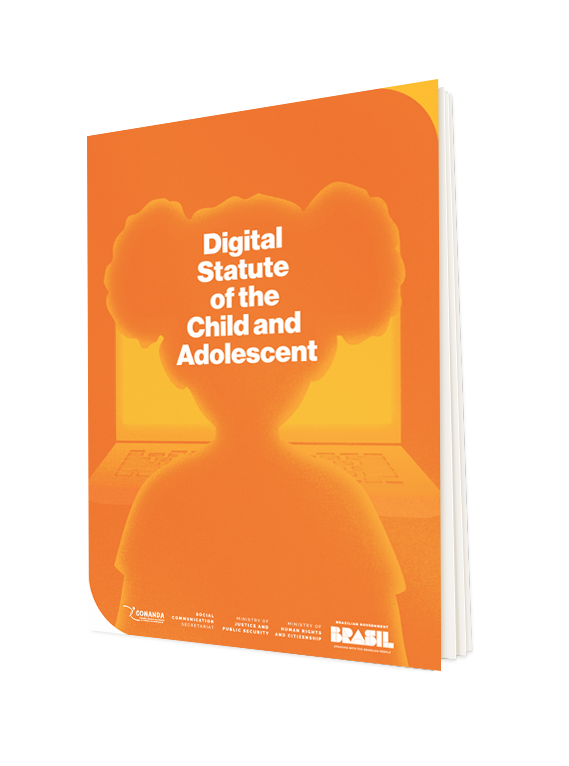
Digital Statute of the Child and Adolescent (English version)
Timeline – Implementation stages for age assurance solutions
As part of its supervisory activities, the ANPD began monitoring compliance by digital product and service providers from 2026 and may extend this initiative in the coming months. The following timetable outlines the implementation stages for age-assurance solutions.
The first phase, which began immediately after Eca Digital entered into force, prioritises the monitoring of app stores and proprietary operating systems. These entities play a key role in protecting children and young people in the digital environment by enabling age assurance and setting up parental controls on devices, with the potential for wide-ranging, cross-cutting impact. Market concentration in these sectors in a small number of companies allows even ANPD’s targeted actions to have significant effects on the range of digital services accessed by children and young people.
The second phase, scheduled to begin in August 2026, following the publication of definitive guidelines by the Agency, will extend monitoring to other sectors or groups of suppliers, to be defined on the basis of the information gathered during the first phase and the criteria set out in the Eca Digital, particularly the risk level associated with each product or service. The update to the regulations governing inspections and the imposition of administrative sanctions is also included in the timetable, setting out the procedures for investigating infringements and the criteria for imposing penalties.
The monitoring activities set out in this timetable do not preclude other enforcement actions that the ANPD may carry out at any time, following the receipt of complaints or the identification of breaches of the law that pose a high risk to the protection of children and adolescents.
Further technical information is available here (in Portuguese).
Timeline
Stage I | Expected date | Objective | Updates |
Publication of preliminary guidelines for the adoption of reliable age assurance mechanisms | From March 2026 | To establish preliminary guidelines to provide greater legal certainty and predictability for regulated entities. | The preliminary guidelines have been published on the ANPD website. The updated version was submitted for consultation, as set out below. |
Creation of a dedicated web page to provide information about the Eca Digital | From March 2026 | To disseminate key information about the Eca Digital to the wider public, including a Q&A section, amongst other communication initiatives | The page has been created and is constantly being updated (in Portuguese and in English). |
Monitoring the implementation of age assurance solutions: online app stores and operating systems | From March 2026 | Carry out specific monitoring to ensure the age assurance system is properly implemented. Gather relevant information to inform the ANPD's drafting of general guidelines. | Apple (App Store), Google (Google Play Store) and Microsoft (Windows) will, by July, submit information and documents regarding system architecture, data flows, age-assurance mechanisms, internal policies and other elements that demonstrate compliance with the ECA Digital and the General Data Protection Law (LGPD). |
Submit the guide entitled “Suppliers of information technology products or services: scope and general obligations under the Eca Digital” to the Consultation Process. | From April 2026 | To conduct a consultation process to gather technical input from the public and improve the interpretation and application of the Law. | Public participation to the “Guide to Suppliers of Information Technology Products or Services: Scope and General Obligations under the Eca Digital” until 15 June 2026 via the platform Brasil Participativo. For more information, access Procedure n. 00261.002701/2026-50. |
Stage II | Expected date | Objective | Updates |
Publication of guidelines and regulatory parameters on age assessment mechanisms and the announcement of monitoring priorities for Stage II | From August 2026 | To detail the principles laid down in the Decree and to provide guidance to regulated entities on their interpretation and application (through regulations or Guides), as provided for in the ANPD’s Regulatory Agenda. | The updated version of the Guidance Document “Age Assurance Mechanisms” has been submitted for public contributions via the Brasil Participativo platform until 9 July. For more information, access Procedure n. 00261.003182/2026-47 |
Adaptation period and monitoring of the implementation of age assurance solutions | August – November 2026 | To establish a transition period to allow regulated entities to adapt to the ANPD’s requirements, and to monitor and assess the implementation of age assurance solutions. | |
Updates on the Regulations on Enforcement and on Administrative Sanctions | From November 2026 | Publication of the updated Regulations, as set out in the ANPD’s Regulatory Agenda. | |
Stage III | Expected date | Objective | Updates |
Enforcement actions, as set out in the Priority Issues Roadmap (“Mapa de Temas Prioritários”) | From January 2027 | To ensure that regulated entities comply effectively with the provisions of the Eca Digital, particularly regarding age-assurance obligations, in accordance with the Decree and the guidelines and regulatory acts issued by the ANPD. |
Planning for the update of ANPD regulations
Following the publication of Decree No. 12.881/2026, which sets out the Agency’s new structure, the ANPD presents its plan to align with the provisions of Act No. 15.352/2026. The document sets out the timetable for the internal reforms for the public, which are based on three key pillars: Organisational Structure, Internal Regulations, and the Regulatory Process.