Agreement between ANPD and the European Union strengthens protection forchildren and adolescents in the digital environment
The partnership aims to promote the exchange of knowledge, technology, and regulatory mechanisms to make the internet safer in the signatory countries
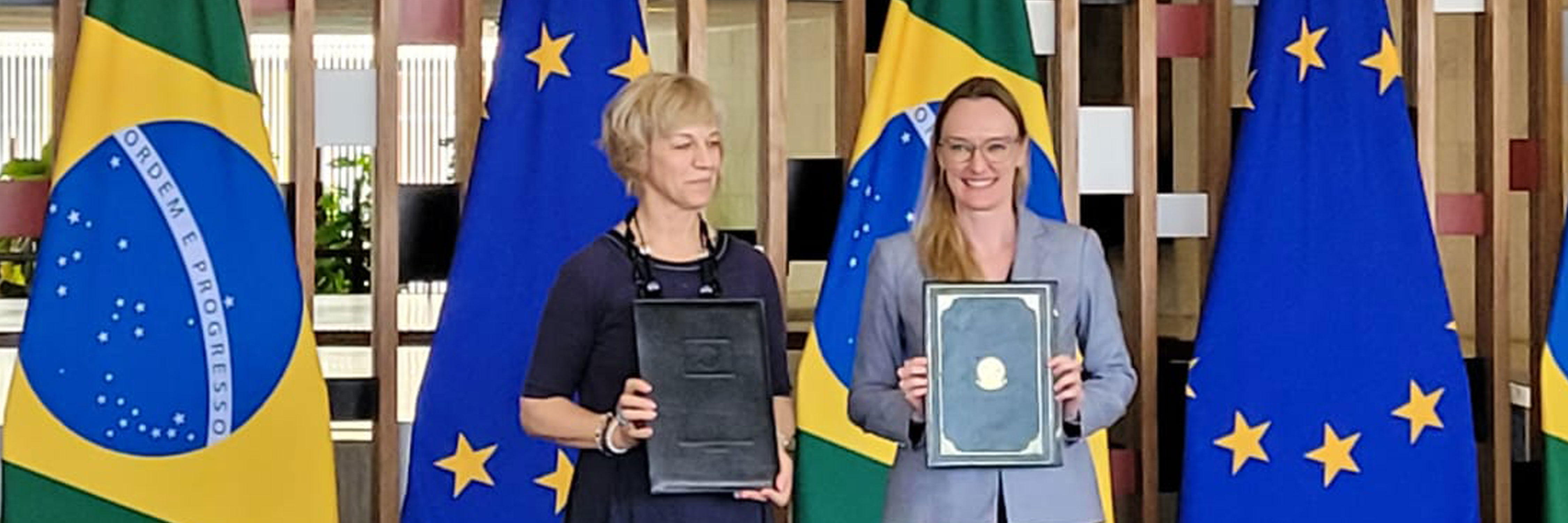
The National Data Protection Agency (ANPD) has gained further support in developing measures to enforce and protect children and adolescents online. On Friday (June 12), the agency signed an agreement with the European Commission’s Directorate-General for Communications Networks, Content and Technology (DG CONNECT). The document was signed at the Itamaraty Palace in Brasília.
The Administrative Arrangement was signed by ANPD’s acting Director-President, Miriam Wimmer, and by DG CONNECT’s Deputy Director-General, Renate Nikolay. For Ms. Wimmer, the agreement was made possible by the existing relationship between Brazil and the European Union (EU). “Both parties recognized that there is an equivalent legal and institutional framework, and this facilitates cooperation agreements such as the one we are signing today,” she explained.
Cooperation between Brazil and the European Union will enable the exchange of knowledge, technology, and regulatory mechanisms that make the internet safer for the signatory countries. The expected outcome is that children and adolescents will develop under the protection of measures that prevent their access to inappropriate digital content.
According to ANPD Director Iagê Miola, the expectation is that ANPD and DG CONNECT will hold technical meetings to exchange experiences on topics jointly defined within the scope of protecting children and adolescents in the digital environment. “Other relevant stakeholders may be involved as the topics addressed progress, such as regulatory authorities from EU member states and Brazilian bodies with related competencies, depending on the specific agendas that emerge from the cooperation.”
The ANPD’s Office of Institutional and International Relations (SRII) is responsible for establishing and seeking mutual cooperation between the agency and other national and international entities, such as the European Commission. “This cooperation will be implemented through concrete mechanisms, such as technical dialogues among experts, joint training sessions, shared studies, and coordinated research projects,” explained SRII Head Eduardo Gomes Salgado, who emphasized that the agreement comes at a time when the ANPD is expanding its competencies as a regulatory agency.
Brazil-European Union Digital Partnership
Prior to the formalization of the Administrative Arrangement between ANPD and DG CONNECT, the signing ceremony for the Brazil-European Union Digital Partnership also took place at the Itamaraty Palace. The Minister of Management and Innovation in Public Services, Esther Dweck, representing the Brazilian government, signed the agreement with the European Commission’s Executive Vice-President for Technological Sovereignty, Security, and Democracy, Henna Virkkunen. The document in question addresses, in a broader sense, the exchange of technology and data protection practices.
On the occasion, Ms. Virkkunen noted that Brazil and the European Union have been partners for two decades. “During this time, we have built a solid relationship to establish a digital security environment, and this only happens when there is cooperation among different stakeholders.”
Meanwhile, Minister Dweck highlighted the signing of the agreement between the ANPD and DG CONNECT. “Now that the ANPD has expanded its competencies, the Digital Child and Adolescent Statute (Digital ECA) is a key public policy under the agency’s responsibility,” she explained.
Also present at the event, representing the ANPD, were managers from the Executive, Enforcement, Regulation, and Technology Innovation Offices.
Key points of the agreement
- Cooperation in risk assessment and mitigation measures implemented by digital service providers to protect children and adolescents online;
- Cooperation in transparency obligations for digital platforms;
- Cooperation in age-appropriate design, including research on emerging age verification technologies that preserve privacy;
- Technological cooperation in the area of algorithms and artificial intelligence, including recommendation systems, when relevant to risks to children and adolescents in the digital environment.
More information for the press
ANPD Communications Office
ascom@anpd.gov.br