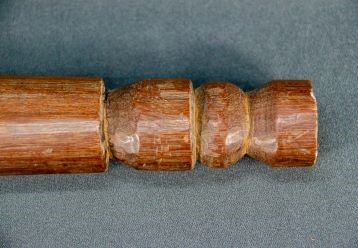
Arandu Ybyrá: the Tree of Memory
National Museum of Indigenous Peoples (Rio de Janeiro, Brasil)
Presentation
Pau-brasil (Brazilwood), the tree that gave our country its name, is an essential figure in the history of colonization of Brazil. From its core, a crimson dye can be extracted, which became the first major commodity exploited in this territory, sought after by european markets. In order to paint in red the garments of imperial courts, entire forests were brought down and the ground was left stained by the sweat and the blood of indigenous peoples, exploited by the colonial occupation.
In this exhibition, pau-brasil is presented as "arandu ybyrá" (guarani for "tree of memory"), a witness to history. The red in its trunk evokes the violated bodies of indigenous peoples; its rings are a record for the cycles of invasion, resistance and continuity; transformed into a commodity, its wood reveals the colonial logic that sought to turn lands, forests, and lives into profit. However, pau-brasil is also the tree of sound: its wood can be carved to make violin bows, capable of transforming friction into music. Thus, the tree symbolizes not only the violence of colonization, but also the capacity to resonate, to keep memory alive, and to transform pain into expression.
Like pau-brasil, indigenous peoples continue to resist. For more than five centuries, they have preserved their songs, languages, rituals and ties to ancestral lands, despite continuous attempts to render them invisible and to oppress them. Their territories are living lands, places of memory, spirituality and collective persistence. If pau-brasil is the plant of the ember, indigenous peoples are the ancestral fire that passes from generation to generation without being extinguished. Amidst devastation and regeneration, between colonial violence and territorial reclamation, this exhibition invites the public to recognize that Brazil is an Indigenous land and that the struggle to defend these territories remains alive, like a flame that insists on staying lit.
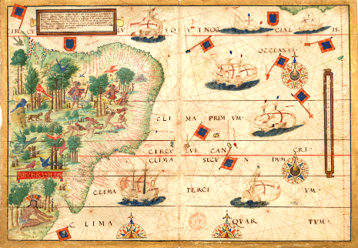
Terra Brasilis
Galdino Lives