Notícias
Intercultural Dialogues and Ethnobotany: The JBRJ and Collaborative Research with Indigenous Peoples
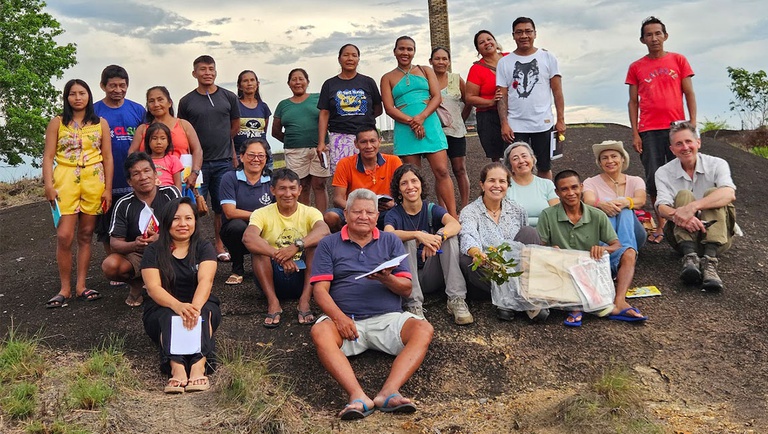
Photo from the 2025 expedition to the Uaupés River as part of the Amazon+10 project: participants in the training workshop on collecting and herbarium preparation of botanical material, and documenting ethnobotanical information associated with the plants, alongside indigenous researchers, representatives of the Tukano people, and non-indigenous researchers (JBRJ, MPEG, KEW, BBK) | Photo: Luciana Martins
On April 19, Indigenous Peoples’ Day, the Rio de Janeiro Botanical Garden highlights its continuous joint research efforts, the promotion of indigenous languages, and the development of ethical information systems.
Indigenous Peoples’ Day is a key date for highlighting the leading role of indigenous communities in understanding and protecting socio-biodiversity. At the Rio de Janeiro Botanical Garden (JBRJ), this recognition forms the basis for ongoing collaborative research initiatives carried out by the Ethnobotany department. Through work guided by respect, the institution operates directly within these territories, integrating traditional knowledge with scientific knowledge.
A recent example of this work was the expedition to the Uaupés River in Amazonas. The mission was part of the subproject “Intercultural Dialogues on Plants, Histories, and Knowledge,” which is part of the “Voices of the Indigenous Amazon” project. Funded by the Amazon+10 Initiative and developed in close partnership with the Emílio Goeldi Museum of Pará (MPEG), this research network brings together indigenous and academic knowledge with the urgent goal of seeking local solutions and responses to address the climate crisis.
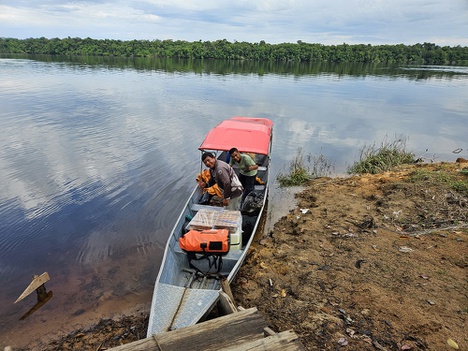
- Boat used on the expedition to the Uaupés River | Photo: Viviane Kruel
The Voices of the Indigenous Amazon project works in direct collaboration with communities in three ecologically distinct regions: the Alto Rio Negro (AM), the Alto Xingu (MT), and the Xingu Ecological Corridor within the Kayapó Indigenous Territory (PA). Since each of these regions has its own unique ethnic, historical, and socio-environmental characteristics, all research areas are developed jointly by scientists and communities.
In the case of the expedition to the Uaupés River, in the Upper Rio Negro Indigenous Territory—a region where the JBRJ is conducting research—fieldwork has been combining botany with disciplines such as archaeology, ethnology, and historical linguistics. The goal is to gain a deep, long-term understanding of the complex relationships between Indigenous peoples, plants, and their territory.
This collaborative agenda continues to expand. Between March and April of this year, the JBRJ is conducting extensive fieldwork in the Panará Indigenous Territory, located between Mato Grosso and Pará. These immersive projects reaffirm the Botanical Garden’s institutional commitment to working across different biomes, ensuring that responses to ecological and climate challenges are developed collaboratively and guided by the leadership of indigenous peoples.
The promotion of more than 270 living languages in Brazil
Brazil is a multilingual country. In addition to Portuguese, there are currently more than 270 living indigenous languages spoken within our borders. For the JBRJ, scientific dissemination must reflect and respect this immense diversity.
Ensuring that research findings are returned to communities in their own languages is an essential step. For this reason, the “Ethnobotany Manual: Indigenous Plants, Artifacts, and Knowledge,” in addition to its Portuguese version, includes editions translated and adapted into the Baniwa and Tukano languages. Making scientific and educational materials available in indigenous languages is a concrete way to value these cultures and ensure that knowledge remains alive and accessible to new generations in the villages.
- Ethnobotany Manual (Portuguese)
- Baniwa Language Edition (Pakapakaroda...)
- Tukano Language Edition (Yokuri...)
- Guide to Richard Spruce’s Rio Negro Collection - Maloca: Between Artifacts and Plants
This dissemination also takes place through initiatives such as the comic book “Jardim dos Saberes” (Garden of Knowledge), aimed at children and young people, and through audiovisual documentaries that illustrate the dialogue in the field, such as the documentaries from the Workshop on the Exchange of Scientific and Indigenous Knowledge and *The Many Lives of a Shield* in Portuguese and English. These documentary and exhibition projects also involve outstanding international collaborations, with strong joint efforts with the Royal Botanic Gardens, Kew (Kew Gardens) and Birkbeck University in the United Kingdom, as well as in partnership with the Socio-Environmental Institute (ISA) and the Emílio Goeldi Museum of Pará (MPEG).
Ethnobotany and Data Science: A Technological and Ethical Partnership
Another key distinguishing feature of JBRJ’s work is the innovative collaboration between the Ethnobotany team, led by researcher Viviane Fonseca-Kruel, and the Scientific Computing and Geoprocessing Coordination unit, with the participation of technologist Eduardo Dalcin, and the strategic partnership with the Useflora project, led by the Laboratory of Human Ecology and Ethnobotany (ECOHE) at the Federal University of Santa Catarina (UFSC). Together, these teams lead global discussions on how technology can protect indigenous peoples’ rights to their own knowledge.
A key milestone in this joint effort took place on May 22 and 23, 2025, when the JBRJ’s Thematic Collection of Medicinal Plants (CTPM) hosted the 1st Collaborative and Intercultural Workshop of the Useflora project on the Sociobiodiversity Database. The initiative, supported by the Serrapilheira Institute, brought together representatives of Indigenous Peoples, Traditional Communities, and Family Farmers, alongside members of the Ministry of the Environment and Climate Change (MMA) and the Ministry of Science, Technology, and Innovation (MCTI).
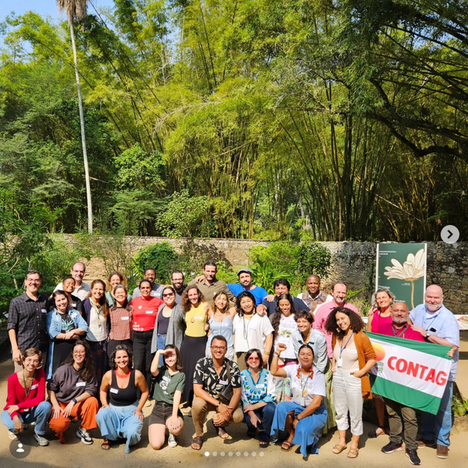
- A collaborative and intercultural workshop held at the Rio de Janeiro Botanical Garden (May 22–23, 2025) brought together representatives of Indigenous Peoples, Traditional Communities, and Family Farmers, as well as representatives from the Ministry of the Environment (MMA) and the Ministry of Science, Technology, and Innovation (MCTI), to discuss the creation of a database of traditional knowledge related to socio-biodiversity.
The main objective of the meeting was to discuss the creation of an ethical database for traditional knowledge associated with socio-biodiversity. The workshop sought to strengthen the safeguarding and deep recognition of the knowledge of guardians, promoting the co-production of an intercultural science that directly contributes to the protection of ancestral knowledge and the valorization of territories.
This intense practical debate has resulted in high-impact scientific publications, consolidating guidelines for the ethical use of technology. A major milestone of this collaborative effort is the article recently published in the prestigious journal *Nature npj biodiversity* (2026), titled “A global biodiversity use data infrastructure acknowledging indigenous and local knowledge.” The study, developed in close partnership between researchers from JBRJ, the Useflora/UFSC group, and Indigenous leaders, as well as other partners, proposes essential global standards for a data infrastructure that ensures traceability, consent, and the sovereignty of communities over their knowledge.
In addition to this core study, the collaboration produced fundamental reflections on the future of ethnobiological data management, recently published in the journal Plants, People, Planet:
- Reframing the Diversity of Sociobiodiversity: Toward Best Practices for Strengthening Ethnobotany in Digital Herbariums (Hart et al., 2025)
- Advances and Guidelines for Data Sovereignty and Ethical Use in Botanical Collections. In practice, this robust transdisciplinary partnership drives ongoing cutting-edge initiatives:
- The GEF “Entre-Ciências” Project, aimed at establishing data standards for sociobiodiversity.
- The ongoing development of the Architecture for a Traditional Knowledge Associated with Biodiversity Information System (Version 1.4).
- The CESP (Capacity Enhancement Support Programme) promotes capacity building in direct synergy with SiBBr and GBIF.
“Developing a data infrastructure for socio-biodiversity requires combining technical rigor with a deep respect for indigenous knowledge. Our work proposes an architecture that integrates initiatives such as USEFLORA with platforms like SiBBr and GBIF, always protecting the information at its source,” explains researcher Eduardo Dalcin.
Researcher Viviane S. Fonseca-Kruel adds, emphasizing the ethical premise of this innovation: “Technology must guarantee the autonomy of indigenous peoples over their own knowledge! Every step of this technological framework is designed to ensure community leadership and the unrestricted protection of the rights of the communities with whom we seek to maintain an ongoing intercultural dialogue.”
The JBRJ's Conservation Program and Ethnobotanical Collection
All the information, knowledge, and botanical materials resulting from this research are not lost; they directly enrich the Ethnobotanical Collection of the RB Herbarium and the Thematic Collection of Medicinal Plants at the JBRJ. Under the coordination and curatorship of researcher Viviane S. Fonseca-Kruel, the expansion and rigorous conservation of these collections have benefited from important collaborations, notably the ongoing partnership with Dr. Carlos Coimbra Júnior.
This joint effort is essential to ensuring that the Rio de Janeiro Botanical Garden remains an active space for science and preservation, housing a living, ethical, and documented record of the ancient relationships between human societies and the flora of Brazil.
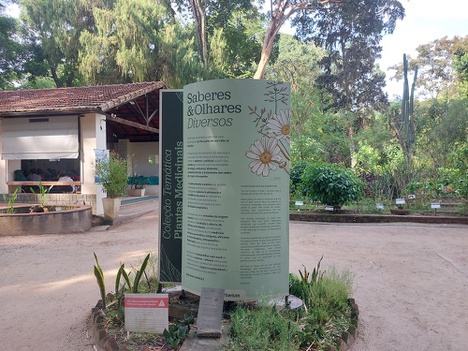
- Entrance to the JBRJ Thematic Collection of Medicinal Plants | Photo: Ester Santos
The Importance of Partnerships
None of these initiatives can be carried out in isolation. The work of the JBRJ’s Ethnobotany program is underpinned by robust collaborations, bringing together institutions such as the MCTI, the Useflora database (UFSC), the Thematic Chamber for Indigenous Peoples and Traditional Communities of the Ministry of the Environment (MMA), and the GBIF and SiBBr data platforms.
Essentially, all these fronts of research, dissemination, technology, and conservation gain meaning through direct engagement with indigenous organizations. Notable here are the historic alliance with the Federation of Indigenous Organizations of the Rio Negro (FOIRN) and the work carried out with the Iakiô Indigenous Association of the Panará people.
It is through this network of connections—which combines active listening in the villages, the promotion of indigenous languages, innovation in data, and the pursuit of curatorial excellence—that the Rio de Janeiro Botanical Garden is forging new paths for the joint protection of socio-biodiversity.