Notícias
The Rio Botanical Garden celebrates Bees Day with the launch of a guide to stingless bees, lectures, and honey tastings
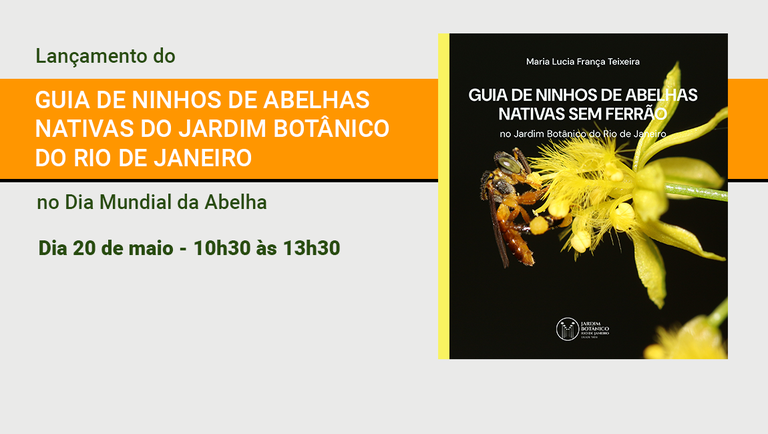
The free event will also feature honey tastings and lectures
Between centuries-old trees, historic monuments, and even on the ground, thousands of tiny, silent architects help keep the Atlantic Forest alive every day, creating a green haven in the city of Rio de Janeiro. This still little-known universe is now being detailed in the Guide to Nests of Native Stingless Bees at the Rio de Janeiro Botanical Garden, a catalog to be launched by the Botanical Garden and authored by agronomist Maria Lucia França Teixeira on May 20, when World Bee Day is celebrated.
The launch will take place at the Rio Botanical Garden’s Visitor Center at 10:30 a.m. During the free event, there will be a tasting of honey from native stingless bee species. The program will also feature lectures, in addition to celebrating the tenth anniversary of the institution’s meliponary—a facility where stingless bee colonies are housed for breeding.
With accessible language, color photographs, location maps, and scientific information, the publication presents species of stingless bees that nest in the arboretum of the Rio Botanical Garden. So named because they have atrophied stingers, these bees pose no risk to the population and are essential for the survival of a large portion of native plants, ranging from low-growing species to large trees. If they become extinct, the reproduction of wild plants will be compromised.
The digital version will be available for free download on the JBRJ website starting May 20. The print edition can be purchased at the Friends of the Botanical Garden Association store.
The guide includes descriptions of behavior, physical characteristics, nest shapes, locations within the Botanical Garden’s arboretum, geographic distribution, and traditional uses of the honey, propolis, and geopropolis produced by the species.
In addition to the species profiles, the material includes a glossary, bibliographic references, and explanations of the scientific and common names of the bees, bringing scientific knowledge closer to the general public.
Among the bees featured are the jataí (Tetragonisca angustula), yellow uruçu (Melipona mondury), boca-de-sapo (Partamona helleri), the caga-fogo (Oxytrigona cagafogo), and even curious species, such as the vulture bee (Trigona hypogea), which uses animal organic matter as a protein source.
The work arose from the author’s experience during pruning and the removal of dead trees in the arboretum.
“I realized the need to conserve the nests of native stingless bees, built in branches and trunks, within the arboretum. Thus, in 2016, the Botanical Garden’s Meliponary was inaugurated, a space for the conservation of these nests, research, outreach, and environmental education,” says Maria Lúcia.
More than just an illustrated guide, the publication also serves as a tool for raising environmental consciousness. The text highlights the vital role of stingless bees in pollination and the preservation of biodiversity, while also drawing attention to threats such as deforestation, excessive use of pesticides, and climate change.
According to the author, the reduction of native vegetation areas has meant that urban green spaces such as the Rio Botanical Garden, despite being exposed to pollution and other anthropogenic impacts, serve as a refuge for bee populations.
- More recently, knowledge about stingless bees and their ecological importance has been growing in society through research, environmental education, and the dissemination of techniques that encourage the creation and commercialization of their hives and products. Studies have revealed broad potential for therapeutic and cosmetic use, due to the presence of substances with antimicrobial and antioxidant properties, for example—notes Maria Lucia França Teixeira.
World Bee Day Schedule, May 20
10:30 a.m. – Launch of the Guide to Native Stingless Bee Nests at the Rio de Janeiro Botanical Garden, authored by Maria Lucia França Teixeira
12:00 PM – Lecture: “Native stingless bees at the Botanical Garden,” Maria Lúcia França Teixeira (JBRJ)
12:30 PM – Lecture: “Environmental awareness and education,” Celicina Ferreira (Association of Meliponiculture Beekeepers of Rio de Janeiro – AME-Rio)
1:00 PM – Lecture: “Environmental education and awareness activities with native stingless bees in state conservation areas,” Christiane dos Santos Rio Branco, technician at the Rio Guandu State Environmental Protection Area – State Institute of the Environment (Inea)
Botanical Garden Meliponary – 10 Years
Established on May 13, 2016, the Botanical Garden Meliponary celebrates its 10th anniversary as a leading center for the conservation of native stingless bees. It was established with the goal of conserving the nests of native stingless bees, rescued from dead branches and trees within the arboretum, thereby preserving the pollination process. It is also used for environmental education activities and scientific research.
Registered with the State Department of Agriculture, the Meliponary currently has 40 hives of 11 species found in the Atlantic Forest biome of the Southeast Region. This collection represents about 50% of the native stingless bee species recorded in the state of Rio de Janeiro. Among them are the jataí (Tetragonisca angustula), the boca-de-sapo (Partamona helleri), and the Mirim droryana (Plebeia droryana).
In addition to these, five other species—the ground jataí (Paratrigona subnuda),
Trigona braueri, the vulture (Trigona hypogea), the irapuá (Trigona spinipes), and the caga-fogo (Oxytrigona cagafogo)—occur exclusively in the arboretum. As a result, the Rio de Janeiro Botanical Garden is home to more than 70% of the stingless bee species recorded in the state, establishing itself as an important urban refuge for these native pollinators.