Notícias
The epithets of new species of Araceae honor prominent figures in Brazilian botany
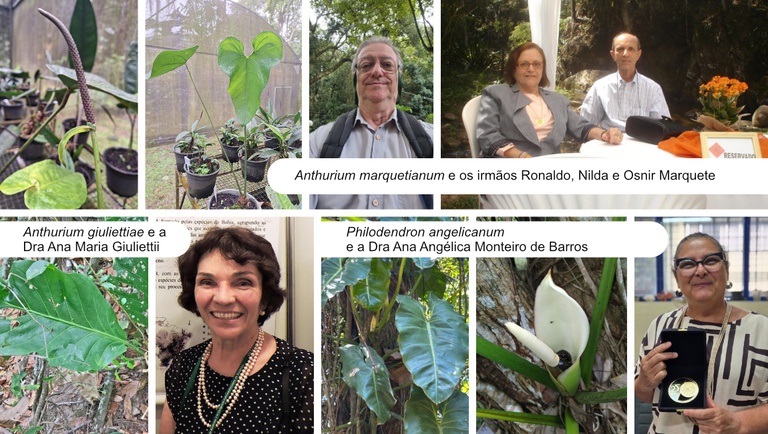
The Marquete family and researchers Ana Maria Giulietti Harley and Ana Angélica Monteiro de Barros are honored.
The Marquette family and researchers Ana Maria Giulietti Harley and Ana Angélica Monteiro de Barros were honored in the epithets of three new species of the Araceae family, whose descriptions were published in April of this year: Anthurium marquetianum, Anthurium giuliettiae, and Philodendron angelicanum.
Anthurium marquetianum Felipe & Nadruz was collected during expeditions conducted in 2023 in the municipalities of Macaé and Santa Maria Madalena, in the state of Rio de Janeiro. The species has no recorded occurrences within protected areas and was assessed by the National Center for Flora Conservation (CNCFlora/JBRJ) as Endangered (EN). Its epithet honors the siblings Nilda, Ronaldo, and Osni Marquete for their commitment to disseminating botanical knowledge, including that of the Araceae family. “Nilda was my first advisor,” says researcher Marcus Nadruz Coelho, co-author of this and the other two articles mentioned here.
The same article, published in the journal Phytotaxa, describes another new species: Anthurium bonetiense Felipe, Nadruz & J.M.A. Braga, discovered during expeditions to Petrópolis (RJ) also in 2023, on the trail to Pedra do Bonet. A. bonetiense was rated by CNCFlora as a species with insufficient data (DD – Data Deficient) regarding extinction risk, occurring outside of conservation areas. The article is also co-authored by Thays Felipe da Silva (National Museum/UFRJ), Juliana Ribeiro de Mattos (ENBT/JBRJ), and Rosana Conrado Lopes (IB/UFRJ).
Professor Ana Angélica Monteiro de Barros (UERJ/FFP) was honored with the naming of another new species from the Atlantic Forest of Rio de Janeiro: Philodendron angelicanum Dutra Junior & Sakur. Collected in the municipality of Cachoeiras de Macacu in 2024, this plant stands out in the landscape due to the broad margins of its leaves, which resemble wings—a characteristic that contributed to the choice of the epithet angelicanum.
Although it was recorded in a Conservation Unit, the Serra do Soarinho Municipal Natural Monument, the species is estimated to be classified as Endangered (EN) because it was found only in a very restricted area and under pressure from human occupation, among other factors. The authors of the article, published in Phytotaxa, are Daniel Dutra Jr. and Davi Machado (ENBT/JBRJ), Deyvison Damasceno (UERJ), Marcus Nadruz, and Cassia Sakuragui (JBRJ).
If the Atlantic Forest of the state of Rio de Janeiro still has gaps in our knowledge of its flora and presents us with surprises such as those described above, what can be said about the Caatinga, which has been comparatively less studied? It is in this phytogeographic region—more specifically in the area of Rio das Contas and Cachoeira do Fraga, in Bahia—that the rare Anthurium giuliettiae Camelo & Nadruz was recorded. First collected in 1977 and then again only in 2019, the species was identified as new through morphological, taxonomic, and phylogenetic studies based on herbarium specimens.
Preliminary assessment indicates that this species is Critically Endangered (CR), among other reasons because its habitat is being converted to agriculture, pasture, and urbanization. With its epithet, the researchers pay tribute to Dr. Ana Maria Giulietti Harley, who, like Anthurium giuliettiae, has her roots in the Caatinga. The article was published in the journal Taxon and is authored by Mel de Castro Camelo and Georgios Pappas, Jr. (UnB), Marcus Nadruz Coelho (JBRJ), Micheline Carvalho Silva (UnB), and Mónica Carlsen (Missouri Botanical Garden).
Links to the publications:
Two new species of Anthurium Schott (Araceae) from Southeastern Brazil