Notícias
The CNCFlora/JBRJ team conducted an expedition through 11 municipalities in São Paulo, Paraná and Santa Catarina
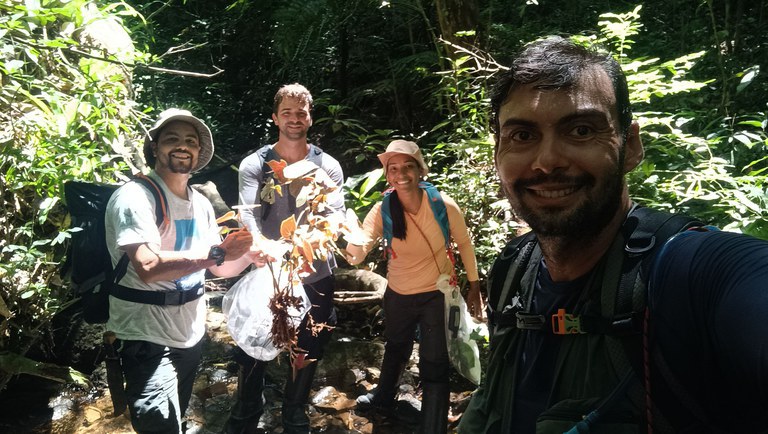
The CNCFlora team finds the species Begonia scharffii Hook. in Serra do Tabuleiro State Park
By Gláucia Crispim, Carlos Ferreira & Eduardo Fernandez (CNCFlora/JBRJ)
Between February 2 and 16, 2023, the National Center for Flora Conservation, of the Rio de Janeiro Botanical Garden Reseach Institute (CNCFlora/JBRJ), carried out a scientific expedition in the context of the Territorial Action Plan (PAT) for the Conservation of Threatened Species Caminho das Tropas, between the states of São Paulo and Paraná, in order to detect species of the flora that are Critically Endangered - CR of extinction and that are the target of conservation actions being implemented from this strategy. The expedition also extended to the state of Santa Catarina, in order to collect information on threatened species but little known, with insufficient data or in need of re-evaluation regarding the state of conservation, and had as its main target the species Begonia scharffii Hook. (Begoniaceae), Critically Endangered (CR).
In its entirety, the expedition traveled through the States of São Paulo, Paraná and Santa Catarina, prospecting plant samples in 11 municipalities (namely: Adrianópolis, Barra do Chapéu, Bom Sucesso de Itararé, Jaguariaíva, Lapa, Palhoça, Palmeira, Ponta Grossa, Porto Amazonas, Ribeira and Sengés); covering the following Conservation Units (UCs): APA Estadual da Escarpa Devoniana, Parque Estadual da Serra do Tabuleiro, Parque Estadual do Cerrado, Parque Estadual do Monge, Parque Estadual do Vale Do Codó, RPPN Botuquara, RPPN Caminho das Tropas, RPPN Fazenda Ilha, RPPN Mata do Uru, RPPN Meia Lua and RPPN Vale do Corisco.
The expedition aimed to update information on endemic species assessed as Critically Endangered (CR) and that need to be reassessed as to their current conservation status, in the context of the GEF Project Pro-Species: everyone against extinction.
When fertile (with flowers and/or fruits), samples of non-threatened species were also collected, in order to fill knowledge gaps about the flora of the region. At the same time, information on the biology, ecology, population size, and anthropic threats in the locations visited that directly or indirectly affect the perpetuation of the threatened species was collected.
Eduardo Fernandez, project coordinator of NuAC/CNCFlora/JBRJ, and conservation analysts Gláucia Crispim and George Queiroz composed the expeditionary team of CNCFlora/JBRJ. In addition, in the campaigns carried out in the states of São Paulo and Paraná, the members of CNCFlora/JBRJ were accompanied by local researchers: Bruno Bastos, Christopher Blum, Gabriela Ribeiro, Marcelo Brotto, Oliver Bizarro, Peterson Leivas and Rodrigo Dallagnol, representatives of the following institutions, Instituto Água e Terra, Jardim Botânico de Curitiba, Secretaria do Desenvolvimento Sustentável (Sedest), Sociedade Chauá and Universidade Federal de Curitiba.
The regions visited suffer a strong threat due to the expansion of the Pinus spp. and Eucalyptus spp. forestry system, which are gaining more and more space due to the favorable terrain and weather conditions. During the incursions carried out, the strong pressure exerted by these plantations was verified. The team noted that the severe growth of Pinus spp. over natural grassland formations is recurrent, representing the most intense threat to native and/or threatened species. Likewise, extensive soybean plantations are frequent in the region, in some cases being observed in regions adjacent to Conservation Units. Such activities promote massive conversion of natural ecosystems.
Of the species searched, the Critically Endangered (CR) Galianthe souzae E.L.Cabral & Bacigalupo (Rubiaceae), Mimosa strobiliflora Burkart (Fabaceae) and Serjania hatschbachii Ferrucci (Sapindaceae) were found, the latter having not been collected in nature since 1995.
Possibly a new locality of occurrence of the threatened Butia pubispatha Noblick & Lorenzi (Arecaceae) - CR was found, which awaits confirmation by experts in the palm botanical family, besides the first documentation of Begonia scharffii Hook. inside the State Park of Serra do Tabuleiro, in SC.
At the end of the expedition, 288 plant samples were collected and will be herborized and included in the RB herbarium, having their duplicates distributed to other herbaria. In addition to 14 specimens for cultivation, which will be properly acclimatized and added to the living collections of the Botanical Garden of Rio de Janeiro. In total, a priori, these materials represent 66 botanical families. This number will possibly increase after the finalization of the determinations of specimens not yet identified at this taxonomic level.
The data collected during this expedition, which is the fifth expedition carried out by the CNCFlora/JBRJ under the ProSpecies Project, adds substantial value and great relevance to the knowledge of the national flora, having succeeded in its objectives, supporting a wide range of advances in different fronts primarily aimed at by the institution. It should also be noted that, in addition to the samples already determined at the species level, unidentified specimens may represent new species for science, or even new occurrences of species' extinction.