Notícias
Study shows versatility of Caatinga cactus outside its natural environment
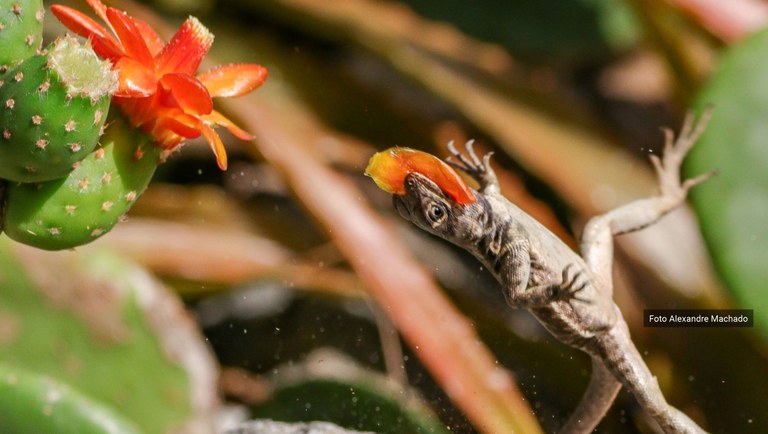
A lizard interacts with 'Tacinga inamoena' in the JBRJ Cactarium | Photo: Alexandre Machado
Researchers from the Rio de Janeiro Botanical Garden (JBRJ) and the Federal University of Western Pará (UFOPA) investigated floral visitors and florivory in Tacinga inamoena, a Caatinga cactus cultivated in the Thematic Collection of Cacti and Succulents at the JBRJ, in order to understand the species' high fruiting rate in this ex situ cultivation, i.e. outside its natural environment. They observed that, although adapted to pollination by birds, the flowers of this species also attract other visitors, such as bees, butterflies and flies, which suggests more complex reproductive interactions than previously thought.
In addition, interaction was observed with Tropidurus torquatus lizards, which occur naturally in the area of the collection. These lizards consume floral parts, causing damage to the flowers, but without compromising the fruiting of the species.
The researchers point out that more studies need to be carried out to deepen knowledge of the reproductive mechanisms of this species, but consider that the research findings “highlight the resilience and versatility of Caatinga plants, even in challenging contexts, and reinforce the importance of ex situ investigations for the conservation and understanding of native species”.
Access the article Floral Visitors and Florivory in Tacinga inamoena (Cactaceae) in der Ex-situ-Sammlung des Botanischen Gartens von Rio de Janeiro