Notícias
Study reveals how the roots of the boa plant change their “clothing” to protect themselves from dehydration
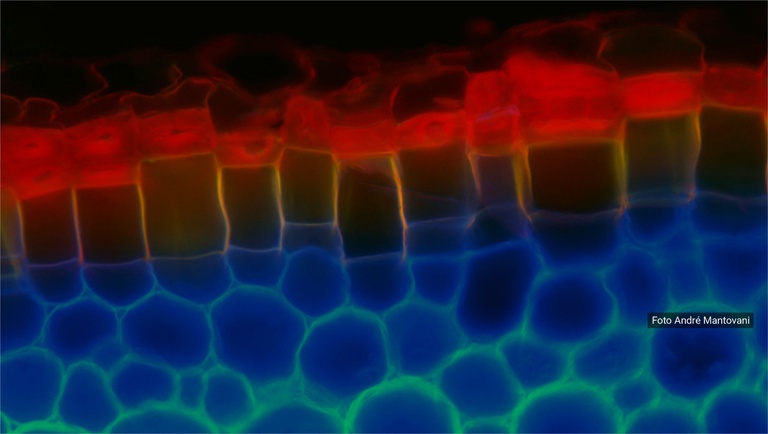
Aerial root of Epipremnum aureum: triple staining in fluorescence microscopy; Basic fuchsin stains lignin red, Fluorol Yellow 088 stains suberin yellow, and Calcofluor White stains cell walls blue; the new lignin-suberin coating significantly reduces water loss | Photo: André Mantovani
From a scientific perspective, even what seems trivial can become a fascinating discovery. Researcher André Mantovani, from the Rio de Janeiro Botanical Garden (JBRJ), and his undergraduate research student Yago Chagas Groba studied a plant species that is quite common in the landscape, in gardens, or even in homes in Brazil: Epipremnum aureum, popularly known as the golden pothos. They demonstrated how this species has developed strategies to reduce dehydration and survive in the tree canopy, where the environment is much hotter and drier than on the ground: its roots change their “clothing.”
Epipremnum aureum plants are lianescent aroids—also known in English as aroid vines or nomadic vines—and constitute an ecologically interesting group, because they are capable of shifting from horizontal growth along the forest floor to vertical growth, climbing up tree trunks in search of abundant light in the canopy, where they grow with their beautiful, enormous leaves.
This change is no small matter. In the canopy, the air is hotter and drier than on the forest floor. The combination of these factors can cause stress and dehydration in plants that venture up there. The air’s drying potential in the canopy can be up to 100 times greater than at ground level, which is the primary source of water and various nutrients for most vascular plants, including liana-like araceae. So, even after reaching the treetops, they never lose contact with the forest floor, thanks to their roots, which extend down many meters… through the air!
“Imagine a root that, having always grown in moist, protected soil, will now have to grow in an atmosphere up to 100 times more desiccating,” comments Mantovani. He explains: when in the air, the covering tissue originally produced under soil conditions (epidermis with exoderm) is replaced by a new, thick tissue resistant to water loss (called sclerified suber). While a terrestrial root with exoderm cannot withstand 3 hours of dehydration, rapidly losing 30 to 40% of its water, this new tissue allows aerial roots to retain most of their water content even after 24 hours.
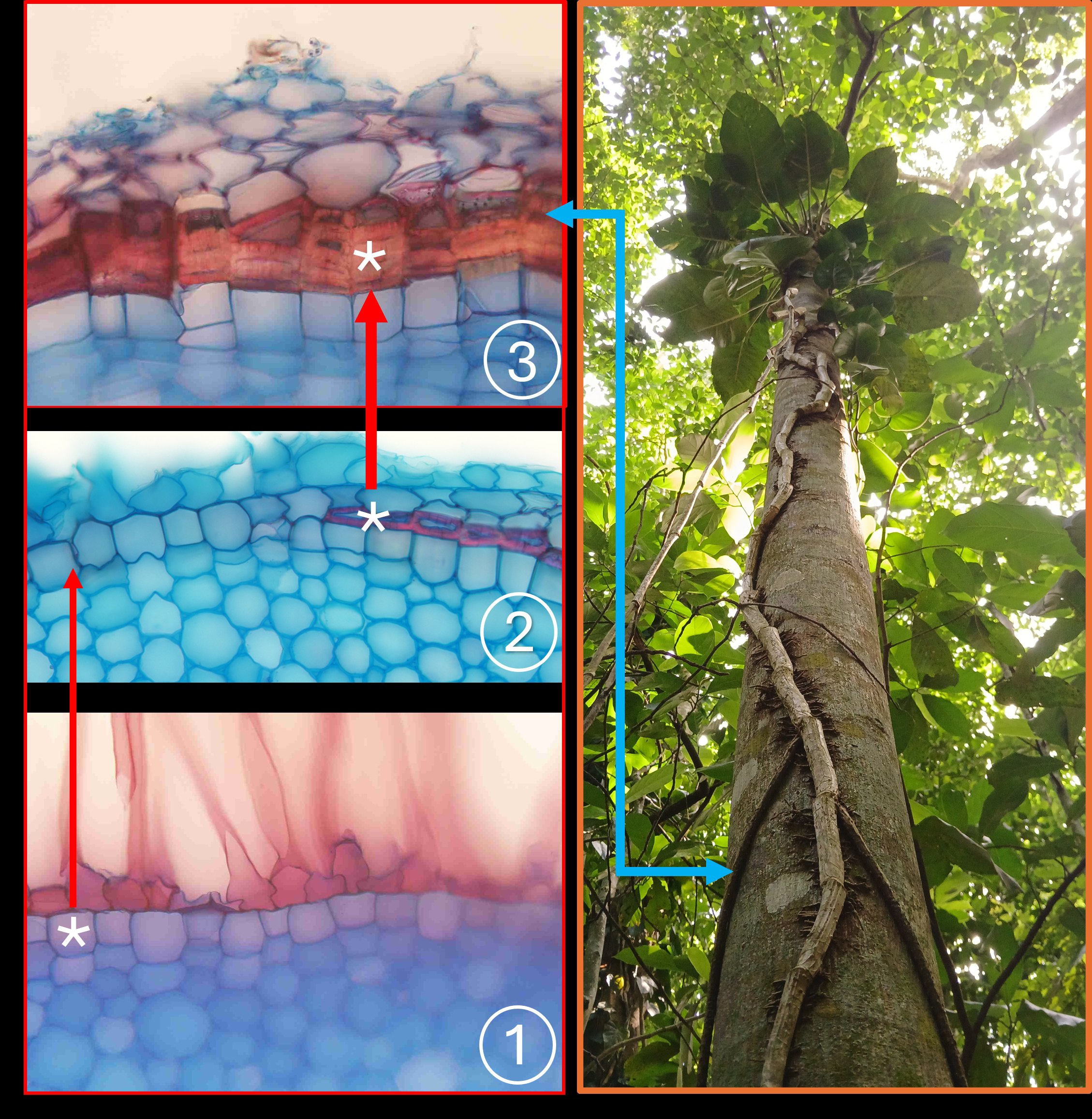
- Using optical microscopy, it is possible to observe the replacement of the “original covering” of the terrestrial roots (epidermis + exodermis, Figure 1) of E. aureum by the emergence of the “new covering” (Figure 2) in response to the aerial environment; in a short time, the ‘new covering’ develops into a sclerified cork consisting of multiple layers (Figure 3), which covers and protects the plant’s aerial roots; this fully developed Araceae, with its enormous leaves and long aerial roots, can be found in the arboretum of the Rio de Janeiro Botanical Garden | Photos: André Mantovani
The study was conducted entirely at the arboretum and in the Structural Botany laboratory at JBRJ. Mantovani points out that it was Yago Groba, a PIBIC-CNPq scholarship holder, who developed the main technique used in the research. The results they obtained add to others published by the researcher on the resistance of the aerial roots of lianescent araceae to dehydration.
“Among the many vascular plants that live in the tree canopy, perhaps the most important in terms of species diversity are bromeliads, orchids, ferns, and araceae. While the first three have been extensively studied, araceae still have strategies yet to be uncovered. This and other studies will help write the ecological-evolutionary history behind this family of plants’ conquest of the tree canopy,” concludes the researcher.
The article was recently published in the international journal Physiologia Plantarum, in a special issue dedicated to the ecology of roots under stress.
Access the full article, with open access guaranteed by CAPES.