Notícias
Respect and reparation mark the inauguration of the Memorial to the Black Hands who built Rio de Janeiro's Botanical Garden

Minister Marina Silva and JBRJ president Sergio Besserman Vianna gathered at the event with members of the Memorial's Working Group and Advisory Committee, religious representatives and guests | Photo: Matheus dos Santos/CRS JBRJ
On November 29, 2024, the Memorial to the Black Hands who built the Rio de Janeiro Botanical Garden was inaugurated. The aim of the new space is to bring to the public's attention a part of history that had hitherto been silenced: the fundamental contribution of black men and women in the building of the institution.
In her speech at the inauguration ceremony, the Minister for the Environment and Climate Change, Marina Silva, stressed that this is an act of reparation to the people who, as enslaved people, did not have their authorship and achievement recognized in the construction of something that came to be of great benefit to everyone, the Rio de Janeiro Botanical Garden. “Everyone needs authorship, accomplishment and recognition. Without recognition, we cannot constitute ourselves culturally, socially and morally,” said the minister.
The president of the Botanical Garden, Sergio Besserman Vianna, recalled that President Lula had apologized to the enslaved people on behalf of the Brazilian state and, on behalf of the JBRJ, he was doing the same at that moment. He also thanked Minister Marina Silva for her immediate understanding and support for the Memorial initiative and subsequent actions, which will include scientific research into the archaeological finds, historical research and the internalization of an anti-racist culture in the institution. Besserman also thanked the members of the Working Group (WG) that proposed and drew up the project, the Advisory Commission, the directors and the entire team that worked on the construction of the new space.
JBRJ's Engineering, Restoration and Maintenance coordinator, Marcelo Ferreira, spoke on behalf of the WG and the team of workers who built the memorial. “We're delivering more than a piece of work, we're delivering the realization of a shared dream,” he said, recalling that the first gardeners at the JBRJ were enslaved black workers.
Babalawô teacher Ivanir dos Santos spoke on behalf of the project's Advisory Committee, emphasizing that the inauguration of the Memorial was truly a historic moment. “This moment shows that it's worth coming together, dialoguing and building a plural society, with respect for diversity.”
Ivanir dos Santos also led the interreligious act that took place inside the Memorial, at which time Rabbi Nilton Bonder, Father Damasceno from the Christ the Redeemer Sanctuary and Pastor Kléber Lucas also spoke. The event was also attended by federal deputies Jandira Feghali and Eduardo Bandeira de Mello and representatives of Rio de Janeiro City Hall.
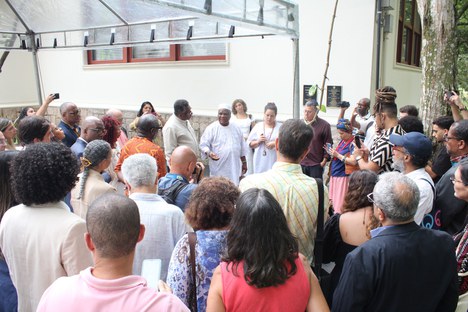
- Interreligious act | Photo: Matheus dos Santos/CRS JBRJ
The Memorial - The purpose of the Memorial of the Black Hands who built the Botanical Garden of Rio de Janeiro is to recognize and make visible those workers whose names and stories have been erased from official narratives. In this way, the names and participation of enslaved men, women and children in the construction of the Botanical Garden in the first half of the 19th century are made public. The work aims to promote the historical and cultural appreciation of black workers, creating a space for memory and reflection. Located between the Botanical Garden Museum and the Barbosa Rodrigues Library, the Black Hands Memorial occupies a symbolic area where bones were found on land owned by Embrapa Solos, next to the Botanical Garden, between 1979 and 1981.
The Memorial has information plaques on the history of black workers and the context of the construction of the Botanical Garden. The site will also have an exhibition space for black artists. The space also includes a bench for contemplation, with integrated planters made up of ritualistic and African plants, chosen to value Afro-Brazilian ancestry and cultural traditions.
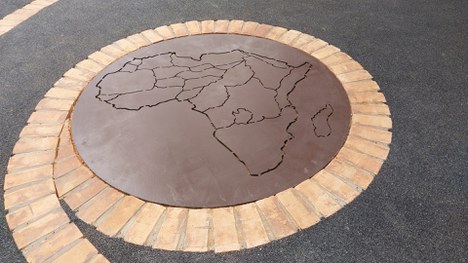
- In the center of the Memorial is a metal map of the African continent that reproduces a map drawn up by William Blaeu (1571-1638), considered by researchers to be the first to accurately represent the contours of the continent | Photo: Ester Santos
The Working Group that proposed and drew up the Memorial is made up of engineer Marcelo Ferreira, the coordinator of JBRJ's Socio-Environmental Responsibility Center, Deborah Tavares Marinho, and the director of Knowledge, Environment and Technology, Marcia Aparecida Lobianco Faraco. The architectural project was designed by Monica Rocio Neves, also a JBRJ employee.
The Advisory Board is coordinated by Prof. Dr. Babalaô Ivanir do Santos and also includes Professors Alda Heizer, Helena Theodoro, Júlio César Medeiros da Silva Pereira, Mariana Gino and Director Marcia Faraco.