Notícias
Researcher Noemia Ishikawa (INPA) and student Eli Minev-Benzecry visit JBRJ and donate ariá seedlings and a book about the plant
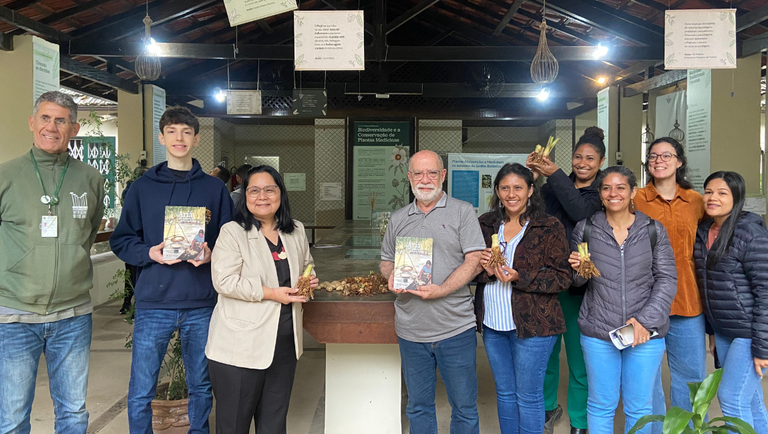
Marcus Nadruz, Eli Minev-Benzecry, Noemia Kazue Ishikawa, Sergio Besserman Vianna, Ruby Vargas-Isla, guests and the team from JBRJ's Thematic Collection of Medicinal Plants
Researcher Noemia Kazue Ishikawa, from the National Institute for Amazonian Research (INPA), visited the Rio de Janeiro Botanical Garden on Thursday (12/6). The biologist was received by the president of the JBRJ, Sergio Besserman Vianna, at the Thematic Collection of Medicinal Plants, where she donated seedlings of ariá - Goeppertia allouia (Aubl.) Borchs. & S. Suárez.
Dr. Ishikawa was accompanied by Eli Minev-Benzecry, a 17-year-old student from the city of Manaus, first author of the book “Ariá, um alimento de memória afetiva”, and Ruby Vargas-Isla, an agronomist and co-author. They presented the JBRJ with two copies of the bilingual book (Portuguese-Tukano), the result of Eli's research into this plant of great nutritional value. Ariá is similar to a small potato and can be eaten cooked, in porridges, drinks, roasted on the grill, in the form of crispy chips or mashed. The student explained that the plant also has the advantage of being harvested during the dry season in the Amazon, when other foods become scarcer. The book was written so that the region's own communities would have access to knowledge about the plant and its traditional ways of preparation, knowledge that was in danger of being lost due to the invasion of ultra-processed foods.
A member of the Brazilian Academy of Sciences, Noemia Kazue Ishikawa holds a master's degree in Agricultural Microbiology from the Federal University of Viçosa and a doctorate in Environmental Resources from Hokkaido University in Japan, with post-doctoral studies at The Tottori Mycological Institute (Japan) and Clark University (United States).
According to the JBRJ's Living Collections coordinator, Marcus Nadruz Coelho, the ariá seedlings donated by Dr. Ishikawa will be the first of the species to be cultivated at the Rio de Janeiro Botanical Garden.