Go to Content 1 Go to Home 2 Go to Navigation 3 Go to Search 4 Go to Sitemap 5
Abrir menu principal de navegação
Instituto de Pesquisas Jardim Botânico do Rio de Janeiro
Most searched terms
  • imposto de renda
  • inss
  • assinatura
  • cnh social
  • mei
Most searched terms
  • imposto de renda
  • inss
  • assinatura
  • Subjects
    • Visitation
      • Hours
      • Tickets
      • Directions
      • Electric cars
      • Guided walking tours and themed tours
      • Conveniences
      • Visiting rules
      • Standards for professional photography
    • Research
    • Education
      • Escola Nacional de Botânica Tropical
      • Stricto Sensu Graduate Program in Botany
      • Professional Graduate Program Biodiversity in Protected Areas
      • Socio-environmental Responsibility
      • Environmental Education
      • Institutional Scientific Initiation Scholarship Program - PIBIC
      • Escola Jardim
    • Collections
      • Archival Collections
      • Bibliographical
      • Biological
      • Museology
    • History
    • News
  • Access to Information
    • Covenants and Transfers
      • Partnership
  • Composition
  • Content Centers
    • Video
    • Images
    • JBRJ Data Portal
    • Publications
      • Books
      • Arboretum Families Series
      • CDs
      • Legislation
      • Botânica Pop
      • Documents
      • Rodriguesia
    • Books and Scientific Publications
      • Rodriguésia
      • Field Guides
      • Archivos do Jardim Botânico
  • Service Channels
    • Contact Us
  • GOV.BR
    • Services
      • Search services by
        • Categories
        • Departments
        • States
      • Services by target audience
        • Citizens
        • Companies
        • Departments and Public Entities
        • Other segments (NGOs, social organizations, etc)
    • Application Gallery
    • Navigation
      • Acessibility
      • Sitemap
    • Government of Brazil
      • Latest News
        • 2021
        • 2022
Useful Links
  • Application Gallery
  • Get involved
  • Application Gallery
  • Get involved
Social Networks
  • Twitter
  • YouTube
  • Facebook
  • Instagram
  • Flickr
Você está aqui: Home Subjects News Protecting hidden treasures: Indigenous Lands safeguard 50% of the areas with the greatest potential for angiosperm discoveries in Brazil
Info

Notícias

Protecting hidden treasures: Indigenous Lands safeguard 50% of the areas with the greatest potential for angiosperm discoveries in Brazil

Share by Facebook Share by Twitter Share by LinkedIn Share by WhatsApp link to Copy to Clipboard
Published in Jul 10, 2025 02:20 PM Updated in Jul 14, 2025 09:34 AM
banner artigo.png

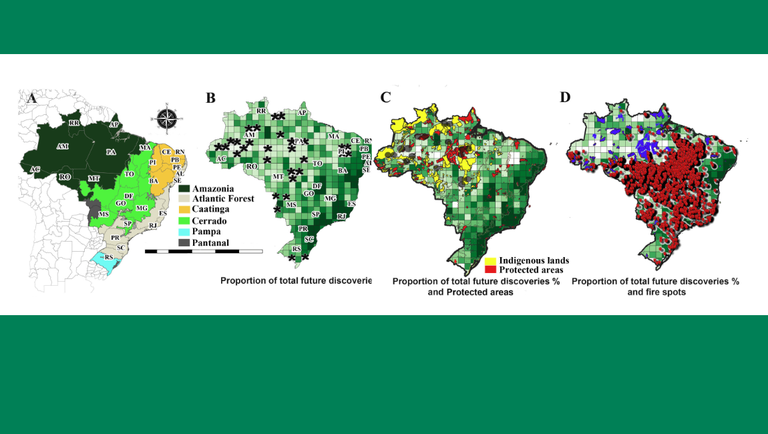
In line with the discussions at COP 30, the 30th Conference of the Parties to the United Nations Framework Convention on Climate Change (UNFCCC), a post-doctoral study carried out at the Rio de Janeiro Botanical Garden, with funding from FAPERJ (Carlos Chagas Filho Foundation for Research Support in the State of Rio de Janeiro), carried out between 2022 and 2024, analyzed more than two centuries of taxonomic data - from 1753 to 2020 - to identify the historical patterns of botanical discoveries in Brazil and predict which phytogeographic domains are still home to the largest number of species unknown to science.

Despite the fact that since the 1990s Brazil has been among the four countries that describe the most new species of angiosperms each year, a significant portion of the Brazilian flora remains unexplored. The absence of a scientific name makes a species practically invisible to science, making it difficult to include it in basic research or conservation policies.

With around 33,600 native angiosperm species, of which 341 genera are exclusive to Brazil, there is a clear imbalance in the distribution of taxonomic wealth between the country's different endemic clades. Understanding where these species are and what they are is essential for drawing up effective conservation strategies. The key question that guided the study was: What would be the impact on conservation priorities if all the undescribed species were known and the catalog was complete?

Published in the scientific journal PLOS ONE, the research used predictive models and incorporated historical taxonomic effort to estimate that the Brazilian angiosperm catalog is still between 19% and 23% incomplete, which corresponds to approximately 7,300 to 9,600 species not yet formally described by science.

The congruence of the results revealed that the Amazon and Caatinga domains concentrate the largest areas with potential for discovering new species. However, only 20% of these areas coincide with established conservation units. A particularly relevant finding is that 50% of the areas with the greatest potential for discoveries are located within Indigenous Lands.

This scenario reinforces the strategic importance of Indigenous Lands in the conservation and cataloging of Brazilian biodiversity. The results also indicate that it is essential to integrate these areas into national conservation planning, with policies that value the role of local communities.

The research also shows that human population density influenced the pace of species discoveries in the past, while scientific effort and the training of taxonomists have been decisive in recent decades. The study warns that recent cuts in research funding, especially between 2019 and 2022, could jeopardize the progress made.

Among its recommendations are the strengthening of public policies aimed at taxonomy, the expansion of Conservation Units, especially in the Caatinga, and investment in training programs and infrastructure for collecting and identifying species, using technologies such as remote sensing and partnerships with indigenous peoples and local communities.

The study is signed by Janaína Gomes-da-Silva, Rafaela Forzza (JBRJ/ICMBio) and Eimear Nic Lughadha (Royal Botanic Gardens, Kew).

Access the full article.

Environment and Climate
Share by Facebook Share by Twitter Share by LinkedIn Share by WhatsApp link to Copy to Clipboard
  • Subjects
    • Visitation
      • Hours
      • Tickets
      • Directions
      • Electric cars
      • Guided walking tours and themed tours
      • Conveniences
      • Visiting rules
      • Standards for professional photography
    • Research
    • Education
      • Escola Nacional de Botânica Tropical
      • Stricto Sensu Graduate Program in Botany
      • Professional Graduate Program Biodiversity in Protected Areas
      • Socio-environmental Responsibility
      • Environmental Education
      • Institutional Scientific Initiation Scholarship Program - PIBIC
      • Escola Jardim
    • Collections
      • Archival Collections
      • Bibliographical
      • Biological
      • Museology
    • History
    • News
  • Access to Information
    • Covenants and Transfers
      • Partnership
  • Composition
  • Content Centers
    • Video
    • Images
    • JBRJ Data Portal
    • Publications
      • Books
      • Arboretum Families Series
      • CDs
      • Legislation
      • Botânica Pop
      • Documents
      • Rodriguesia
    • Books and Scientific Publications
      • Rodriguésia
      • Field Guides
      • Archivos do Jardim Botânico
  • Service Channels
    • Contact Us
Reset Cookies
Social Networks
  • Twitter
  • YouTube
  • Facebook
  • Instagram
  • Flickr
Acesso àInformação
All content on this site is published under license Creative Commons Attribution-NoDerivs 3.0 Unported.
Voltar ao topo da página
Fale Agora Refazer a busca