Notícias
Program for the 21st National Science and Technology Week - 2024
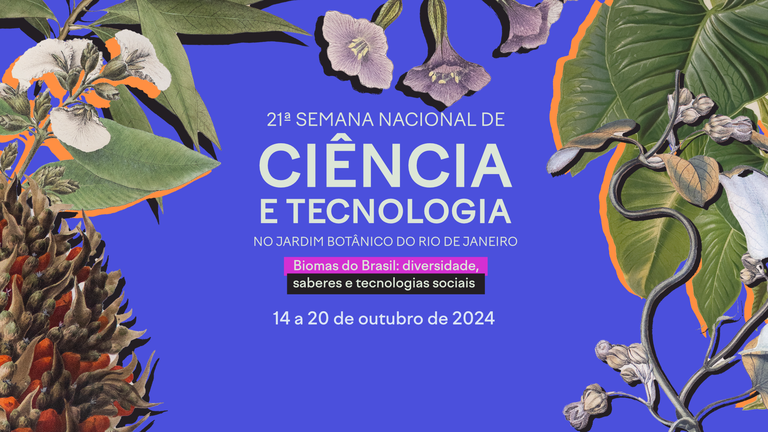
PROGRAMMING - 21st National Science and Technology Week at the Rio de Janeiro Botanical Garden Research Institute
October 14-20, 2024
Tickets and registration are free.
Click on the desired date:
OCTOBER 14
To book a group visit to the Museum, fill in the form below.
Workshops and stands
9 a.m. to 11 a.m.
- Unraveling the fauna of the Rio de Janeiro Botanical Garden
Sensory activities, led by the Fauna Preservation Center team, which allow you to understand and identify the diversity of fauna in the arboretum, as well as learn about the work of biologists in rescuing wild animals.
Location: Botanical Garden Museum.
9 a.m. to 4 p.m.
- A journey into the natural history of Brazil through Von Martius' map and the biomes
An interactive activity, led by educators from the Environmental Education Service (SEA), aimed at children and young people. Students are invited to interact with the map of Brazil created in 1823 by the German botanist Carl Friedrich Philipp Von Martius, who proposed a regional division for the country based on five major biomes.
Venue: Environmental Education Service (SEA)
- Discovering the fantastic world of aromas and essential oils
Researchers from the Rio Botanical Garden will teach how aromas and essential oils are obtained and their importance to society. The public will have the opportunity to follow the extraction of aromas such as cinnamon, clove, lemongrass, citronella, among others, which are used in perfumes, in the treatment of diseases, cleaning products, etc.
Location: Botanical Garden Museum
- Endangered plants and where they live
An exhibition of important work carried out by the National Center for the Conservation of Flora (CNCFlora) to preserve biodiversity, accompanied by an interactive game. Instruments used to collect botanical specimens, such as tweezers, exsiccates and loppers, will also be on display. The public will be able to watch demonstrations on the extinction risk assessment flow and consult detailed factsheets on various endangered species.
Venue: Botanical Garden Museum
- Information garden
The interactive activity Popular diversity and privacy will address popular and scientific knowledge, offering a fun way to learn.
Venue: Botanical Garden Museum
- Ibama's National Center for Preventing and Fighting Forest Fires (Prevfogo)
The brigade's equipment will be on display in a tent.
Location: Gardens in front of the Museum
- Virtual tour of the Botanical Garden Arboretum
Sitting in an electric trolley using virtual reality glasses, participants will be able to take a brief tour of iconic points in the living collection of the Rio de Janeiro Botanical Garden. A meeting between cutting-edge technology and a collection that is over 200 years old. The video was developed in partnership with Shell, the Botanical Garden's master sponsor.
Location: Gardens in front of the Museum
10 a.m. to 12 p.m.
- History of the use and occupation of Brazilian biomes
Video screening on Brazilian biomes.
Location: Botanical Garden Museum
12 p.m. to 4 p.m.
- Unraveling the moss forests
Magnifying glasses and a microscope are available for observing mosses, highlighting the diversity of species that can be found on a rock, a tree trunk or even on sidewalks. Mosses are ancient, tiny plants called bryophytes and are considered by many to be the first plants to dominate the terrestrial environment around 500 million years ago. Although countless scientists have studied these plants throughout the history of modern science, they are still unknown or ignored by the majority of the population.
Venue: Botanical Garden Museum
2 p.m. to 4 p.m.
- Sun Observation
Telescope for observing the Sun. A technical team from the Planetarium Foundation of the City of Rio de Janeiro will be on hand to talk to the public about solar activity and its effects on our planet, demystifying false alarms and showing the Sun as many have never seen it.
Venue: gardens in front of the Museum
- Botanical drawing workshop
Venue: Botanical Garden Museum
- Creator and creature: the research carried out at JBRJ and who is behind it
A video introduces the institute's scientists, what they do and how their work contributes to the conservation of biodiversity.
Venue: Botanical Garden Museum
Lecture
11 a.m. to 12 p.m.
- First steps in the conservation of Antarctic vegetation - The BryoAntar Project and the preparation of the Red List of Threatened Species
This remote lecture will discuss the urgent and necessary actions for the conservation of Antarctic vegetation, as well as the BryoAntar project's initiatives to tackle threats to Antarctic flora and the process of drawing up the red list of threatened species. The talk will be broadcast live on the Rio de Janeiro Botanical Garden's YouTube channel.
Trails / Guided tours
10 a.m. to 11 a.m.
- Caatinga Trail
Guided tour to see the Caatinga species found in the Botanical Garden's arboretum, such as the juazeiro (Ziziphus joazeiro) and mulungu (Erythrina velutina).
Location: Arboretum (meeting point at the Visitor Center)
10 a.m. to 12 p.m.
- Frei Leandro Trail
The trail commemorates the bicentenary of Frei Leandro's tenure (1824-2024) at the Rio de Janeiro Botanical Garden. It includes species that the botanist introduced, managed, researched and collected, such as the tea (Camelia sinensis), the biribá or fruta-do-conde (Annona mucosa), and the breadfruit (Artocarpus altilis).
Location: Arboretum (meeting point at the Visitor Center)
- The fascinating world of Aráceas
Guided tour and interactive workshop focusing on the Araceae family, known for its diversity, beauty and economic importance. The program includes a guided tour of the arboretum to observe different species of Araceae (anthuriums, milkcups, rib-of-addon and others) and learn about their specific adaptations to their habitats, as well as an interactive and itinerant workshop on the morphology of these plants.
Location: Arboretum (meeting point at the Visitor Center)
Exhibitions
10 a.m. to 4 p.m.
- Biomes of Brazil: diversity, knowledge and social technologies
Exhibition of books from the Barbosa Rodrigues Library collection, which present the richness, importance and diversity of plant and animal species in Brazilian biomes, as well as the traditional knowledge of communities who have knowledge of medicinal plants, sustainable agricultural techniques and natural resource management.
Venue: Barbosa Rodrigues Library
- Exhibition of botanical illustrations
Exhibition of botanical illustrations in graphite, ink and watercolor techniques produced by students and former students of the extension courses at the National School of Tropical Botany. The aim of scientific illustration is to make a graphic representation of a species with drawings, engravings and paintings, using graphite, ink and watercolor techniques.
Venue: Botanical Garden Museum
OCTOBER 15
To book a group visit to the Museum, fill in the form below.
Workshops and stands
9 a.m to 11 a.m
- Mysteries of the forest
Interactive game of questions about the interaction of fauna and flora.
Location: Botanical Garden Museum
9 a.m. to 4 p.m.
- A journey into the natural history of Brazil through the Von Martius map and the biomes
Interactive activity, led by educators from the Environmental Education Service (SEA), aimed at children and young people. Students are invited to interact with the map of Brazil created in 1823 by the German botanist Carl Friedrich Philipp Von Martius, who proposed a regional division for the country based on five major biomes.
Venue: Environmental Education Service (SEA)
- Discovering the fantastic world of aromas and essential oils
Researchers from the Rio Botanical Garden will teach how aromas and essential oils are obtained and their importance to society. The public will have the opportunity to follow the extraction of aromas such as cinnamon, clove, lemongrass, citronella, among others, which are used in perfumes, to treat illnesses, cleaning products, etc.
Venue: Botanical Garden Museum
- Information garden
The interactive activity Popular diversity and privacy will address popular and scientific knowledge, offering a fun way to learn.
Venue: Botanical Garden Museum
- Brazilian biomes game
Playful gamification activity, using a board game, led by staff and students from the Center for Social and Environmental Responsibility, with information on biomes, including botany, relief, agronomy, forests and urban impacts.
Venue: The Arts Shed
- Amazon biome game
This game invites participants to reflect on important themes such as conservation, ecology and the risk of extinction, as well as exploring curiosities about the fauna and flora of the Amazon. With a roulette wheel and cards that highlight unique aspects of Amazonian biodiversity, participants learn more about this biome, developing environmental awareness in a playful way and promoting learning through interaction and healthy competition.
Venue: The Arts Shed
- Endangered plants and where they live
Exhibition of work carried out by CNCFlora, containing data on species assessed and threatened in each biome, accompanied by an interactive memory game. Also on display are instruments used to collect botanical specimens, such as tweezers, exsiccates and loppers. The conservation of plants and biomes is fundamental to maintaining life on planet Earth. Plants play essential roles in producing oxygen, regulating the climate, purifying water and sustaining food chains.
Venue: Botanical Garden Museum
- Exhibition by Ibama's National Center for Preventing and Combating Forest Fires (Prevfogo)
The brigade's equipment will be on display in a tent.
Location: gardens in front of the Museum
- Virtual tour of the Botanical Garden Arboretum
Sitting in an electric trolley using virtual reality glasses, participants will be able to take a brief tour of iconic points in the living collection of the Rio de Janeiro Botanical Garden. A meeting between cutting-edge technology and a collection that is over 200 years old. The video was developed in partnership with Shell, the Botanical Garden's master sponsor.
Location: Gardens in front of the Museum
9:30 a.m. to 4 p.m.
- Pollinating
The public will learn about the process of pollination, which is responsible for the production of fruit and seeds in nature and food on our tables. Through illustrated materials and a game, visitors will also learn about pollinating animals.
Venue: Botanical Garden Museum
10 a.m. to 12 p.m.
- History of the use and occupation of Brazilian biomes
Video screening on Brazilian biomes
Location: Botanical Garden Museum
10 a.m. to 3.30 p.m.
- Conscious consumption in Brazilian biomes
Interactive activity relating conscious consumption to Brazilian biomes and a costume jewelry recycling workshop.
Venue: Botanical Garden Museum
2 p.m. to 4 p.m.
- Botanical drawing workshop
This workshop aims to give the public an insight into the plant world and its visual representativeness. Drawing from observation of living plants with guidance on the elements that characterize the species used, their leaf shapes and veins in graphite, application of light and shadow, finishing in ink.
Venue: Botanical Garden Museum
- Creator and creature: the research carried out at JBRJ and who is behind it
A video introduces the institute's scientists, what they do and how their work contributes to the conservation of biodiversity.
Venue: Botanical Garden Museum
Trails/guided tours
10 a.m. to 11 a.m.
- Atlantic Forest Trail
Guided trail through the arboretum, highlighting the Atlantic Forest species in the JBRJ's living collection. The Atlantic Rainforest is one of the richest biomes in terms of plant species diversity in the world, many of which are threatened.
Location: Arboretum (meeting point at the Visitor Center)
10 a.m. to 10:40 a.m. and 2 p.m. to 2:40 p.m.
- Guided tour of the Collection and Memory Shed
Location: Collection and Memory Shed (meeting point at the Visitor Center)
Exhibitions
9 a.m. to 4 p.m.
- Exhibition of botanical illustrations
Exhibition of botanical illustrations in graphite, ink and watercolor techniques produced by students and former students of the extension courses at the National School of Tropical Botany. The aim of scientific illustration is to make a graphic representation of a species with drawings, engravings and paintings, using graphite, ink and watercolor techniques.
Venue: Botanical Garden Museum
10 a.m to 4 p.m
- Biomes of Brazil: diversity, knowledge and social technologies
Exhibition of books from the Barbosa Rodrigues Library collection, which present the richness, importance and diversity of plant and animal species in Brazilian biomes, as well as the traditional knowledge of communities who have knowledge of medicinal plants, sustainable agricultural techniques and natural resource management.
Venue: Barbosa Rodrigues Library
OCTOBER 16TH
To book a group visit to the Museum, fill in the form below.
Workshops and stands
9 a.m to 11 a.m
- Unraveling the fauna of the Rio de Janeiro Botanical Garden
Sensory activities, led by the Fauna Preservation Center team, which allow you to understand and identify the diversity of fauna in the arboretum, as well as learn about the work of biologists in rescuing wild animals.
Location: Botanical Garden Museum
9 a.m. to 4 p.m.
- A journey into the natural history of Brazil through Von Martius' map and the biomes
An interactive activity, led by educators from the Environmental Education Service (SEA), aimed at children and young people. Students are invited to interact with the map of Brazil created in 1823 by the German botanist Carl Friedrich Philipp Von Martius, who proposed a regional division for the country based on five major biomes.
Venue: Environmental Education Service
- Discovering the fantastic world of aromas and essential oils
Researchers from the Rio Botanical Garden will teach how aromas and essential oils are obtained and their importance to society. The public will have the opportunity to follow the extraction of aromas such as cinnamon, clove, lemongrass, citronella, among others, which are used in perfumes, to treat illnesses, cleaning products, etc.
Venue: Botanical Garden Museum
- Information garden
The interactive activity Popular diversity and privacy will address popular and scientific knowledge, offering a fun way to learn.
Venue: Botanical Garden Museum
- Brazilian biomes game
Playful gamification activity, using a board game, led by staff and students from the Center for Social and Environmental Responsibility, with information on biomes, including botany, relief, agronomy, forests and urban impacts.
Venue: The Arts Shed
- Amazon biome game
This game invites participants to reflect on important themes such as conservation, ecology and the risk of extinction, as well as exploring curiosities about the fauna and flora of the Amazon. With a roulette wheel and cards that highlight unique aspects of Amazonian biodiversity, participants learn more about this biome, developing environmental awareness in a playful way and promoting learning through interaction and healthy competition.
Venue: Arts Shed
- Unraveling the moss forests
A magnifying glass and microscope will be available for observing mosses, highlighting the diversity of species that can be found on a rock, a tree trunk or even on the sidewalk. Mosses are ancient, tiny plants called bryophytes and are considered by many to be the first plants to dominate the terrestrial environment around 500 million years ago. Although countless scientists have studied these plants throughout the history of modern science, they are still unknown or ignored by the majority of the population.
Location: Botanical Garden Museum
- Endangered plants and where they live
An exhibition of important work carried out by the National Center for the Conservation of Flora (CNCFlora) to preserve biodiversity, accompanied by an interactive game. Instruments used to collect botanical specimens, such as tweezers, exsiccates and loppers, will also be on display. The public will be able to watch demonstrations on the extinction risk assessment flow and consult detailed factsheets on various endangered species.
Venue: Botanical Garden Museum
- Virtual tour of the Botanical Garden Arboretum
Sitting in an electric trolley using virtual reality glasses, participants will be able to take a brief tour of iconic points in the living collection of the Rio de Janeiro Botanical Garden. A meeting between cutting-edge technology and a collection that is over 200 years old. The video was developed in partnership with Shell, the Botanical Garden's master sponsor.
Location: Gardens in front of the Museum
9 a.m. to 11 a.m. and 2 p.m. to 4 p.m.
- Botanical drawing workshop
Scientific illustration aims to make a graphic representation of a species with drawings, engravings and paintings, using graphite, ink and watercolor techniques.
Venue: Botanical Garden Museum
9.30 a.m. to 4 p.m.
- Pollinating
The public will learn about the process of pollination, responsible for the production of fruit and seeds in nature and food on our table. Through illustrated materials and a game, they will also learn which animals are pollinators.
Venue: Botanical Garden Museum
10 a.m. to 12 p.m
- History of the use and occupation of Brazilian biomes
Video showing on Brazilian biomes.
Venue: Botanical Garden Museum
- Creator and creature: the research carried out at JBRJ and who is behind it
A video introduces the institute's scientists, what they do and how their work contributes to biodiversity conservation.
Venue: Botanical Garden Museum
Trails / Guided tours
9:30 a.m. to 11 a.m. and 3:30 p.m. to 5 p.m.
- Tour of medicinal plants: stories, knowledge and interactive game
Guided tour of the thematic collection of medicinal plants at the Rio de Janeiro Botanical Garden, including identification of the main species and discussion of their properties, knowledge and historical and contemporary medicinal uses.
Location: arboretum (meeting point at the Visitor Center)
10 a.m to 11 a.m
- Discovering pollinators at the Rio Botanical Garden
The public will learn about the process of pollination, pollinating animals and their behavior when visiting flowers, followed by a guided tour of the arboretum to observe flowers.
Venue: Botanical Garden Museum and arboretum
- Cerrado Trail
The trail includes Cerrado species grown in the arboretum. There are several examples of flora species from the biome, characterized by vegetation and landscapes with small, sparse trees, crooked trunks, twisted branches, thick bark and thick leaves, as well as a hot climate with rainy and dry periods. It is one of the biomes that has suffered most from human occupation. Species are visited, some of which have exotic names, such as the dog's meleca (Clidemia hirta), okra (Cipocereus minensis), soap tree (Sapindus saponaria), barriguda (Cavanillesia umbellata), cashew tree (Anacardium occidentale), among others.
Location: Arboretum (meeting point at the Visitor Center)
10 a.m. to 12 p.m.
- Friar Leandro Trail
The trail commemorates the bicentenary of Frei Leandro's tenure (1824-2024) at the Rio de Janeiro Botanical Garden. It includes species that the botanist introduced, managed, researched and collected, such as the tea (Camelia sinensis), the biribá or fruta-do-conde (Annona mucosa), and the breadfruit (Artocarpus altilis).
Location: Arboretum (meeting point at the Visitor Center)
- The fascinating world of Aráceas
Guided tour and interactive workshop focusing on the Araceae family, known for its diversity, beauty and economic importance. The program includes a guided tour of the arboretum to observe different species of Araceae (anthuriums, milkcups, rib-of-addon and others) and learn about their specific adaptations to their habitats, as well as an interactive and itinerant workshop on the morphology of these plants.
Location: arboretum (meeting point at the Visitor Center)
- Biomes, plants and their uses
An interpretive trail about plants threatened with extinction due to indiscriminate human use, highlighting the ways in which they can be conserved. Target audience: primary and secondary school students.
Location: arboretum. meeting point at the Visitor Center)
Exhibitions
9 a.m to 4 p.m
- Exhibition of botanical illustrations
Exhibition of botanical illustrations in graphite, ink and watercolor techniques produced by students and former students of the extension courses at the National School of Tropical Botany. The aim of scientific illustration is to make a graphic representation of a species with drawings, engravings and paintings, using graphite, ink and watercolor techniques.
Venue: Botanical Garden Museum
- Biomes of Brazil: diversity, knowledge and social technologies
Exhibition of books from the Barbosa Rodrigues Library collection, which present the richness, importance and diversity of plant and animal species in Brazilian biomes, as well as the traditional knowledge of communities who have knowledge of medicinal plants, sustainable agricultural techniques and natural resource management.
Venue: Barbosa Rodrigues Library
OCTOBER 17TH
To book a group visit to the Museum, fill in the form below.
Workshops and stands
9 a.m to 11 a.m
- Mysteries of the forest
Interactive game of questions about the interaction of fauna and flora.
Location: Botanical Garden Museum
9 a.m to 4 p.m
- A journey into the natural history of Brazil through the Von Martius map and the biomes
Interactive activity, led by educators from the Environmental Education Service (SEA), aimed at children and young people. Students are invited to interact with the map of Brazil created in 1823 by the German botanist Carl Friedrich Philipp Von Martius, who proposed a regional division for the country based on five major biomes.
Venue: Environmental Education Service (SEA)
- Discovering the fantastic world of aromas and essential oils
Researchers from the Rio Botanical Garden will teach how aromas and essential oils are obtained and their importance to society. The public will have the opportunity to follow the extraction of aromas such as cinnamon, clove, lemongrass, citronella, among others, which are used in perfumes, to treat illnesses, cleaning products, etc.
Venue: Botanical Garden Museum
- Information garden
The interactive activity Popular diversity and privacy will address popular and scientific knowledge, offering a fun way to learn.
Venue: Botanical Garden Museum
- Brazilian biomes game
Playful gamification activity, using a board game, led by staff and students from the Center for Socio-Environmental Responsibility, with information on biomes, including botany, relief, agronomy, forests and urban impacts.
Venue: The Arts Shed
- Amazon biome game
This game invites participants to reflect on important themes such as conservation, ecology and the risk of extinction, as well as exploring curiosities about the fauna and flora of the Amazon. With a roulette wheel and cards that highlight unique aspects of Amazonian biodiversity, participants learn more about this biome, developing environmental awareness in a playful way and promoting learning through interaction and healthy competition.
Venue: The Arts Warehouse
- Exhibition and workshops of the Embrapa & School Program and Soil Education
Exhibition and didactic and playful workshops show the importance of soils in our lives and for the sustainability of planet Earth, covering their origin, diversity, characteristics and uses.
Venue: Botanical Garden Museum
- Endangered plants and where they live
An exhibition of important work carried out by the National Center for the Conservation of Flora (CNCFlora) to preserve biodiversity, accompanied by an interactive game. Instruments used to collect botanical specimens, such as tweezers, exsiccates and loppers, will also be on display. The public will be able to watch demonstrations on the extinction risk assessment flow and consult detailed factsheets on various endangered species.
Venue: Botanical Garden Museum
- Virtual tour of the Botanical Garden Arboretum
Sitting in an electric trolley using virtual reality glasses, participants will be able to take a brief tour of iconic points in the living collection of the Rio de Janeiro Botanical Garden. A meeting between cutting-edge technology and a collection that is over 200 years old. The video was developed in partnership with Shell, the Botanical Garden's master sponsor.
Location: Gardens in front of the Museum
9 a.m to 11 a.m and 2 p.m to 4 p.m
- Botanical drawing workshop
Exhibition of botanical illustrations in graphite, ink and watercolor techniques produced by students and former students of the extension courses at the National School of Tropical Botany. The aim of scientific illustration is to make a graphic representation of a species with drawings, engravings and paintings, using graphite, ink and watercolor techniques.
Venue: Botanical Garden Museum
9.30 a.m. to 4 p.m.
- Pollinating
The public will learn about the process of pollination, responsible for the production of fruit and seeds in nature and food on our table. Through illustrated materials and a game, they will also learn which animals are pollinators.
Venue: Botanical Garden Museum
10 a.m. to 12 p.m.
- History of the use and occupation of Brazilian biomes
Video showing on Brazilian biomes.
Location: Botanical Garden Museum
2 p.m to 4 p.m
- Sun Observation
Telescope for observing the Sun. A technical team from the Planetarium Foundation of the City of Rio de Janeiro will be on hand to talk to the public about solar activity and its effects on our planet, debunking false alarms and showing the Sun as many have never seen it.
Location: gardens in front of the Museum
- Unraveling Brazilian plant diversity: a secret for the future
Plant DNA extraction workshop. The public will learn about the new technologies that are helping to unravel the secrets of plants in more detail. The so-called NGD (neutral genetic variation), for example, is crucial for the conservation of plants, as it allows them to survive in the long term, despite climate change and habitat alterations.
Venue: Botanical Garden Museum
- Creator and creature: the research carried out at JBRJ and who is behind it
A video introduces the institute's scientists, what they do and how their work contributes to biodiversity conservation.
Location: Botanical Garden Museum
Trails/Guided Tours
9:30 a.m. to 11 a.m. and 3:30 p.m. to 5 p.m.
- Digital journey: learn about medicinal plants and their knowledge with QR codes
This interactive activity explores the thematic collection of medicinal plants at the Rio Botanical Garden using QR codes, revealing the rich diversity of plants and their traditional uses.
Location: Arboretum (meeting point at the Visitor Center)
10 a.m to 11 a.m
- Morning with the stingless bees
A walk through the arboretum to see the natural nests of stingless bees, followed by a tasting of different honeys in the meliponarium. Stingless bees live in the Rio de Janeiro Botanical Garden in natural nests, mainly inside trees. When they need to be rescued, they go to the meliponary, where they are raised in rational boxes. There are several species, with different sizes, shapes, colors and honey with different flavors and aromas. They pollinate most of our plants and are harmless, since their sting is atrophied.
Location: Arboretum (meeting point at the Visitor Center)
- Discovering pollinators at the Rio Botanical Garden
The public will learn about the process of pollination, pollinating animals and their behavior when visiting flowers, followed by a guided tour of the arboretum to observe flowers.
Venue: Botanical Garden Museum and arboretum
10 a.m to 11 a.m
- Pantanal Trail
During the guided walk, you can see 15 species from the biome, such as antwood (Triplaris americana L.), ipê-do-cerrado (Tabebuia aurea), pau-de-ervilha (Trichilia elegans A. Juss), among others. The Pantanal is considered one of the largest continuous wetlands on the planet. The biome's vegetation forms a mosaic made up of forests, savannahs and savannas.
Location: Arboretum (meeting point at the Visitor Center)
2 p.m to 3:30 p.m
- The transformation of the biosphere
Guided walk through the arboretum to talk about the impacts caused by human beings on ecosystems, altering biological cycles and transforming the biosphere. This is currently leading to a decrease in biodiversity and irreversible changes in living and non-living beings.
Location: Arboretum (meeting point at the Visitor Center)
3 p.m to 5 p.m
- Diversity of the Cactaceae family in Brazilian biomes
Guided tour of the Cactarium, where species representing different Brazilian biomes, local uses, cultivation challenges and the importance of conservation will be shown.
Location: Arboretum (meeting point at the Visitor Center).
Exhibitions
9 a.m to 4 p.m
- Exhibition of botanical illustrations
Exhibition of botanical illustrations in graphite, ink and watercolor techniques produced by students and former students of the extension courses at the National School of Tropical Botany. The aim of scientific illustration is to make a graphic representation of a species with drawings, engravings and paintings, using graphite, ink and watercolor techniques.
Venue: Botanical Garden Museum 10am to 4pm
10 a.m to 4 p.m
- Biomes of Brazil: diversity, knowledge and social technologies
Exhibition of books from the Barbosa Rodrigues Library's collection, which present the richness, importance and diversity of plant and animal species in Brazilian biomes, as well as the traditional knowledge of communities who have knowledge of medicinal plants, sustainable agricultural techniques and natural resource management.
Venue: Barbosa Rodrigues Library
OCTOBER 18TH
To book a group visit to the Museum, fill in the form below.
Workshops and stands
9 a.m to 4 p.m
- A journey into the natural history of Brazil through Von Martius' map and the biomes
An interactive activity, led by educators from the Environmental Education Service (SEA), aimed at children and young people. Students are invited to interact with the map of Brazil created in 1823 by the German botanist Carl Friedrich Philipp Von Martius, who proposed a regional division for the country based on five major biomes.
Venue: Environmental Education Service
- Discovering the fantastic world of aromas and essential oils
Researchers from the Rio Botanical Garden will teach how aromas and essential oils are obtained and their importance to society. The public will have the opportunity to follow the extraction of aromas such as cinnamon, clove, lemongrass, citronella, among others, which are used in perfumes, in the treatment of diseases, cleaning products, etc.
Venue: Botanical Garden Museum
- Information garden
The interactive activity Popular diversity and privacy will address popular and scientific knowledge, offering a fun way to learn.
Venue: Botanical Garden Museum
- Brazilian biomes game
Playful gamification activity, using a board game, led by staff and students from the Center for Social and Environmental Responsibility, with information on biomes, including botany, relief, agronomy, forests and urban impacts.
Venue: The Arts Shed
- Amazon biome game
This game invites participants to reflect on important themes such as conservation, ecology and the risk of extinction, as well as exploring curiosities about the fauna and flora of the Amazon. With a roulette wheel and cards that highlight unique aspects of Amazonian biodiversity, participants learn more about this biome, developing environmental awareness in a playful way and promoting learning through interaction and healthy competition.
Venue: Arts Shed
- Exhibition by Ibama's National Center for Preventing and Fighting Forest Fires (Prevfogo)
The public will see the equipment used by PrevFogo brigades to fight forest fires.
Venue: Museum gardens
- Virtual tour of the Botanical Garden Arboretum
Sitting in an electric trolley using virtual reality glasses, participants will be able to take a brief tour of iconic points in the living collection of the Rio de Janeiro Botanical Garden. A meeting between cutting-edge technology and a collection that is over 200 years old. The video was developed in partnership with Shell, the Botanical Garden's master sponsor.
Location: Gardens in front of the Museum
- Uncovering moss forests
Loupes and microscopes are available for observing mosses, highlighting the diversity of species that can exist on a rock, a tree trunk or even on the sidewalk. Mosses are ancient, tiny plants called bryophytes and are considered by many to be the first plants to dominate the terrestrial environment around 500 million years ago. Although countless scientists have studied these plants throughout the history of modern science, they are still unknown or ignored by the majority of the population.
Location: Botanical Garden Museum
- Endangered plants and where they live
An exhibition of important work carried out by the National Center for the Conservation of Flora (CNCFlora) to preserve biodiversity, accompanied by an interactive game. Instruments used to collect botanical specimens, such as tweezers, exsiccates and loppers, will also be on display. The public will be able to watch demonstrations on the extinction risk assessment flow and consult detailed factsheets on various endangered species.
Venue: Botanical Garden Museum
- Exhibition and educational and recreational workshops of the Embrapa & School Program and Soil Education
Exhibition and workshops show the importance of soils in our lives and for the sustainability of planet Earth, covering their origin, diversity, characteristics and uses.
Venue: Botanical Garden Museum
9 a.m to 11 a.m
- Unraveling the fauna of the Rio Botanical Garden
Sensory activities, led by the Fauna Preservation Center team, which allow you to understand and identify the diversity of fauna in the arboretum, as well as learn about the work of biologists in rescuing wild animals.
Location: Botanical Garden Museum.
10 a.m. to 12 p.m.
- History of the use and occupation of Brazilian biomes
Video screening on Brazilian biomes
Venue: Botanical Garden Museum
- Creator and creature: the research carried out at JBRJ and who is behind it
A video introduces the institute's scientists, what they do and how their work contributes to biodiversity conservation.
Location: Botanical Garden Museum
Trails/Guided Tours
9 a.m to 12 p.m
- iNaturalist trail in the restinga of the Rio Botanical Garden
Trail in the restinga region of the JBRJ with the iNaturalist app. Target audience: elementary school students.
Location: Arboretum (meeting point at the Visitor Center)
10 a.m to 11 a.m
- Morning with the stingless bees
A walk through the arboretum to see the natural nests of stingless bees, followed by a tasting of different honeys in the meliponarium. Stingless bees live in the Rio de Janeiro Botanical Garden in natural nests, mainly inside trees. When they need to be rescued, they go to the meliponary, where they are raised in rational boxes. There are several species, with different sizes, shapes, colors and honey with different flavors and aromas. They pollinate most of our plants and are harmless, since their sting is atrophied.
Location: arboretum (meeting point at the Visitor Center)
10 a.m to 11 a.m
- Pampa Trail
The guided trail shows the species grown in the arboretum that occur in the Pampa biome and provides more information about the Rio Botanical Garden's living collection.
Location: arboretum (meeting point at the Visitor Center)
10 a.m. to 12 p.m.
- Frei Leandro Trail
The trail commemorates the bicentenary of Frei Leandro's tenure (1824-2024) at the Rio de Janeiro Botanical Garden. It includes species that the botanist introduced, managed, researched and collected, such as the tea (Camelia sinensis), the biribá or fruta-do-conde (Annona mucosa), and the breadfruit (Artocarpus altilis).
Location: arboretum (meeting point at the Visitor Center)
- The fascinating world of Araceae
Guided tour and interactive workshop focused on the Araceae family, known for its diversity, beauty and economic importance. The program includes a guided tour of the arboretum to observe different species of Araceae (anthuriums, milkcups, rib-of-addon and others) and learn about their specific adaptations to their habitats, as well as an interactive and itinerant workshop on the morphology of these plants.
Location: Arboretum (meeting point at the Visitor Center)
10 a.m. to 10:40 a.m. and 2 p.m. to 2:40 p.m.
- Guided tour of the Collection and Memory Shed
Location: Collection and Memory Shed (meeting point at the Visitor Center)
3.30 p.m. to 5.30 p.m.
- Dialogues of knowledge: the Juruna parataxonomist and the construction of knowledge about biodiversity in the Amazon
Walk along the Amazon trail with Ocírio de Souza Pereira (Juruna), a naturalist who acquired detailed knowledge about the scientific taxonomy and ecology of palm trees, anurans, lizards, mammals and birds from world experts.
Location: Arboretum (meeting point at the Visitor Center)
Exhibitions
9 a.m to 4 p.m
- Exhibition of botanical illustrations
Exhibition of botanical illustrations in graphite, ink and watercolor techniques produced by students and former students of the extension courses at the National School of Tropical Botany. The aim of scientific illustration is to make a graphic representation of a species with drawings, engravings and paintings, using graphite, ink and watercolor techniques.
Venue: Botanical Garden Museum
10 a.m to 4 p.m
- Biomes of Brazil: diversity, knowledge and social technologies
Exhibition of books from the Barbosa Rodrigues Library's collection, which present the richness, importance and diversity of plant and animal species in Brazilian biomes, as well as the traditional knowledge of communities who have knowledge of medicinal plants, sustainable agricultural techniques and natural resource management.
Venue: Barbosa Rodrigues Library
OCTOBER 19
To book a group visit to the Museum, fill in the form below.
Workshops and stands
9 a.m to 4 p.m
- Art with science: explore the magic and importance of sandbanks
An interactive and playful trail through the restinga with plants and animals characteristic of the region made from stationery.
Location: Botanical Garden Museum
- Exhibition and didactic and playful workshops of the Embrapa and School Program and soil education
Exhibition and workshops show the importance of soils in our lives and for the sustainability of planet Earth, covering their origin, diversity, characteristics and uses.
Venue: Botanical Garden Museum
- Information garden
The interactive activity Popular diversity and privacy will address popular and scientific knowledge, offering a fun way to learn.
Venue: Botanical Garden Museum
- Brazilian biomes game
Playful gamification activity, using a board game, led by staff and students from the Center for Social and Environmental Responsibility, with information on biomes, including botany, relief, agronomy, forests and urban impacts.
Venue: The Arts Shed
- Amazon biome game
This game invites participants to reflect on important themes such as conservation, ecology and the risk of extinction, as well as exploring curiosities about the fauna and flora of the Amazon. With a roulette wheel and cards that highlight unique aspects of Amazonian biodiversity, participants learn more about this biome, developing environmental awareness in a playful way and promoting learning through interaction and healthy competition.
Venue: Arts Shed
- Exhibition by Ibama's National Center for Preventing and Fighting Forest Fires (Prevfogo)
The public will see the equipment used by PrevFogo brigades to fight forest fires.
Venue: gardens in front of the Museum
- Endangered plants and where they live
An exhibition of important work carried out by the National Center for the Conservation of Flora (CNCFlora) to preserve biodiversity, accompanied by an interactive game. Instruments used to collect botanical specimens, such as tweezers, exsiccates and loppers, will also be on display. The public will be able to watch demonstrations on the extinction risk assessment flow and consult detailed factsheets on various endangered species.
Venue: Botanical Garden Museum
- Virtual tour of the Botanical Garden Arboretum
Sitting in an electric trolley using virtual reality glasses, participants will be able to take a brief tour of iconic points in the living collection of the Rio de Janeiro Botanical Garden. A meeting between cutting-edge technology and a collection that is over 200 years old. The video was developed in partnership with Shell, the Botanical Garden's master sponsor.
Location: Gardens in front of the Museum
9 a.m to 3 p.m
- Brazilian praying mantis: diversity in tropical forests
With more than 250 species in the country, the Brazilian praying mantis, which camouflages itself with twigs and flowers, dry or green leaves, mosses and bark, will be presented by the Mantis Project team. The public will get to know the diversity of the insect in tropical forests, its stories, curiosities, life cycle and details of ecosystems.
Venue: Botanical Garden Museum
2 p.m. to 2.40 p.m.
- Didactic game about Brazilian biomes
The game correlates pictures of the six Brazilian biomes with their corresponding fauna and flora, as well as their location on the map of Brazil and the characteristic climate of each one.
Venue: Botanical Garden Museum
Exhibitions
9 a.m. to 4 p.m.
- Exhibition of botanical illustrations
Exhibition of botanical illustrations in graphite, ink and watercolor techniques produced by students and former students of the extension courses at the National School of Tropical Botany. The aim of scientific illustration is to make a graphic representation of a species with drawings, engravings and paintings, using graphite, ink and watercolor techniques.
Venue: Botanical Garden Museum
Lecture
11 a.m. to 12 p.m.
- Colors of the night: Brazil's new praying mantis species
A talk about the Mantis Project's initiatives to find new and rare species of praying mantis in the nights of tropical forests. Through photographs and stories of expeditions in the Amazon and the Atlantic Rainforest, the plurality of our biodiversity and ecosystems will be presented, as well as the challenges faced, the beauty and fragility encountered, highlighting the importance of the Rio de Janeiro Botanical Garden in this journey.
Venue: Botanical Garden Museum
OCTOBER 20TH
To book a group visit to the Museum, fill in the form below.
Workshops and stands
9 a.m. to 4 p.m.
- Art with science: explore the magic and importance of sandbanks
An interactive and playful trail through the restinga with plants and animals characteristic of the region made from stationery.
Location: Botanical Garden Museum
- Endangered plants and where they live
An exhibition of important work carried out by the National Center for the Conservation of Flora (CNCFlora) to preserve biodiversity, accompanied by an interactive game. Instruments used to collect botanical specimens, such as tweezers, exsiccates and loppers, will also be on display. The public will be able to watch demonstrations on the extinction risk assessment flow and consult detailed factsheets on various endangered species.
Venue: Botanical Garden Museum
- Exhibition and educational and recreational workshops of the Embrapa & School Program and Soil Education
Exhibition and workshops show the importance of soils in our lives and for the sustainability of planet Earth, covering their origin, diversity, characteristics and uses.
Venue: Botanical Garden Museum
- Information garden
The interactive activity Popular diversity and privacy will address popular and scientific knowledge, offering a fun way to learn.
Venue: Botanical Garden Museum
- Unraveling the moss forests
Magnifying glasses and a microscope are available for observing mosses, highlighting the diversity of species that can be found on a rock, a tree trunk or even on the sidewalk. Mosses are ancient, tiny plants called bryophytes and are considered by many to be the first plants to dominate the terrestrial environment around 500 million years ago. Although countless scientists have studied these plants throughout the history of modern science, they are still unknown or ignored by the majority of the population.
Venue: Botanical Garden Museum
- Brazilian biomes game
Playful gamification activity, using a board game, led by staff and students from the Center for Social and Environmental Responsibility, with information on biomes, including botany, relief, agronomy, forests and urban impacts.
Venue: The Arts Shed
- Amazon biome game
This game invites participants to reflect on important themes such as conservation, ecology and the risk of extinction, as well as exploring curiosities about the fauna and flora of the Amazon. With a roulette wheel and cards that highlight unique aspects of Amazonian biodiversity, participants learn more about this biome, developing environmental awareness in a playful way and promoting learning through interaction and healthy competition.
Venue: Arts Shed
- Virtual tour of the Botanical Garden Arboretum
Sitting in an electric trolley using virtual reality glasses, participants will be able to take a brief tour of iconic points in the living collection of the Rio de Janeiro Botanical Garden. A meeting between cutting-edge technology and a collection that is over 200 years old. The video was developed in partnership with Shell, the Botanical Garden's master sponsor.
Location: Gardens in front of the Museum
9 a.m. to 3 p.m.
- Brazilian praying mantis: diversity in tropical forests
With more than 250 species in the country, the Brazilian praying mantis, which camouflages itself in branches and flowers, dry or green leaves, mosses and bark, will be presented by the Mantis Project team. The public will get to know the diversity of the insect in tropical forests, its stories, curiosities, life cycle and details of ecosystems.
Venue: Botanical Garden Museum
Exhibitions
9 a.m. to 4 p.m.
- Botanical illustrations exhibition
Exhibition of botanical illustrations in graphite, ink and watercolor techniques produced by students and former students of the extension courses at the National School of Tropical Botany. The aim of scientific illustration is to make a graphic representation of a species with drawings, engravings and paintings, using graphite, ink and watercolor techniques.
Venue: Botanical Garden Museum
Lecture
11 a.m. to 12 p.m.
- The secret of the centenary araucaria: investigating a mysterious new species of praying mantis from the Serra Gaúcha mountains
The lecture tells, in a scientific and entertaining way, the investigative process of a praying mantis taxonomist (researcher responsible for classifying species), from the night-time searches and his findings, to the process of identifying the new species in the Botanical Garden's phytosanitary laboratory.
Venue: Botanical Garden Museum