Notícias
New ways to pollination research are the focus of the first INPol Chat
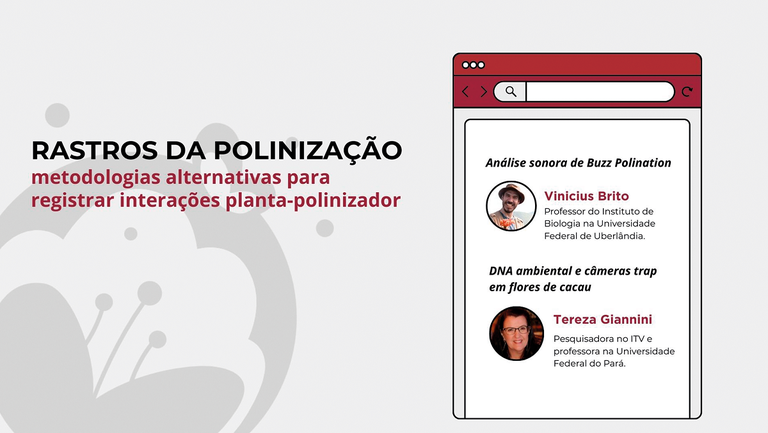
Studying interactions between plants and pollinators isn’t always straightforward. Many of these encounters take place on tiny flowers, involving insects that are fast or nearly invisible to the naked eye. Today, new technologies are helping scientists document these relationships with much greater precision.
Equipment such as vibrometers can simulate, in the laboratory, the behavior of bees that vibrate flowers to release pollen. Meanwhile, camera traps installed in trees record discreet visitors, such as the small pollinators of cocoa flowers.
In the first episode of Bate Papo INPol, the guests are Tereza Cristina Giannini, a researcher at the Vale Institute of Technology (ITV) specializing in ecological interactions and ecosystem services such as pollination and seed dispersal, and Vinicius Brito, a professor at the Federal University of Uberlândia who studies ecosystem ecology and plant reproductive biology.
Together, they discuss alternative methodologies for studying plant–pollinator interactions and show how technology is expanding what we can observe in nature.
Watch and discover new ways to research pollination. The full episode is available on the INPol YouTube channel.
The Bate Papo INPol project is an initiative of INCT Pollination (INPol) fellows. This first episode of the series featured Victor Duarte, from the Pollination in Ecosystems Research Group, and Renata Santos Souza, from Applied Pollination.
INPol is part of the Ministry of Science, Technology, and Innovation’s (MCTI) National Institutes of Science, Technology, and Innovation Program and is dedicated to scientific research and the dissemination of knowledge about pollination, pollinators, and ecosystem services—the benefits that people derive from nature, which are essential to our survival, economic activities, and well-being.