Notícias
New species of Verbenaceae with blue flowers named in honor of researcher Rafaela Forzza
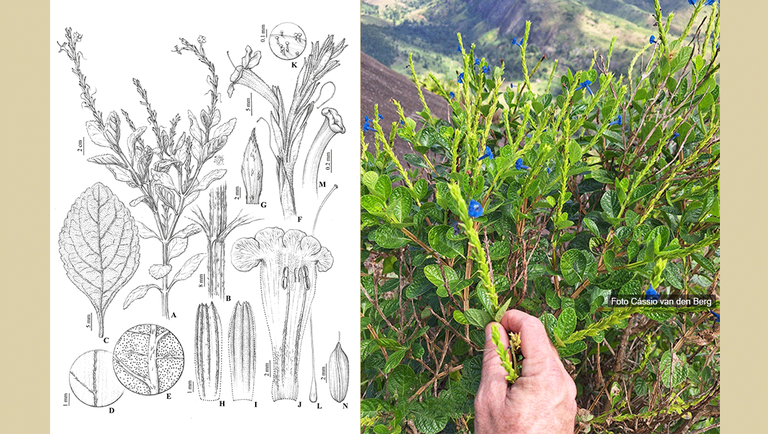
An article published on December 6 in the Nordic Journal of Botany introduced science to a new species of blue flowers, named Stachytarpheta forzzae. This species occurs in Pedra do Oratório, an inselberg (a rock formation similar to Sugarloaf Mountain) in the Atlantic Forest located in the municipality of Guaratinga, in the state of Bahia.
The discovery was made from photos posted on INaturalist (a citizen science platform) by researcher Cássio van den Berg, from the State University of Feira de Santana, Bahia. The images caught the attention of researcher Pedro Henrique Cardoso (ENBT/JBRJ), not only because of the plant's unique characteristics, but also because, until then, only one other species of the genus Stachytarpheta had been recorded on inselbergs. According to the expert, species of this genus are found mainly in the rocky fields of the Espinhaço Range and Chapada dos Veadeiros.
The collection of plant samples, in a location that was extremely difficult to access, was carried out later with the help of a local resident, Mr. Wilton Silva dos Santos, which shows the importance of local knowledge for scientific research on biodiversity. Using this material, the authors performed morphological, palynological, and anatomical analyses.
The name of the new species pays tribute to researcher Rafaela Campostrini Forzza (ICMBio and JBRJ), recognized by the authors as a visionary botanist whose scientific rigor and unwavering strength have consistently promoted knowledge and conservation of Brazilian flora, leaving a legacy that inspires generations. The preliminary assessment of extinction risk indicates that Stachytarpheta forzzae is Critically Endangered (CR).
According to Pedro Henrique Cardoso, the discovery of a new species restricted to Pedra do Oratório reinforces the urgency of protecting this inselberg in Guaratinga. He also points out that, without the records made available by iNaturalist, the plant could have remained unknown for years. Therefore, even with difficult access, expanding collection efforts in the region is essential to prevent other equally rare species from going unnoticed. For the botanist, strengthening taxonomic research is indispensable for understanding, valuing, and conserving biodiversity.