Notícias
New Global Report Highlights the Digital Revolution in Biodiversity and Features Projects Coordinated by the Rio de Janeiro Botanical Garden
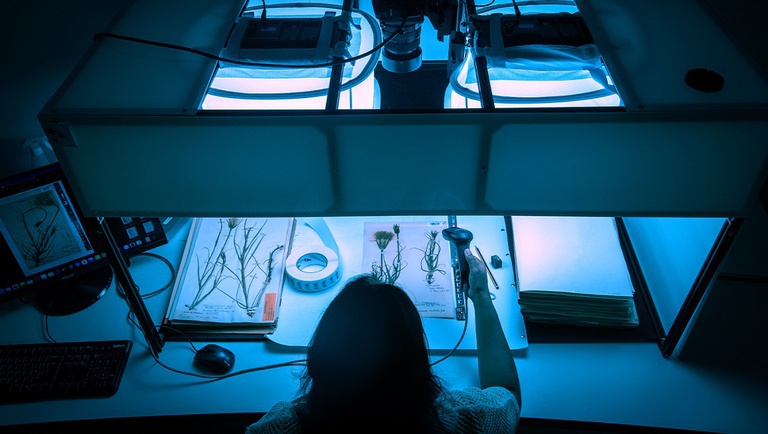
The digitization of plant and fungal specimens (herbarium vouchers) allows specialists to access and study the material online, greatly accelerating research efforts | Photo: Jeff Eden / © RBG Kew**
The new edition of the State of the World’s Plants and Fungi (SOTWPF) report was published on Tuesday, June 16. Coordinated by the Royal Botanic Gardens, Kew (United Kingdom), the report brings together contributions from more than 400 experts from 40 countries. The 2026 edition focuses on the digital revolution in biodiversity, presenting the main advances in the generation and sharing of biodiversity data achieved over the last two decades.
According to the report, more than 145 million plant and fungal specimens housed in physical herbaria worldwide have now been digitized, with their images and associated data made freely available online. This unprecedented level of access has facilitated, integrated, and accelerated the work of specialists across a wide range of fields—from taxonomy and pharmacology to conservation, history, and anthropology—while also supporting citizen science initiatives and improving the management of protected areas.
Rapid technological advances, including mass digitization and the use of Artificial Intelligence (AI), have helped democratize knowledge and address historical inequalities. Digitization and mathematical models are also accelerating species extinction risk assessments, although the report argues that current assessment methods should be reconsidered. New technological tools have further revealed that flowering times have shifted globally over the last century due to climate change and have generated important new insights into fungal diversity.
The first chapter of SOTWPF 2026 highlights the role of systems developed and/or coordinated by the Rio de Janeiro Botanical Garden (JBRJ) for managing Brazilian floristic biodiversity data. According to the report:
“Brazil, the largest and most biodiverse country in the Global South—with approximately 50,000 known native species of plants and fungi—is now a pioneer in the digital repatriation of Brazilian specimens held in foreign herbaria, as well as in the digitization of its own botanical and mycological collections.”
A featured diagram illustrates the integration of several key biodiversity information systems: Flora e Funga do Brasil (the unified directory of scientific names of Brazilian species), Jabot (the JBRJ botanical collections management system), the Reflora Virtual Herbarium, which provides images and data for approximately five million plant, algal, and fungal specimens—many digitally repatriated from European and North American herbaria—and the Catalogue of Plants of Brazil’s Protected Areas.
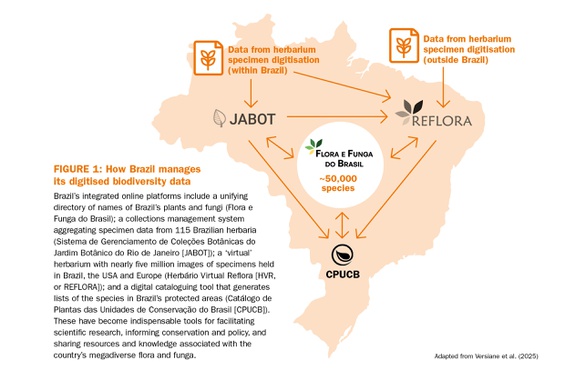
- **The report features an infographic illustrating the integration of these systems.**Ou, de forma um pouco mais formal:**The report includes an infographic showing the integration among these systems.**
For Domingos Cardoso, a researcher at the Rio de Janeiro Botanical Garden, this integration represents a major advance in biodiversity data governance in Brazil.
“In a megadiverse country of continental dimensions such as Brazil, cataloguing and making knowledge about our flora and funga accessible is an enormous challenge. The systems developed and coordinated by the Rio de Janeiro Botanical Garden have made it possible to integrate previously scattered information, strengthen data governance, and open new pathways for accelerating the documentation of Brazilian biodiversity,” he said.
According to SOTWPF 2026, Brazil’s success in creating these interconnected resources “is supported by collaborations between bioinformaticians specializing in the application of computer science to the management and analysis of biological data and taxonomists with expertise in the nomenclature, description, and classification of living organisms.”
The report also gives special recognition to the fully digitized Ethnobotanical Collection of the Rio de Janeiro Botanical Garden, which is featured in the chapter on the digital future of research. Other Brazilian projects are highlighted as examples, including one focused on the conservation of the genus Cambessedesia and another investigating the impacts of the West-East Integration Railway (FIOL) on species from the Cerrado, Caatinga, and Atlantic Forest biomes.
In addition to the report, a special collection of 50 scientific articles has been published in the journals New Phytologist and Plants, People, Planet. These articles explore in greater depth the themes addressed in SOTWPF 2026 and include contributions from researchers at the Rio de Janeiro Botanical Garden and other Brazilian institutions.
Access the State of the World’s Plants and Fungi 2026.
Access the special article collection, Harnessing the Benefits of Specimen Digitisation.