Notícias
Lecture discusses possible paths for the Anthropocene
The consequences of human action on the planet are undeniable and are becoming increasingly significant. Many of them are negative, as can be seen with global warming, species extinction, pollution, and deforestation. For this reason, many scholars have adopted the term Anthropocene to describe this era marked by unprecedented imbalances and increased human impacts on the biosphere.
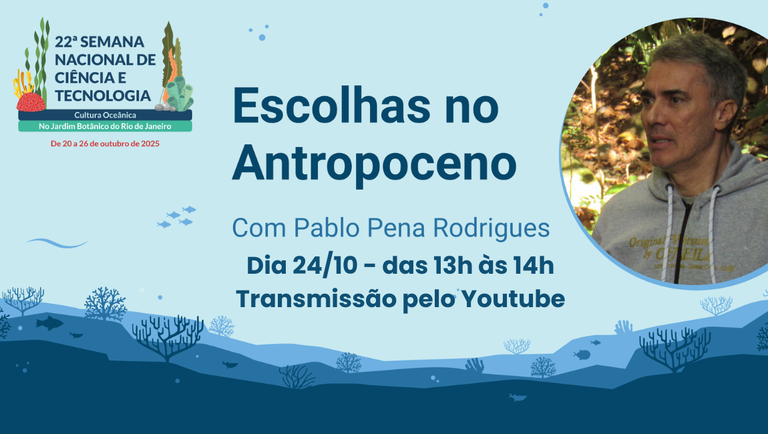
In the online lecture Choices in the Anthropocene, researcher Pablo Pena Rodrigues, from the Rio de Janeiro Botanical Garden Research Institute (JBRJ), discusses three possible alternatives for dealing with this reality. The lecture will take place on Friday, October 24, at 1 p.m., broadcast on the JBRJ YouTube channel, and is part of the program for the 22nd National Science and Technology Week (SNCT) at the JBRJ.
Doing nothing or not doing enough to change the current situation is the path that humanity is currently following, which Rodrigues calls the Anthropocentric path. According to the researcher, the inability to develop new technologies and cultures that are favorable to the environment will lead to the collapse of current life support systems, resulting in dangerous scenarios for humanity itself.
Given this scenario, two other alternatives are proposed, which can help us choose a safer and more sustainable future. The “Biocentric-Technological” path emphasizes the need to recalibrate human-ecological interactions to halt the process of transforming the biosphere. The “Bio-Anthropogenic” path is a middle ground between the extremes, based on strategies that can lead to the creation of new ecosystems and a symbiotic relationship between humans and new organisms. Both paths require ethical, cultural, and technological changes.
The lecture is thus an invitation to rethink the ways we inhabit the planet and to change our attitudes and actions. The mediation is by Claudia Rabelo Lopes (JBRJ and doctoral student at IH-UFRJ).
Pablo Pena Rodrigues holds a bachelor's degree in Biology and a master's degree in Ecology from the Federal University of Rio de Janeiro (UFRJ), and a PhD in Biosciences from the State University of Norte Fluminense (UENF). A researcher at the Rio de Janeiro Botanical Garden since 2002, he coordinated the Atlantic Forest Program (2004 to 2008) and the Atlantic Forest Biome Biodiversity Project/JBRJ/MCTI/MMA (2009 to 2014). He also teaches graduate and undergraduate courses. His research focuses on tropical forest ecology and anthropogenic effects on the biosphere, with the main themes being habitat fragmentation and extinction, ecological restoration, and aspects related to the Anthropocene. In 2019, he co-authored the Bio-evolutionary Anthropocene hypothesis, which explores the role of humanity and new organisms in the transformation of the biosphere.
Choices in the Anthropocene - Online lecture with Pablo Pena Rodrigues (JBRJ)
October 24, 2025, from 1:00 p.m. to 2:00 p.m.
Broadcast on the JBRJ YouTube channel.