Notícias
JBRJ receives hundreds of bromeliads seized in Ibama operation against international trafficking of endangered native flora
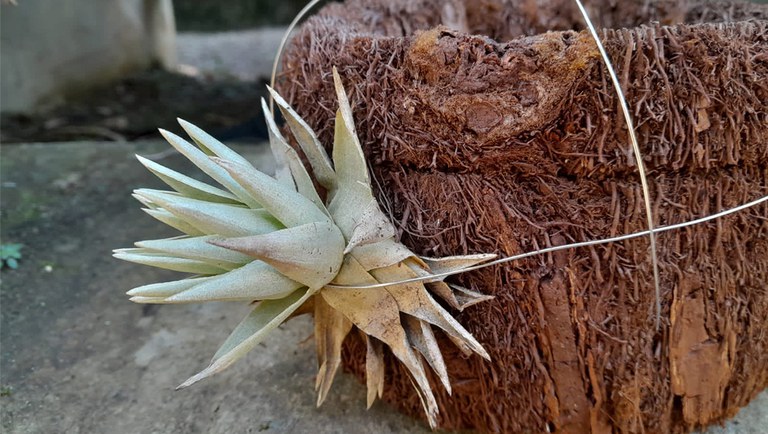
One of the bromeliads seized and already in cultivation at the Rio de Janeiro Botanical Garden, on a tree fern support also seized by Ibama in a previous operation.
he Rio de Janeiro Botanical Garden (JBRJ) received 549 specimens of endangered bromeliads seized in an inspection operation carried out by the Brazilian Institute for the Environment and Renewable Natural Resources (Ibama) between May 12 and 15. The plants were in an irregular warehouse located in the municipality of Cotia, in São Paulo. Entitled Operation Hermes - Tillandsias, the action was the result of an interception of irregular exports at Viracopos International Airport last year. The action also resulted in fines of more than R$165,000.
The bromeliads seized are from the genus Tillandsia. Among the species are Tillandsia araujei, Tillandsia carminea, Tillandsia heubergeri, Tillandsia kaustskyi, Tillandsia neglecta and others, all endemic to the Atlantic Forest. The plants are now being cultivated in JBRJ's scientific collection of bromeliads. The removal of their habitat without authorization is not only an environmental crime, but also a risk to the survival of these species, which are essential to the balance of our ecosystems.
The operation, carried out by Ibama's inspection teams and officials from the Biodiversity Foreign Trade Coordination Office of the Biodiversity and Forestry Directorate (Comex/DBFlo/Ibama), had the collaboration of researchers from the Rio Botanical Garden and the Chico Mendes Institute for Biodiversity Conservation (ICMBio). The aim of the operation was to prevent illegal trade in these plants and to reinforce measures to protect Brazilian flora. The sanctions were applied on the basis of current environmental legislation, which provides for punishments for crimes against flora and trafficking in wild species.
The curator of JBRJ's Bromeliad collection, Bruno Rezende, went to São Paulo to collect the plants and spoke to Lilian Iara Sasso (Ibama), who was responsible for the seizure. The species were identified by Rafaela Forzza (a researcher at JBRJ and ICMBio) and specialist Elton Leme.
The aim of the operation was to prevent the illegal trade in these plants and to reinforce measures to protect Brazilian flora. The sanctions were applied on the basis of current environmental legislation, which provides for punishments for crimes against flora and trafficking in wild species.
* With information from Ibama's website.