Notícias
JBRJ participates in project to learn about the biodiversity of the Upper Rio Negro
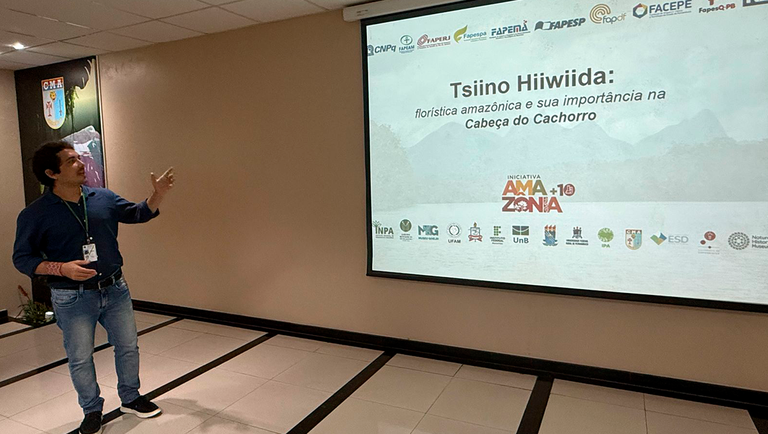
Domingos Cardoso presents the project during the 1st Meeting | Photo Cimone Barros/ Ascom Inpa
The project “Tsiino Hiiwiida: revealing multiple dimensions of plant and fungal biodiversity in the Upper Rio Negro” kicked off its activities with a meeting on April 23 and 24 at the Amazon Military Command (CMA). The project, which was one of those included in the Amazônia+10 initiative to support scientific expeditions to expand knowledge about socio-biodiversity and Amazonian biodiversity, has the participation of the Rio de Janeiro Botanical Garden (JBRJ/MMA) through researcher Domingos Cardoso, and seven other institutions, led by the National Institute for Amazonian Research (INPA/MCTI).
In the Baniwa language, Tsiino Hiiwiida means Cabeça do Cachorro, the name of the region in the northwest of Amazonas, on the Upper Rio Negro, which borders Venezuela and Colombia. The project will be carried out in partnership between indigenous and non-indigenous researchers. The name was chosen as a way of showing commitment and appreciation for the native peoples of the region, which has one of the largest indigenous populations in the country, with 24 ethnic groups. The Tsiino Hiiwiida project aims to reduce the gaps in knowledge of Amazonian biodiversity through botanical collections and to strengthen collaborative networks.
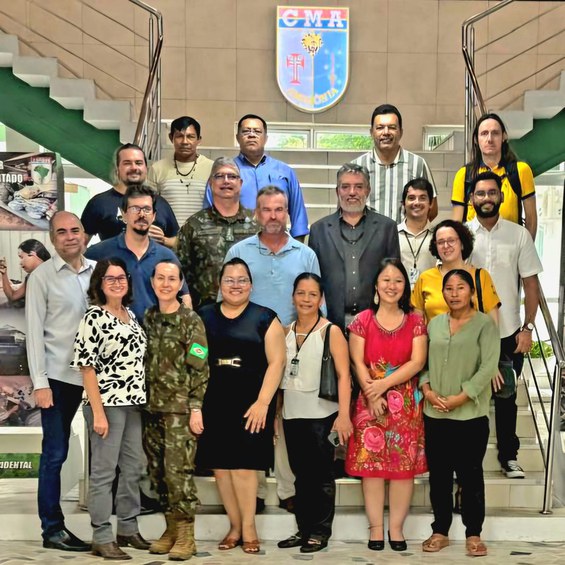
At this first meeting, which was attended by researchers, military personnel and representatives of indigenous peoples, the members discussed the challenges for research in regions that are difficult to access, and the geographical characteristics and biodiversity of the region where the scientific expeditions will be carried out. According to the project's coordinator, Charles Zartman (INPA), the different areas of study that make up the project, strategic planning and the organization of the expedition schedule were presented. It was also an opportunity to strengthen the relationship with the CMA, a partner that will provide the necessary logistical support and will work in the areas of geography and unique health, which studies new epidemiological threats from an integrated dimension between human health, animal health and environmental health.
The researchers from the eight participating research institutions will receive funding from their states' funding agencies: Fapem: Charles Eugene Zartman -Inpa; Faperj: Domingos Cardoso - JBRJ; Fapespa: Anna Luiza Ilkiu-Borges - Museu Paraense Emílio Goeldi - MPEG); Facepe: Clístenes Williams Araújo do Nascimento - Universidade Federal Rural de Pernambuco - UFRPE); Fapema: Dirce Leimi Komura - Federal Institute of Science and Technology of Maranhão - IFMA; Fapesp: Denilson Fernandes Peralta - Environmental Research Institute - IPA; Fapesq: Felipe Wartchow - Federal University of Paraíba - UFPB; FAPDF: Micheline Carvalho-Silva - University of Brasília - UnB and UKRI: Sandra Knapp - Natural History Museum.
Researcher Domingos Cardoso believes that the meeting was extremely symbolic and strategic: “We are talking about one of the most beautiful and biodiverse regions on the planet, but which, paradoxically, still has vast areas that are little known from a scientific point of view. The field studies we will be carrying out will enrich the collections of the Amazonian herbaria and the Rio de Janeiro Botanical Garden, and will also open the way to possible discoveries of species that have never been catalogued.”
He adds that JBRJ's role will be fundamental in ensuring that the knowledge produced is in fact systematized, becomes accessible and generates lasting impacts: “Through the platforms of Jabot, Reflora Herbário Virtual and Flora e Funga do Brasil, we will ensure that the information generated is available to society, to the scientific community and to the local communities themselves. In this way, we contribute not only to conservation, but also to strengthening collaborative, intercultural and integrative science, which is the essence of the Tsiino Hiiwiida project,” concludes the researcher.
*With information from the INPA website.