Notícias
Has the reduction in rainfall already transformed the Amazon rainforest? Leandro Valle Ferreira (MPEG) discusses the topic at the Biodiversity Forum
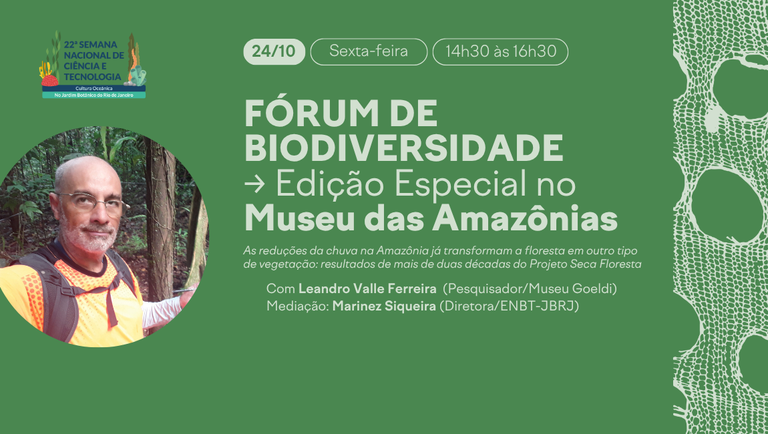
Much is said about a dystopian future in which the Amazon rainforest may cease to exist or become something different from what we know today. But what if this is already a reality? The Botanical Garden Museum in Rio de Janeiro and the Amazon Museum in Belém—both managed by idg - Institute for Development and Management - are joining forces in their first institutional partnership to bring this emerging topic to a special edition of the Biodiversity Forum on October 24, at 2:30 p.m., in the newly inaugurated space in the capital of Pará.
The meeting, which is part of the program of the Rio de Janeiro Botanical Garden for the 22nd National Science and Technology Week, organized by the Ministry of Science, Technology, and Innovation (MCTI), will have as its theme “Rainfall reductions in the Amazon are already transforming the forest into another type of vegetation: results from more than two decades of the Seca Floresta Project,” and will feature Leandro Valle Ferreira, a researcher at the Emílio Goeldi Museum of Pará (MPEG), as a guest speaker. For him, “It is urgent to bring this debate to the public so that we can collectively think about mitigation and conservation strategies.” The panel will also be moderated by Marinez Ferreira de Siqueira, director of the National School of Tropical Botany at the Rio de Janeiro Botanical Garden (ENBT/JBRJ).
The Biodiversity Forum is a regular program organized by JBRJ, dedicated to discussing key topics in biodiversity science. In this edition, it joins forces with the Amazon Museum and the Emílio Goeldi Museum of Pará to expand the exchange of knowledge between institutions and audiences in Belém and Rio de Janeiro. The event is free and will be broadcast in the Multipurpose Room of the Botanical Garden Museum and on the JBRJ YouTube channel.
The lecture will present the results of the Seca Floresta Project, one of the longest-running experiments in artificial rain exclusion in tropical forests. Since 2001, the research has been assessing the impacts of water reduction on the Caxiuanã National Forest (PA), simulating conditions similar to those caused by the El Niño phenomenon. The studies have recorded an increase in the mortality of large trees, a reduction of up to 30% in sap flow, transpiration, and photosynthesis, the disappearance of species dependent on mycorrhizal fungi, micrometeorological changes, and the collapse of shrubby biological forms.
The findings indicate that prolonged reductions in precipitation can lead to abrupt and irreversible transformations of the tropical rainforest into more open and dry vegetation, with less biomass and biodiversity.
Biodiversity Forum - Special edition at the Amazon Museum
Date: Friday, October 24, 2025
Time: 2:30 p.m. – 4:30 p.m.
Location: Amazon Museum - Porto Futuro II Complex, Warehouse 4, Reduto Neighborhood, Belém (PA).
Seats: 50, on a first-come, first-served basis
Live broadcast on JBRJ's YouTube channel and in the Multipurpose Room of the Botanical Garden Museum (50 seats) - Rua Jardim Botânico, 1008 - Jardim Botânico, Rio de Janeiro (RJ).