Go to Content 1 Go to Home 2 Go to Navigation 3 Go to Search 4 Go to Sitemap 5
Abrir menu principal de navegação
Instituto de Pesquisas Jardim Botânico do Rio de Janeiro
Most searched terms
  • imposto de renda
  • inss
  • assinatura
  • cnh social
  • enem
Most searched terms
  • imposto de renda
  • inss
  • assinatura
  • Subjects
    • Visitation
      • Hours
      • Tickets
      • Directions
      • Electric cars
      • Guided walking tours and themed tours
      • Conveniences
      • Visiting rules
      • Standards for professional photography
    • Research
    • Education
      • Escola Nacional de Botânica Tropical
      • Stricto Sensu Graduate Program in Botany
      • Professional Graduate Program Biodiversity in Protected Areas
      • Socio-environmental Responsibility
      • Environmental Education
      • Institutional Scientific Initiation Scholarship Program - PIBIC
      • Escola Jardim
    • Collections
      • Archival Collections
      • Bibliographical
      • Biological
      • Museology
    • History
    • News
  • Access to Information
    • Covenants and Transfers
      • Partnership
  • Composition
  • Content Centers
    • Video
    • Images
    • JBRJ Data Portal
    • Publications
      • Books
      • Arboretum Families Series
      • CDs
      • Legislation
      • Botânica Pop
      • Documents
      • Rodriguesia
    • Books and Scientific Publications
      • Rodriguésia
      • Field Guides
      • Archivos do Jardim Botânico
  • Service Channels
    • Contact Us
  • GOV.BR
    • Services
      • Search services by
        • Categories
        • Departments
        • States
      • Services by target audience
        • Citizens
        • Companies
        • Departments and Public Entities
        • Other segments (NGOs, social organizations, etc)
    • Application Gallery
    • Navigation
      • Acessibility
      • Sitemap
    • Government of Brazil
      • Latest News
        • 2021
        • 2022
Useful Links
  • Application Gallery
  • Get involved
  • Application Gallery
  • Get involved
Social Networks
  • Twitter
  • YouTube
  • Facebook
  • Instagram
  • Flickr
Você está aqui: Home Subjects News Fire and logging in the Amazon impoverish ecological interactions
Info

Notícias

Fire and logging in the Amazon impoverish ecological interactions
Share by Facebook Share by Twitter Share by LinkedIn Share by WhatsApp link to Copy to Clipboard
Published in Apr 25, 2025 01:38 PM
banner_site_artigo.png

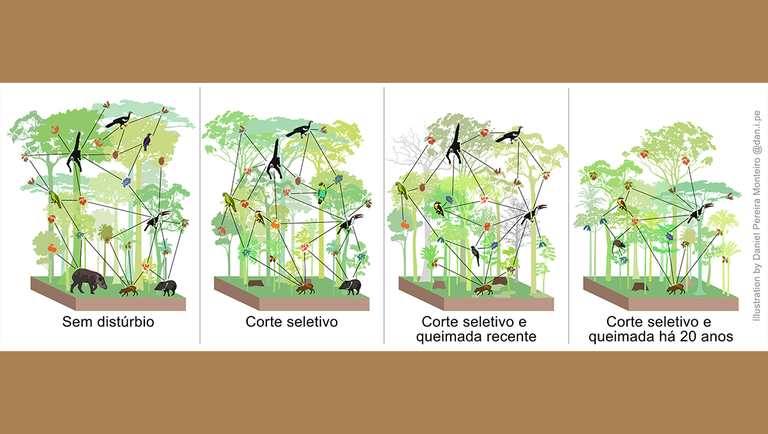
A new study reveals that fires and selective logging - unnatural disturbances for Amazonian ecosystems - reduce animal-plant interactions that are essential for forest maintenance and regeneration.

Frugivory interactions refer to the ecological relationships between animals that feed on fruits (frugivores) and plants that produce fleshy fruits. These interactions are fundamental to the maintenance of ecosystems, as frugivores - such as birds, primates and bats - consume fruit and disperse seeds, helping to regenerate forests and maintain biodiversity. This is especially crucial in tropical forests like the Amazon, where many plant species depend on animals for seed dispersal.

Based on the importance of these interactions, a new study by Brazilian and British researchers has quantified the impacts of forest fires and selective logging on frugivory interactions in the heart of the Brazilian Amazon.

Published in the renowned journal Oikos, the study reveals that forest fires and selective logging significantly reduce frugivory interactions in the Amazon, threatening essential processes necessary for forest regeneration, such as seed dispersal. Forest fires are a recent phenomenon in the Amazon forests and can have profound and lasting impacts on biodiversity and species interactions.

Led by Dr. Liana Chesini Rossi, who dedicated 1,500 hours to focal observations and almost 30,000 hours to camera trap monitoring, the research offers the most comprehensive quantification to date of how forest fires and selective logging affect frugivory interactions in tropical forests. The fieldwork required to collect this data was challenging, with researchers facing adverse conditions, long walks through dense forests and the curiosity of local fauna - including capuchin monkeys that interacted with the cameras - to document these ecological interactions for tropical forests.

The study revealed that forests that had been burned and logged for almost two decades showed a 16% reduction in species and a 66% decline in the number of interactions. These disturbances also led to significant changes in the composition of the local fauna, including the disappearance of some species, and in the interactions between frugivorous animals and plants, compared to primary forests.

“These results highlight the long-term effects of forest fires and selective logging on the configuration of ecological interactions, especially when they act together,” explains Liana, currently a postdoctoral fellow at the Rio de Janeiro Botanical Garden, who led the study during her doctorate at São Paulo State University (UNESP-Rio Claro). “Although the organization of these interactions has not changed drastically, the continued loss of species and interactions, coupled with the predicted increase in the frequency and intensity of forest fires due to climate change, could threaten the resilience of tropical forests.”

One of the most worrying aspects of the research is that forests affected by logging and fires for almost 20 years are still unable to sustain key species. “In addition to making burned forests poorer in life, the absence of these species also deprives some plants of their main seed dispersers, which can compromise the structure and continuity of plant populations in the long term,” explains Prof. Marco Aurélio Pizo, the study's principal investigator. The lack of these interactions suggests that the effects of human disturbances persist for much longer than previously thought and can damage the functionality of the ecosystem on a prolonged scale.

This study was carried out as part of the Long-Term Ecological Monitoring Program of the National Council for Scientific and Technological Development (CNPq), within the project coordinated by the Sustainable Amazon Network.

Read the full article here.

Environment and Climate
Share by Facebook Share by Twitter Share by LinkedIn Share by WhatsApp link to Copy to Clipboard
  • Subjects
    • Visitation
      • Hours
      • Tickets
      • Directions
      • Electric cars
      • Guided walking tours and themed tours
      • Conveniences
      • Visiting rules
      • Standards for professional photography
    • Research
    • Education
      • Escola Nacional de Botânica Tropical
      • Stricto Sensu Graduate Program in Botany
      • Professional Graduate Program Biodiversity in Protected Areas
      • Socio-environmental Responsibility
      • Environmental Education
      • Institutional Scientific Initiation Scholarship Program - PIBIC
      • Escola Jardim
    • Collections
      • Archival Collections
      • Bibliographical
      • Biological
      • Museology
    • History
    • News
  • Access to Information
    • Covenants and Transfers
      • Partnership
  • Composition
  • Content Centers
    • Video
    • Images
    • JBRJ Data Portal
    • Publications
      • Books
      • Arboretum Families Series
      • CDs
      • Legislation
      • Botânica Pop
      • Documents
      • Rodriguesia
    • Books and Scientific Publications
      • Rodriguésia
      • Field Guides
      • Archivos do Jardim Botânico
  • Service Channels
    • Contact Us
Reset Cookies
Social Networks
  • Twitter
  • YouTube
  • Facebook
  • Instagram
  • Flickr
Acesso àInformação
All content on this site is published under license Creative Commons Attribution-NoDerivs 3.0 Unported.
Voltar ao topo da página
Fale Agora Refazer a busca