Notícias
Environment Week at the Rio Botanical Garden highlights the role of science in addressing socio-environmental crises
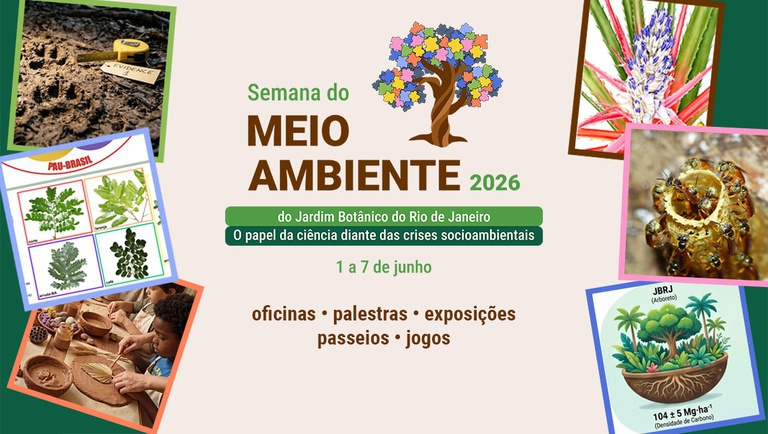
From June 1 to 7, the Rio de Janeiro Botanical Garden is hosting Environment Week, which invites the public to reflect on “The role of science in the face of socio-environmental crises.” Inspired by World Environment Day—celebrated on June 5 and established by the UN in 1972—the program brings together initiatives that combine scientific knowledge, experiences in the arboretum, and environmental awareness.
Throughout the week, the public can participate in workshops, exhibitions, roundtables, and guided trails, engaging in activities that bring together science, education, and environmental conservation. All activities are free, and no admission ticket to the arboretum is required. From Monday through Wednesday, booths will be set up in the Galpão das Artes. Starting Thursday, other activities will be offered at the Botanical Garden Museum.
With the aim of showing how science can help us address socio-environmental crises, the game “EcoRota: Choose Your Path” presents visitors with real-world dilemmas involving urbanization and the environment in the city. Participants take on the role of decision-makers who must make choices and take responsibility for the consequences. Researcher Catarina Lira and her students, the game’s creators, emphasize that all scenarios presented are based on actual research conducted at the Rio de Janeiro Botanical Garden, and what unfolds on the game board reflects their laboratory studies.
Carbon (CO2) released by the burning of fossil fuels, such as diesel and gasoline, is the primary greenhouse gas responsible for warming the planet to alarming levels—the crux of the current climate crisis. In a reverse process, plants remove CO2 from the air to grow. That is why green spaces, including those in cities, are essential for helping to regulate the climate. The imperial palm trees at the Rio de Janeiro Botanical Garden, for example, famous for their grandeur, store 1,962 tons of biomass on their own. This is one of the facts visitors will discover in the activity “Trees That Protect the Climate,” where they will learn how to calculate the carbon stock of trees and palms with the help of an app.
Also famous, a Brazilian tree plays a fundamental role in the country’s history and revolutionized the arts and music. If you thought of the brazilwood tree, you’re right. Although much talked about, this species still holds mysteries, many stories, and surprises, which will be on the agenda at the roundtable “Brazilwood: A Dialogue Between the Arts, Sciences, and Traditional Knowledge,” on the 3rd at 2 p.m. in the AAJB Auditorium.
Art also joins forces with science in the exhibition, workshop, and lecture on Botanical Illustration, featuring Professor Paulo Ormindo (UFRRJ and ENBT/JBRJ). The Botanical Art exhibition features works by Aline Oliveira, Cristiane Melo, David Lucena, Maria Alice Rezende, Mônica Claro, Paulo Ormindo, Susana F. de Souza, and Thelma Rezende, depicting specimens of endangered and historic species from some of our biomes. For those seeking to reconnect with the earth, the “Poetics of the Earth” workshop—using clay and natural elements—integrates body, imagination, and matter, valuing the process and individual expression.
Children can participate in a botanical watercolor workshop using natural paints, while discovering how plants are present in our daily lives—in our food, medicine, construction, and various cultural practices. The activity “Plants in the Culture of Biomes” is organized by the JBRJ Environmental Education Service (SEA).
In most cases, botanists identify plant genera and species by observing and comparing the characteristics of flowers and leaves. Plants from the same family may look very different, but they share certain common characteristics. A good example is the bean and the brazilwood tree, both from the legume family, also known as Fabaceae, which will be the focus of the hands-on workshop on Taxonomy and Ontogeny (the study of flower development).
Identifying animal tracks left by creatures that live in or pass through the Botanical Garden is the challenge the Wildlife Center is setting for visitors at its booth. And speaking of animals, stingless bees, native to the Atlantic Forest, are the focus of a tour through the arboretum and the Meliponary, where visitors can see the nests and learn about the characteristics of different species living in the Garden. Also on offer will be the guided tour “The Path of the Araceae—Jorge Tadeu’s Mystical Flowers,” led by researcher Marcus Nadruz, and the Endangered Species Trail, as well as guided activities for species identification using the iNaturalist app.
For undergraduate and graduate students and researchers, the 1st Graduate Research Seminar of the National School of Tropical Botany is a special opportunity to learn about the groundbreaking research being conducted by ENBT master’s and doctoral students, engage in discussions, and perhaps even be inspired to come study at the Rio de Janeiro Botanical Garden. The Seminar will take place on June 2 in the multipurpose room of the Botanical Garden Museum.
The Museum will inaugurate the new Amazon BioOCAnomy exhibit, which will offer educational tours on Thursday (4) and Sunday (7), as well as card games on sustainability, an invention lab, and art and nature workshops.
Check out the full schedule for JBRJ Environment Week 2026 with dates and times for all activities.