Notícias
CNCFlora launches seven publications to guide and implement conservation actions
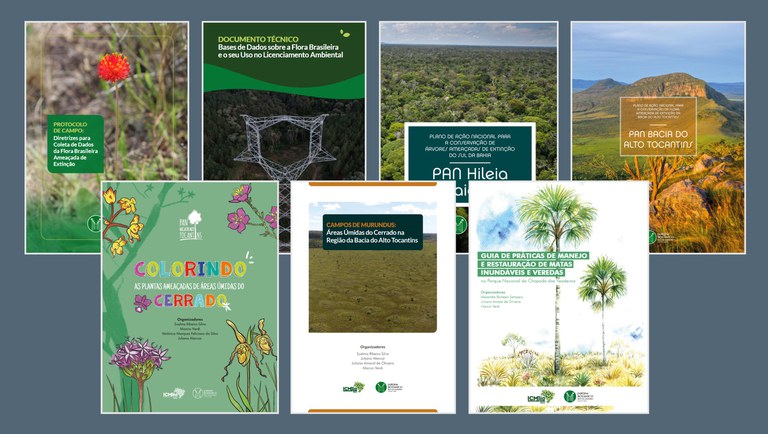
The Rio de Janeiro Botanical Garden Research Institute, through the National Center for Flora Conservation (CNCFlora), is making available seven new publications launched on International Biodiversity Day, May 22 this year. Among them are two new National Action Plans: one for the conservation of endangered trees in southern Bahia (PAN Hileia Baiana) and another for the conservation of endangered flora in the Upper Tocantins Basin (PAN Bacia do Alto Tocantins).
As part of the actions of the Upper Tocantins Basin PAN and in partnership with the Chico Mendes Institute for Biodiversity Conservation (ICMBio), three publications were also launched: the books “Coloring the Threatened Plants of the Cerrado Wetlands”, “Murundus Fields: Wetlands of the Cerrado in the Upper Tocantins Basin Region” and the “Guide to Management and Restoration Practices for Flooded Forests and Footpaths in the Chapada dos Veadeiros National Park”.
Completing the set of releases are two digital-only publications: the “Field Protocol: Guidelines for Collecting Data on Endangered Brazilian Flora” and the “Technical Document on Brazilian Flora Databases”, aimed at environmental licensing.
All the publications were supported by the Global Environment Facility Trust Fund (GEF) through the National Strategy for the Conservation of Threatened Species Project - Pro-Species: Everyone against extinction.
Find out more about each of the publications below:
National Action Plan for the Conservation of Endangered Trees in Southern Bahia (PAN Hileia Baiana)
The PAN Hileia Baiana is a management and public policy instrument in Brazil, defining strategies for the conservation of endangered species. The publication covers environmental and socio-economic aspects of the area covered, as well as providing information on threatened species and those indirectly benefiting from conservation actions. The document also discusses the main vectors of pressure on the flora, as well as the priority areas for conservation, restoration and scientific research. It also includes a Supplementary Table summarizing the spatial prioritization analyses and details the actions taken to mitigate the risk of extinction of threatened species in the region.
National Action Plan for the Conservation of the Endangered Flora of the Upper Tocantins Basin (PAN Upper Tocantins Basin)
The PAN Upper Tocantins Basin is a management and public policy instrument in Brazil, defining strategies for the conservation of endangered species. It addresses the environmental and socio-economic aspects of the territory covered, which includes part of the Federal District and the state of Goiás, as well as the species threatened with extinction and those benefiting indirectly from conservation actions. Also presented is a brief history of Action Plans and their methodology, the main vectors of pressure on the flora in the territory, the priority areas for conservation and the actions taken to reverse the risk of extinction of endangered flora species in the region. In addition, the book includes Supplementary Tables listing the conservation units located in the PAN territory and a summary of the spatial prioritization analyses. The plan also has an Annex, which contains specific information on the species classified as Critically Endangered (CR) and with Insufficient Data (DD), providing subsidies for more targeted conservation actions.
Coloring the Endangered Plants of the Cerrado Wetlands
Aimed at children and teachers in early childhood education, this coloring book invites them to get to know some of the endangered species of the Cerrado that make up the PAN Upper Tocantins Basin with photographs and drawings that students can color and also reproduce characteristics of the plants and their wetland environments. The information related to the drawings helps teachers guide class activities. The book is available in print so that children all over the country can benefit from it.
Murundus Fields: Cerrado Wetlands in the Upper Tocantins Basin Region
Water is a fundamental resource for life, but one that is increasingly threatened by human action and climate change. For this reason, special attention has been paid to the protection of wetlands through the Ramsar Convention, to which Brazil is a signatory. This book aims to give visibility to and raise awareness of one of these wetlands, the Murundus Fields, present in the Cerrado and still little known. Among the topics discussed are the importance of these ecosystems for biodiversity and the ecosystem services they offer, the main threats to these areas, the situation of the Murundus Fields in Brazilian legislation and in the conservation units (UCs) of the Alto Tocantins Basin Region and a list of species collected in the region's murundus fields.
Guide to management practices and restoration of flooded forests and veredas in the Chapada dos Veadeiros National Park
The aim of this guide, according to its presentation, is to propose "monitoring and restoration methods to assist managers in decision-making, conservation actions and, above all, in the recovery of degraded gallery forests in the Chapada dos Veadeiros National Park (PNCV), as part of the project 'Restoration of gallery forests in the Chapada dos Veadeiros after fire' under the CNPq - Prevfogo - Ibama public notice, carried out by the National Center for Research and Conservation in Biodiversity and Ecological Restoration (ICMBio/CBC), coordinated by Alexandre Bonesso Sampaio".
Field protocol: guidelines for collecting data on Brazil's endangered flora
Strategies for conserving Brazil's endangered plant species depend to a large extent on consistent and up-to-date data and information on the species, the characteristics of their environments and their ecosystem interactions. As such, the Field Protocol is intended to guide and standardize procedures for collecting data on field expeditions, as well as offering practical guidelines for photographing species and recording and qualifying pressure vectors that may be affecting the flora. With its adoption by professionals in the field, students, volunteers and enthusiasts interested in the conservation of Brazilian flora, it is hoped that gaps in knowledge will be filled in order to strengthen conservation efforts for species and their habitats.
Technical document: Databases on the Brazilian flora and their use in environmental licensing
This technical document provides information and guidance on how to use the various platforms, databases and tools on the Brazilian flora maintained by the Rio de Janeiro Botanical Garden and other institutions, such as the data repositories and systems of Flora and Funga do Brasil, Jabot, CNCFlora Data Panel, SpeciesLink, among others. The aim is to facilitate the analysis of environmental licensing processes and decision-making based on scientific knowledge. The publication was produced as part of the implementation of the National Action Plan for the Conservation of Endemic Flora Threatened with Extinction in the State of Rio de Janeiro (PAN Flora Endêmica RJ), but is useful for civil servants, technicians and employees of licensing bodies throughout the country.