Notícias
Article discusses how the synergy between taxonomists and bioinformaticians is driving botany forward in Brazil
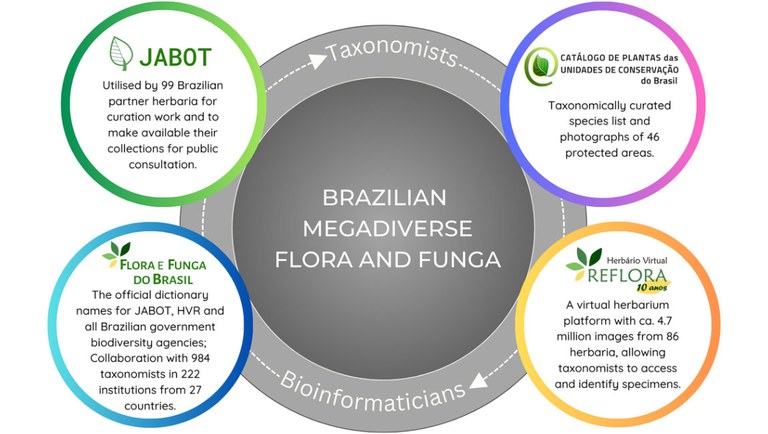
The integrated online platforms for Brazilian biodiversity discussed in the article are the result of synergy between taxonomists and bioinformaticians, and have become indispensable tools for boosting scientific research, conservation and public dissemination of Brazil's flora and fungi (Figure I).
As the country with the greatest floristic diversity in the world, Brazil has made significant progress in its knowledge of plant and fungal species over the last two decades. This has been made possible by the joint work of botanical taxonomists and bioinformatics professionals in developing systems for digitizing, curating and cataloguing the collections of physical herbaria located in our country and abroad. In an article recently published in the scientific journal Plants, People, Planet (PPP), a group of researchers and technicians from the Rio de Janeiro Botanical Garden (JBRJ) report and share their experience in the development and integration of four systems coordinated by the institution: Jabot, Reflora Virtual Herbarium, Flora and Funga of Brazil and Catalog of Plants of the Conservation Units of Brazil.
Jabot is an online platform for managing, digitizing and curating botanical collections, currently used by 99 national herbaria. The Reflora Virtual Herbarium, which began with the digital repatriation of Brazilian botanical specimens from the herbaria of the Royal Botanical Gardens in Kew (UK), the Natural History Museum in Paris and the JBRJ itself, now has more than 4.7 million high-resolution images of specimens, allowing taxonomists to examine and annotate nomenclatural updates without having to physically move between cities or countries. The Flora e Funga do Brasil system, with the collaboration of approximately 1,000 Brazilian and foreign taxonomists working remotely, functions as an online dictionary of the official names of plants and fungi for other systems and for the Brazilian government's biodiversity platforms. And the Catalog of Plants in Brazil's Protected Areas provides lists of species recorded in protected areas in the country, as well as photographs of many of these plants alive in their habitats.
The article presents these systems, tells how teams of taxonomists and bioinformaticians have worked together to create, develop and integrate them in an effort that began 20 years ago, and discusses the results, challenges and future prospects of this work.
Access the article Synergistic efforts in specimen digitization, curation and cataloguing of Brazil's megadiverse flora and funga (original in English)