Notícias
Lists of the Tapajós National Forest and Pedra Azul Park are published in the Catálogo de Plantas das UCs do Brasil
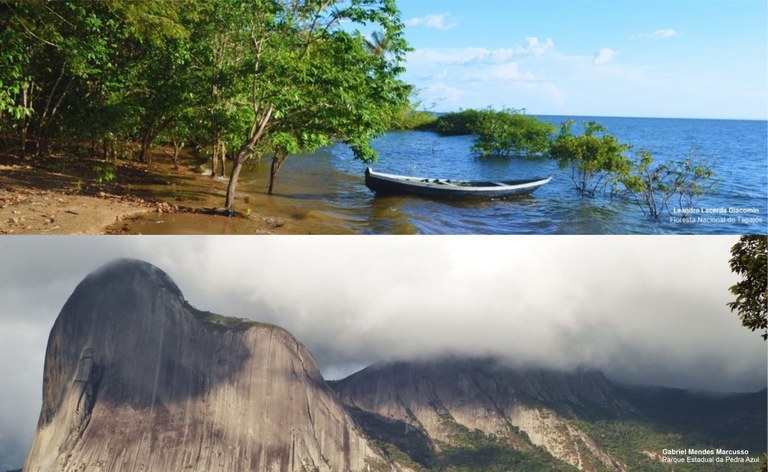
The lists of plants of the Tapajós National Forest (Flona Tapajós), in Pará, and Pedra Azul State Park (PEPA), in Espírito Santo, have been published in the Brazilian Catalog of Conservation Units Plants in December 2022. With this, the Catalog starts the year with the lists of 24 UCs available online.
Created in 1974, the Tapajós Flona currently covers 527,319 hectares located in the municipalities of Aveiro, Belterra, Placas and Rurópolis, in the far west of Pará. The federal UC with the largest number of research records in the SISBIO system in the Brazilian Amazon, it has 855 plant species listed, of which 761 are angiosperms and 94 are ferns and lycophytes. The legume family (Fabaceae) is the most numerous in Flona, with 86 species.
The list brings nine species assessed by the National Center for Conservation of Flora as endangered, of which two in the EN category (Endangered) and seven in the VU (Vulnerable). There are also four species categorized as DD (Data Deficient). Most of the collections made in this UC are deposited in the HSTM, NY and RB herbaria.
The list's main author, Leandro Giacomin, from the Federal University of Paraíba, comments that "the consolidation of the list of the Tapajós Flona is an old demand from the scientific community and from residents and users of the unit, since there are long-term research projects installed and the management of resources, including timber, has been carried out for decades without a list of the UC's plants. The consolidation of this list, although incipient for a UC of half a million hectares, is very relevant and will allow a better control and development of the UC".
Located in the mountainous region in the center-south of Espírito Santo, the Pedra Azul State Park was created in 1960 - initially as a forest reserve - and covers approximately 1,240 hectares of Atlantic Forest mountain ecosystems. However, unlike the Tapajós National Forest, the PEPA has been the target of very little collecting to date. Its list presents 225 species, of which 187 are angiosperms, 36 are ferns and lycophytes, and two are gymnosperms, but the authors warn about the problem of under-sampling and the need for more collections at the site.
"Although PEPA is a much-visited tourist attraction and protects ecosystems that are restricted to the mountains, the Conservation Unit is still poorly explored scientifically. Intensifying sampling efforts can contribute to the conservation and monitoring of these sensitive ecosystems, given the impact that tourist use has on the area, and, in the medium and long term, to assess the effects of climate change on the composition of the park's flora," said Gabriel Marcusso, lead author of the list.
On the PEPA list are two species categorized as CR (Critically Endangered): Senaea janeirensis Brade (Gentianaceae) and Bradea montana Brade (Rubiaceae). There are also ten EN species, three VU and one DD. This Conservation Unit is rich in orchids, with 53 species recorded to date. Most of the samples collected in PEPA are in the HRCB, MBML, RB and VIES herbaria.
The Catalog of Plants of the UCs in Brazil provides images and data, from the Reflora or Jabot Virtual Herbarium systems, of samples of the listed species, as well as more information about each unit and banks of photographs taken in the field.
Access the list of plants of the Tapajós National Forest.