Notícias
COMMUNICATION AND TRANSPARENCY
CADE’s Superintendent General highlights progress in antitrust policy
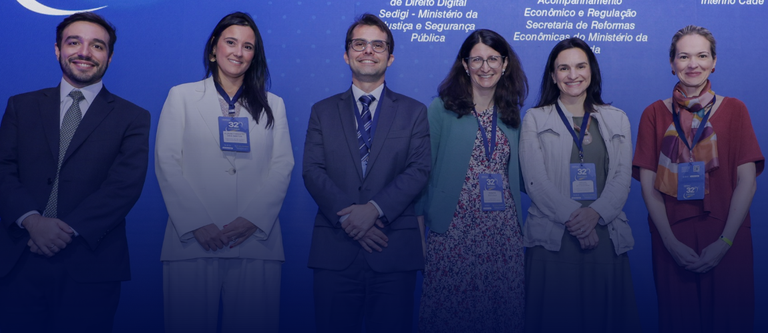
Felipe Roquete, acting Superintendent General of the Administrative Council for Economic Defense (CADE), reviewed recent antitrust policy advances during a closing interview at the 32nd International Seminar on Competition Policy. The Brazilian Institute of Studies on Competition, Consumer Affairs and International Trade (IBRAC) organised the event. “Competition policy has faced the kinds of setbacks to be expected when dealing with powerful, legitimate interests.”
“Over time, CADE has found ways to engage with emerging issues through a collective effort involving stakeholders whose interests do not always align, which is natural. However, we have been working to address today’s challenges,” he said.
Roquete also described the challenges he faced as acting Superintendent General, particularly ensuring that the technical team could continue its work. “The Office of the Superintendent-General (SG) must always keep its doors open. Dialogue with the Office of the Attorney General at CADE (PFE), the Department of Economic Studies (DEE), the Federal Prosecution Services (MPF), the commissioners’ offices and the antitrust community is essential.”
Asked about priorities for the next Superintendent General, whom Brazil’s President will nominate, Roquete said he would leave the agenda to his successor. He pointed to the possible passage of Bill 4675/2025 on digital markets. The Chamber of Deputies was expected to consider the bill in the week beginning 16 November. “It is important for the new Superintendent General to be aware of this issue,” he said. On the opening day, CADE’s Interim President Diogo Thomson highlighted his administration’s joint technical work since April to support the bill’s passage.
Victor Oliveira Fernandes, National Secretary for Digital Rights at the Ministry of Justice and Public Security, and Cristiane Landerdahl de Albuquerque, Undersecretary for Economic Monitoring and Regulation at the Ministry of Finance’s Secretariat for Economic Reforms, also took part in the closing interview.
A broader perspective
The three-day seminar, which ended on 13 November, brought together Brazilian and international antitrust officials and experts. In the panel “Trade war between the United States and the European Union: how does the new trade dispute affect antitrust
policy?”, Commissioner Carlos Jacques called for a realistic, integrated and coordinated approach to competition enforcement. He said antitrust decisions must consider their political, economic and geopolitical context.
Mr Jacques noted that developed economies also use industrial policies to support strategic sectors. He said such policies can coexist with competition if the companies that benefit make tangible contributions in return, particularly through innovation, investment, efficiency and gains in competitiveness. He warned of the risks of economic concentration, undue favouritism and opaque decision-making, and said policymakers should be open about political choices. In his view, politics can help determine when to put the best technical solution into practice.
Academic perspective
On the opening evening, Commissioner Camila Pires Alves said competition law had become “an isolated field” and that the digital age had exposed the limits of that approach. “We are in a much better position today than we were in the past. We have already seen the symptoms, and now we need to work out how to overcome this isolation. We need to bring academia closer to public policy and practice without compromising its academic integrity.”
The programme also covered generative artificial intelligence, anticompetitive practices and unilateral conduct, collaboration between competitors, merger control and digital markets.
Public participation
Representing Diogo Thomson at the panel “Public hearings at CADE: effective public participation or formal legitimisation?”, Paulo Henrique de Oliveira, Head of the Office of the President, called for greater public participation at CADE. He said public input would make competition policy more democratic, improve decisions and bring CADE closer to the sectors it affects. Given their impact on society, competition decisions must take more than technical factors into account, he added.
Oliveira said public hearings and consultations help reduce information asymmetries, particularly in complex markets such as digital platforms. He called for transparency about the interests represented to prevent conflicts of interest and astroturfing. He also advocated clear rules for public participation and procedures for responding to submissions. In his view, public participation strengthens the democratic legitimacy of decisions and brings different perspectives into competition policy.
At the panel “Key issues in merger control: lessons from CADE’s recent practice and review of Resolution 33”, Head of Office Vitor Jardim said the review should help CADE decide which cases to prioritise and how closely to examine them. “Fewer filings of limited relevance could make room for closer analysis of new theories of harm and
help us understand effects on innovation, entry and rivalry that traditional indicators do not always capture. We must use the time this frees up to ask better questions, build stronger evidence and narrow the information gap between CADE and companies. The reform aims to enable a more strategic approach informed by CADE’s own knowledge of markets.” CADE had a public consultation open on revisions to Resolution 33/2022, which governs merger notifications, and a separate consultation on proposed changes to the Statutes of CADE.
Debates
In a panel on limitation periods in competition law, Head of Office Bruno Renzetti highlighted the importance the Administrative Tribunal attaches to the issue and discussed the most recent case to examine it in detail. He called for consistency in future CADE decisions to avoid legal uncertainty for lawyers and parties to its proceedings.
At the panel “From case law to guidelines: the way forward for unilateral conduct analysis in Brazil”, Carolina Helena Coelho, Head of Antitrust Analysis Unit 11 (CGAA 11), outlined the unit’s approach to investigating unilateral conduct. She highlighted four and a half years of work spanning 180 workstreams, 22 completed administrative proceedings and growing use of negotiated solutions. She said a key challenge was balancing thorough analysis with timely investigations, particularly in digital markets. Future guidelines, she said, should draw on that experience to improve clarity and predictability while retaining the flexibility to assess increasingly complex practices and markets.
At the panel “The AI stack: market structure, bottlenecks and competitive dynamics in generative AI”, Adviser Bertrand Wanderer said scale becomes a problem when someone uses it to keep others out of the generative AI market. He described competition between AI models as dynamic and identified risks at both ends of the value chain, from inputs such as chips, cloud computing and energy to routes to users such as mobile phones, search engines and apps. He also noted partnerships linking the two. The key question for Brazil, he said, was whether its companies could continue to choose and switch AI and cloud providers and the channels they use to reach customers.
Assistant Superintendent Felipe Mundim and Carolina Saito, Head of Antitrust Analysis Unit 8 (CGAA 8), also took part in the debates.