Notícias
More knowledge to preserve the Rio de Janeiro brazilwood population
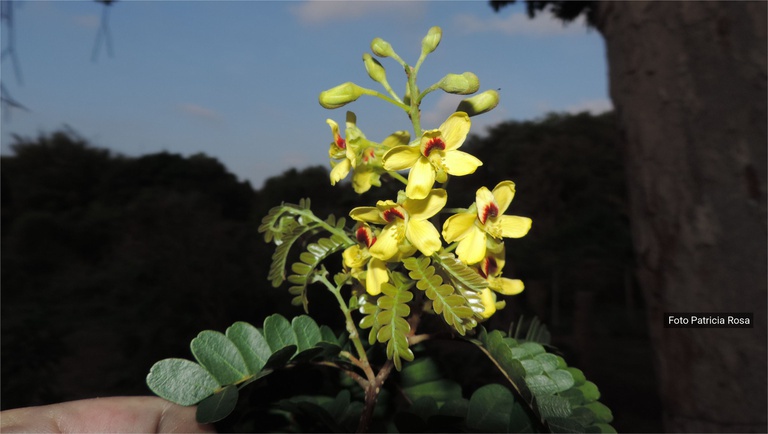
Brazilwood flowers, arruda—RJ | Photo: Patricia da Rosa
Heavily exploited since the beginning of colonization, the brazilwood tree (Paubrasilia echinata) still survives in forest fragments of the Atlantic Forest and is classified as Endangered (EN) on the Brazilian Red List. Among the five known subspecies of this species, the subspecies known as Paubrasilia echinata arruda-RJ occurs exclusively in the state of Rio de Janeiro. A study published on April 7 in the journal Oryx updates the geographic distribution of the fragments where this lineage occurs, identifies which ones are priorities for its conservation, and outlines the necessary actions.
The researchers conducted a survey of native vegetation fragments where P. echinata arruda-RJ occurs, identifying 43 fragments across 11 municipalities along the coast of the state of Rio de Janeiro. This is 30 more fragments than the 13 previously known. They also developed a unique protocol for evaluating and prioritizing these fragments, which can be tested on other species and lineages.
As a result of the protocol, the study shows that there are 8 high-priority fragments for the conservation of arruda-RJ, another 25 of medium priority, and 10 of low priority. In situ and ex situ conservation, land-use management, ecological restoration, and the enrichment of degraded forest fragments are recommended actions for protecting the lineage and its genetic diversity. The authors also discuss the findings in relation to the conservation targets of the Convention on Biological Diversity (CBD).
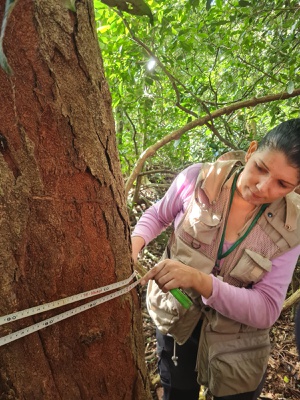
- Patricia da Rosa conducting fieldwork at PEPB Piraquara 3 | Photo: Diego Monsores
The main threat to the Brazilian rosewood (Pau-brasil) identified by the study is urbanization, which is present in 32 of the 43 fragments studied. Energy production and transmission, mining, agriculture and livestock farming, recreational activities, invasive species, fire, and pollution are also among the problems affecting the species.
The article is based on the doctoral thesis of Patricia da Rosa, a biologist at the Herbarium Bradeanum/UERJ, supervised by researcher Haroldo Lima in the Graduate Program in Botany at the National School of Tropical Botany - Rio de Janeiro Botanical Garden, and has as co-authors other researchers from JBRJ, INMA, Kew Gardens, University of California-LA, UFF, and Viveiro Aretê - Búzios. The research was supported by grants from CAPES and Funbio Brasil – Scholarships for the Future–2021, Instituto Humanize, and the Eurofins Foundation.
Access the article Conservation of Atlantic Forest fragments: is the iconic brazilwood Paubrasilia echinata adequately protected in south-east Brazil?