Notícias
G20 English
Countries report priority in their policies to end wage inequality
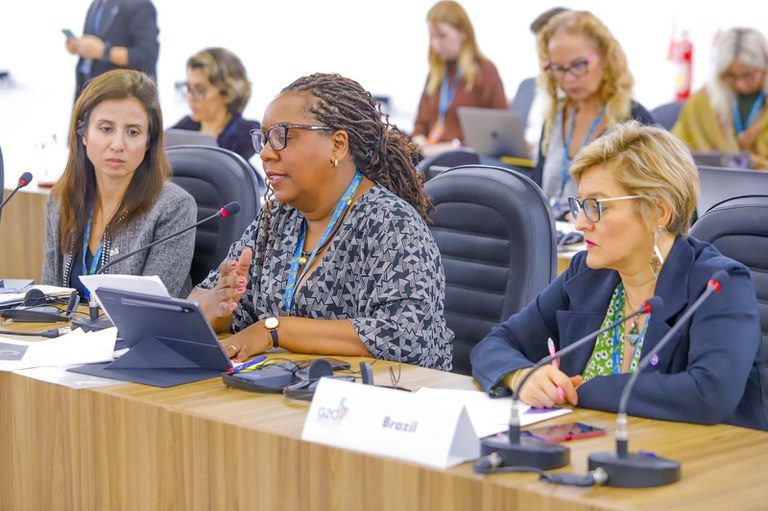
Delegates from the countries of South Africa, Australia, Spain, Canada and Brazil reported on their countries' struggle to end the wage gap between men and women, during the 2nd Technical Meeting of the Working Group on Employment, of the G20 Brazil, held in Brasilia (DF) this afternoon (28th). All of them have public policies aimed at ending the wage gap between men and women.
Australian government representative Heike Phillips said the pay gap in her country is 12 percent. Canada's delegate said his country is committed to the goal of wage equity for workers. In Brazil, women earn an average of 19.4% less than men. In positions of directors and managers, the data indicate a wage gap between men and women of 25.2%, according to the 1st Report on Salary Transparency and Remuneration Criteria, released last week by the Ministry of Labor and Employment (MTE) and the Ministry of Women.
Brazil was applauded after the report of Dercylete Lisboa Loureiro, tax auditor of the Ministry of Labor and Employment (MTE), on the regulation of the Equal Pay Law, approved last year. Dercylete says that the Law will effectively make it possible to reduce wage inequality. "The reality has changed, the Labor Inspectorate was already fining companies. Now, with the Law, companies are required to present a plan to correct wage distortions," she explained.
Dercylete lamented the sad reality of black women, who are the ones who suffer the most from wage distortions. "Black women are always below other groups, we urgently need to change this reality," she said. Dercylete recalled that the majority of the Brazilian population is made up of blacks and browns. "And I, as a black woman, represent the majority in Brazil, and we want to have more dignified laws," she said, to applause from the delegates.
The report showed, for example, that the average salary in Brazil is R$ 4,472. Non-black men receive R$ 5,718 and non-black women appear next with R$ 4,452.
Black men, on the other hand, earn R$ 3,844 and black women earn an average salary of R$ 3,041.
Australian delegate Heike Phillips said gender equality at work is a priority for the government. According to her, the wage gap in Australia is 12%. "But we need to reduce it even more. In industries, inequality is greater, women earn less than men."
South African delegate Letoaba Kgomotso Abram said his country is working to resolve this issue. There, they have a code of good practice and supervise companies. "We have not moved forward as we would have liked, but we want to eliminate inequalities between men and women." The delegate from Spain, on the other hand, said that the inspection is active so that companies comply with the country's determinations on equal pay.