Notícias
PANAMA
President Lula defends regional integration: “The only war we need to wage is against hunger and inequality.”
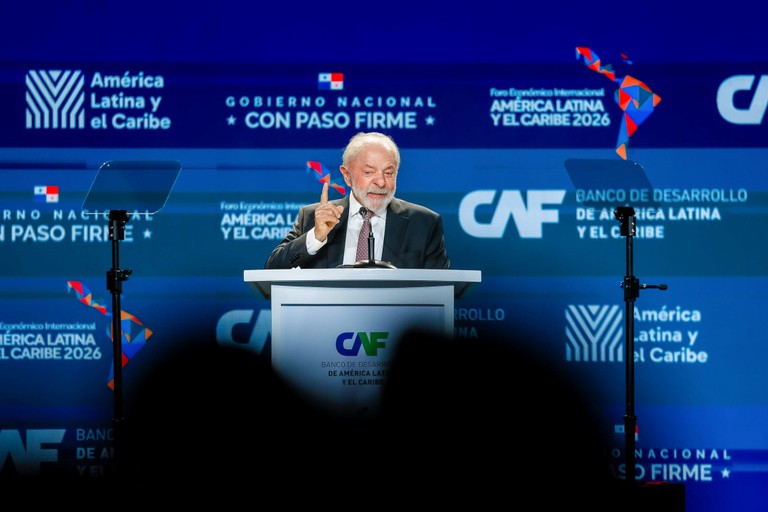
Image: Ricardo Stuckert / PR
President Luiz Inácio Lula da Silva stated on Wednesday, January 28, at the opening of the International Economic Forum of Latin America and the Caribbean 2026, that “the only war we need to wage in this part of the world is against hunger and inequality.” Organized by the Development Bank of Latin America and the Caribbean in partnership with the Government of Panama, the meeting brings together political and economic leaders to discuss the region’s strategic challenges.
In his speech, Lula pointed out the timeliness of holding the Forum has proven in light of a context of growing geopolitical, economic, and technological challenges worldwide, particularly in Latin America and the Caribbean. “The choice of Panama City to host this event carries special symbolism. This is a true point of connection between the Atlantic and the Pacific,” he said.
The President emphasized that, in a global scenario marked by turbulence, Brazil has chosen the path of democracy, peace, multilateralism, and regional integration. According to Lula, the results achieved by the country along these lines reinforce the soundness of that choice. “Our political, social, economic, fiscal, and legal stability has been recognized worldwide. In recent years, Brazil has attracted record volumes of foreign capital. We continue to promote fair and balanced international trade based on multilaterally agreed rules,” he exemplified.
President Lula declared that Brazil will respond to protectionist practices with dialogue, resolve, and support for domestic companies. “In 2025, we surpassed historic records in exports and imports. Our total trade reached USD 629 billion. This reflects a consistent strategy to diversify partnerships with both traditional and emerging economies. We have demonstrated that a new development model, one based on inclusion and sustainability, is possible.”
BRAZILIAN INDICATORS — Lula also listed the country's historic achievements since the beginning of the current administration. “Since 2023, Brazil has grown above the global average, brought inflation under control, and achieved the lowest unemployment rate in our history. We have increased the minimum wage, raised workers’ incomes, and delivered tax justice to millions of Brazilians. We have once again left the FAO Hunger Map. In two years, poverty gave way to social inclusion, and 17.4 million people moved up into higher income brackets in Brazil,” he added.
The President also highlighted Brazil’s leading role in the ecological transition. “We are at the forefront of the green economy. Ninety percent of our electricity matrix is renewable. We are leaders in biofuels. Our Ecological Transformation Plan has identified USD 90 billion in projects that will drive the green economy. Soon, we will launch a Roadmap to gradually reduce dependence on fossil fuels,” the Brazilian leader listed.
FIGHT AGAINST FEMICIDE — During his speech, President Lula also rejected the concentration of wealth, identifying it as a major factor behind poverty, hunger, and violence. “Latin America also holds the grim record of being the region with the highest number of femicides. According to the Economic Commission for Latin America and the Caribbean (ECLAC), 11 Latin American women are murdered every single day,” he warned.
The President emphasized that tackling gender-based violence is a collective responsibility. “This is not a battle for women alone. We, men, must join this fight. When people have dignity and security, society thrives. Ensuring access to basic services and implementing policies to combat disinformation and crime are essential to stability and democracy,” he stated.
Another strategy cited by the Brazilian President to promote lasting regional integration was the engagement of multiple stakeholders. “We must involve subnational governments, civil society, and the private sector. Innovative digital payment systems such as PIX, created in Brazil, can boost regional trade,” he detailed. “Cooperation programs between universities and research centers create ties based on knowledge and innovation,” Lula added.
EXPANDED INTEGRATION — In his speech, the President recalled that, since 2023, Brazil has resumed efforts toward regional integration, seeking to expand and diversify partnerships while also concluding new agreements between economic blocs. “We finalized the agreements between Mercosur and Singapore and between Mercosur and the European Free Trade Association (EFTA). After 26 years of negotiations, we signed the Mercosur–European Union agreement, which will encompass a market of 720 million people and a GDP of USD 22 trillion. We will expand the trade agreements we have with India and Mexico,” he anticipated.
Lula also cited the resumption of talks with Canada, progress in negotiations with the United Arab Emirates, and the establishment of frameworks for strategic partnerships with Japan, as well as tariff preferences with Vietnam. “We expect to move quickly in negotiations with Panama, the Dominican Republic, and El Salvador. We will also update Mercosur’s agreements with Colombia and Ecuador,” he said.
The Brazilian President also highlighted progress under the South American Integration Routes program. “We remain committed to working with all neighboring countries. There are dozens of projects to upgrade highways, waterways, railways, ports, and airports, as well as digital corridors and transmission lines, with the potential to double intraregional trade within a few years. Infrastructure integration has no ideology.”

MOBILIZING BANKS — President Lula reaffirmed his defense of the neutrality of the Panama Canal, which has been administered efficiently, safely, and on a non-discriminatory basis for nearly three decades. He highlighted the role of Brazil’s National Development Bank (BNDES) while stressing that regional integration requires additional resources. “We must mobilize multilateral and regional banks such as the Development Bank of Latin America and the Caribbean (CAF), the Fund for the Development of the River Plate Basin (Fonplata), the Inter-American Development Bank, and the BRICS New Development Bank, to turn these initiatives into reality,” he highlighted.
SOVEREIGN INSERTION — In the President’s assessment, leaders committed to balanced institutional mechanisms are essential to rebuilding trust in regional integration. “This is a fundamental condition for keeping Latin America and the Caribbean as a zone of peace and cooperation, governed by international law. Our sovereign engagement in the world depends on it,” he declared.
POSSIBLE INTEGRATION — President Lula advocated that Latin America and the Caribbean must acknowledge that viable integration must be rooted in a plurality of options. “Guided by pragmatism, we can overcome ideological differences and build solid, positive partnerships within and beyond the region. This is the only doctrine that suits us. Remaining divided leaves us all more vulnerable.”
TRADE EXPANSION — Economic relations between Brazil and Panama saw historic expansion over the past year, with bilateral trade jumping 78 percent to reach USD 1.6 billion. The increase was driven primarily by Brazilian exports of oil and petroleum products.
BALANCE — The sharp growth has generated a Brazilian surplus that diplomacy is now seeking to balance, promoting equilibrium through the encouragement of Panamanian product imports. The issue is one of the priorities for the Brazilian Ministries of Foreign Affairs (Relações Exteriores/ Itamaraty) and of Development, Industry, Trade, and Services (Desenvolvimento, Indústria, Comércio e Serviços /MDIC].
DEFENSE AND AVIATION – In the defense sector, the recent sale of four Super Tucano aircraft from EMBRAER to the Panamanian government is seen as a milestone in South-South cooperation. The deal strengthens the reliability of Brazilian supply chains in Latin America and consolidates the country’s technological presence in the region.
INVESTMENTS – In addition to exchanges trade, the partnership is deepening in the field of investments. Currently, Panama holds a stock of USD 9.5 billion in Brazilian capital, making it the seventh-largest destination for Brazil’s investments abroad.
LOGISTICS — Panama is regarded by the Government of Brazil as a key logistical hub. Brazil ranks as the 15th-largest user of the Panama Canal, through which nearly seven million tons of Brazilian exports pass each year. Tocumen International Airport also stands out as a important logistical center in the Central American nation, handling 20 million passengers annually.
MERCOSUR — Another key element in Brazil’s relationship with Panama is the fact that the Central American country became the first from the region to join Mercosur. Its accession strengthened the South American economic bloc, and the country is now preparing to start trade negotiations with Brazil and other countries in the region.